
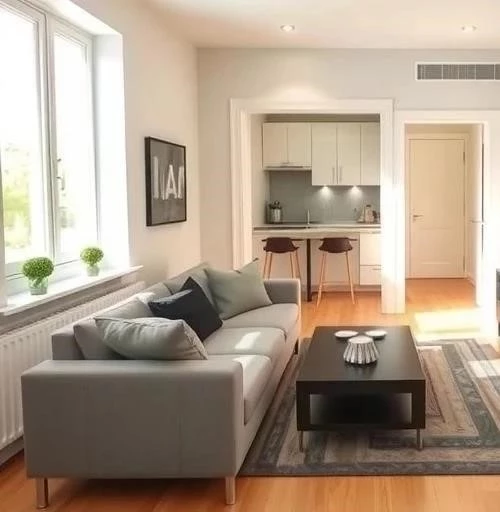
In a small studio, the details at floor level can shape how spacious and coherent the room feels. An aluminum skirting board is more than a protective edge: chosen carefully, it can connect finishes, conceal wiring and support a clean, modern interior. Its value is especially clear in compact homes, where every visual interruption matters.
Why choose aluminum?
A metal skirting board is slim, durable and easy to maintain. Anodized aluminum resists everyday wear and keeps its appearance over time, making it a practical choice for busy apartments. Unlike a bulky traditional board, a narrow profile can frame the floor without making the walls feel shorter. This supports visual expansion of the space, although no trim alone can make a room look larger if the overall palette is crowded.
For a restrained, minimalist scheme, consider a concealed skirting board or a shadow-gap profile. These options reduce visible trim and create a precise line between wall and floor. They work best when planned before finishing: installation may require compatible wall construction and careful coordination with flooring. A surface-mounted model is usually simpler to fit and can still look refined.
Choosing the right color and proportions
Color should be selected in relation to the floor, doors and walls, rather than as an isolated feature. Matching the board to the floor creates a continuous base; matching it to the doors repeats a vertical accent and can make the design feel intentional. A wall-colored profile is less conspicuous and may suit a very small apartment. A contrasting metallic finish can be attractive, but use it sparingly so it does not divide the room into too many visual bands.
Height matters, too. A low profile is often a sensible choice in a room with modest ceilings, while a taller board can balance generous wall proportions. Judge samples in the actual space: daylight, flooring texture and wall color all affect how aluminum reads. Good coordination with the floor finish is more important than following a trend.
Studio layouts and practical details
A skirting board for a studio should support the layout as well as the look. In an open-plan room, a consistent profile helps unify the sleeping, cooking and living zones. Zoning the studio is better achieved with furniture, lighting or rugs; changing the skirting at every boundary can make the floor feel fragmented. For a small-apartment design, visual continuity usually gives a calmer result.
If cables need to run around the room, choose a skirting board with a cable channel. It keeps wires accessible while reducing clutter, which is useful in a compact interior. Check the channel capacity and how its cover opens before buying. Where a concealed system is planned, confirm that sockets, door frames and floor levels will align with the profile;
Installation and lasting value
Correct installation is essential. Measure the perimeter, allow for corners and expansion gaps, and follow the manufacturer’s fixing method. Aluminum can look precise only when cuts and joins are accurate, so complex layouts may call for an experienced installer. This attention to detail protects both the finish and the floor edge.
Ultimately, the best aluminum skirting board for a studio is the one that suits the room’s proportions, finishes and wiring needs. In a modern-style studio interior, a slim anodized profile can combine practicality and durability with a quiet, cohesive appearance. Choose it as part of the design plan—not as an afterthought—and even a small apartment can feel more ordered and spacious.

4 Comments. Оставить новый
This is a helpful overview for anyone choosing trim for a compact apartment. The discussion of color and height is measured: matching the floor, doors or walls can each work, depending on the intended effect. It also avoids promising that a slim profile alone will make a room feel larger, which keeps the design advice realistic.
The article offers sensible guidance on balancing a metallic accent with the rest of a small room. Its suggestion to consider daylight and surface texture when judging samples is important, because aluminum can look quite different under changing conditions. Overall, the advice is clear and grounded in both appearance and practicality.
I found the comparison of aluminum’s durability and clean appearance with bulkier traditional boards particularly useful. The article also correctly points out that concealed systems need to be planned early and coordinated with the wall and flooring. That practical caveat helps readers consider installation before committing to a minimalist look.
The article makes a convincing case that skirting boards should be considered as part of a room’s overall design rather than as a purely functional detail. I especially appreciate the distinction between concealed and surface-mounted profiles, since their installation requirements can affect the choice as much as their appearance. The practical advice to compare samples in the actual room is also useful.