
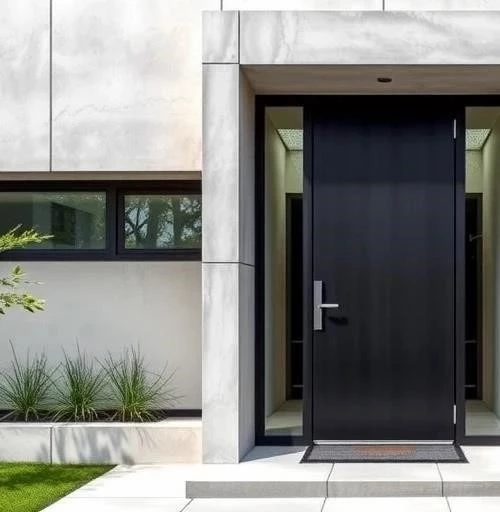
In contemporary buildings, a door is not merely a practical fitting: it contributes to the character of the whole space. Good door selection starts with the architectural concept, the intended use of each room, and the relationship between exterior and interior. A common mistake is choosing a fashionable model first and trying to make it fit later. An entrance door and an interior door have different demands, so appearance alone cannot determine the right choice.
Ignoring proportion, geometry, and materials
Modern architecture often relies on clean lines, minimalism, and carefully balanced architectural details. A door design that clashes with the building’s geometry, proportions, or scale can disrupt that balance. Check the doorway and door dimensions before ordering; even a beautiful door leaf may look awkward if it is too narrow, too tall, or paired with a bulky door frame. A concealed door can create a calm, continuous wall, but only when the opening and installation are planned for it.
Another error is selecting the door color and finish without considering facade coordination and harmony with the interior. Materials should suit both the design and the conditions of use. Natural wood adds warmth, while an aluminum profile and glass inserts can support a crisp, contemporary look. However, a finish must also offer coating durability. Compare technical specifications rather than assuming that attractive materials guarantee long service.
Overlooking performance and installation
Looks cannot replace performance. An entrance door should provide safety, structural reliability, thermal insulation, and sound insulation. For interior doors, consider privacy, ergonomics, functionality, and room ventilation: a tightly sealed door may be unsuitable where air circulation is needed. Energy efficiency also depends on the whole assembly, not just the door leaf.
Do not treat door hardware as an afterthought. Handles and hinges must match the door’s weight, frequency of use, and finish. Manufacturing quality matters: poor joints or weak fittings can lead to sagging, noise, and premature failure.
Finally, avoid rushing door installation. Incorrect measurements, an uneven frame, or badly aligned hinges are common installation errors that compromise operation and sealing. Have the opening checked, follow the manufacturer’s requirements, and use qualified installers. A considered choice and precise mounting preserve the architectural concept while making the door safe, comfortable, and durable.
9 Comments. Оставить новый
The article makes a useful point that door selection should begin with the building and its intended use, rather than with a fashionable design. Considering proportion and installation early can prevent both visual mismatches and costly adjustments later.
Its emphasis on technical specifications is valuable because attractive finishes do not automatically guarantee long-term performance. Comparing durability information before ordering can help homeowners make a decision that remains practical over time.
I appreciate the distinction between entrance and interior doors. Their requirements differ substantially, so evaluating each door by its setting and purpose is more reliable than choosing one style or specification for the entire property.
The points about insulation and safety are important reminders that an entrance door is part of the building envelope. Looking at the complete assembly, rather than only the door leaf, gives a more realistic view of energy efficiency and comfort.
Overall, this is a sensible guide to balancing design with performance. Its central advice—to plan dimensions, materials, and installation together—helps explain why a successful door choice depends on more than selecting an appealing model.
The article also correctly treats hardware as part of the overall decision instead of a decorative afterthought. Handles and hinges need to suit the door and its expected use, which can affect reliability as well as the finished appearance.
I found the discussion of interior-door ventilation thoughtful. A door that seals tightly may improve privacy, but it can be unsuitable in a room where air circulation matters, so function should be considered alongside sound control.
The article rightly avoids treating material choice as purely aesthetic. Wood, aluminum, and glass can each suit a contemporary design, but durability and the conditions of use should guide the final decision as much as appearance.
The discussion of geometry and scale is especially practical. A door may be attractive on its own, but its proportions, frame, and relationship to the surrounding wall determine whether it feels integrated into the architecture.