
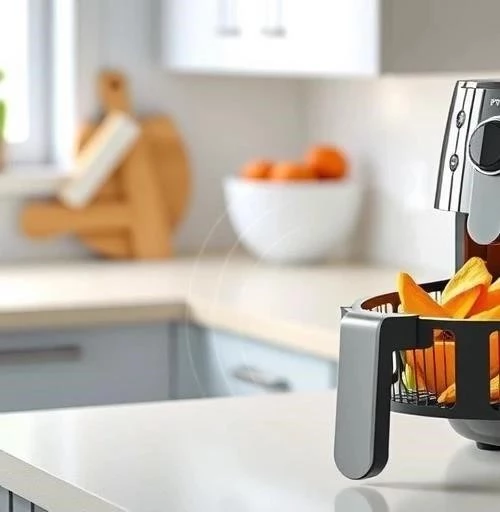
An air fryer is a countertop kitchen appliance that cooks food by circulating hot air around it at high speed. Despite its name, it does not usually fry food by submerging it in oil. Instead, it uses a heating element and a fan to create a compact convection oven. The moving air transfers heat to the food’s surface, helping it become browned and crisp while the inside cooks.
How It Works
Most air fryers have a heating element near the top and a fan that pushes hot air around a cooking chamber. Food is placed in a perforated basket, on a rack, or on a tray. Openings allow air to move around the food and let excess fat drain into a lower compartment. A control panel lets the user set the temperature and cooking time; many models also offer preset programs.
Because the chamber is relatively small and the fan moves air quickly, an air fryer often heats and cooks food faster than a full-size oven. Results depend on the appliance, the amount of food, and how it is arranged. Shaking the basket or turning larger pieces partway through cooking can help them brown more evenly.
What Can You Cook in It?
Common choices include potatoes, vegetables, chicken, fish, and frozen convenience foods. An air fryer can also reheat some leftovers, toast small portions, or bake items in a suitable heat-safe dish. It is most effective when hot air can reach much of the food’s surface. Overfilling the basket may slow cooking and leave some pieces pale or soft, so batches may work better than one crowded load.
A light coating of oil can improve browning for certain foods, but many recipes need little or none. The appliance does not reproduce every feature of deep-frying: foods with wet batter, for example, may not develop the same coating, and texture can differ from oil-fried versions. Following a recipe designed for an air fryer, or adjusting the temperature and checking food as it cooks, can improve results.
Benefits and Limitations
Air fryers are valued for convenience, relatively quick cooking, and the ability to prepare crisp foods with less added oil than traditional deep-frying. They can be useful for small households or modest portions, and some models combine several functions. However, capacity is limited, especially in compact units. Large meals may require multiple batches, and the appliance takes up counter or cupboard space.
“Air-fried” does not automatically mean low-calorie or nutritious. The overall nutritional value depends on the ingredients, portion size, and preparation method. Breaded foods, for instance, remain breaded even when cooked with little oil. An air fryer also uses electricity, makes fan noise, and can produce cooking smells. Its convenience is best considered alongside these practical trade-offs.
Choosing and Using One
When comparing models, consider basket capacity, available counter space, controls, cleaning requirements, and whether a basket or oven-style design suits your cooking habits. A larger capacity can reduce the need for batches but requires more room. Removable, dishwasher-safe parts may make cleanup easier; check the manufacturer’s care instructions before washing any component;
For safe use, place the appliance on a stable, heat-resistant surface with room for ventilation. Do not block air vents, exceed the fill guidance, or operate it near materials that can catch fire. Use utensils that will not damage a non-stick coating, and allow hot parts to cool before cleaning. Always check that food has reached a safe internal temperature using an appropriate food thermometer.
In Short
An air fryer is a small, fan-assisted convection appliance designed to cook food with circulating hot air. It can produce browned, crisp results with less oil than deep-frying, but it is not identical to a deep fryer or a full-size oven. Its usefulness depends on the portions prepared, the foods cooked, and the space available.

6 Comments. Оставить новый
The article distinguishes air frying from deep-frying in a straightforward and informative way.
The practical notes about avoiding an overcrowded basket help set realistic expectations for cooking results.
The examples of foods that can be prepared in an air fryer make the explanation useful for readers considering one.
The article provides a clear overview of how air fryers work and explains the role of hot air circulation in cooking.
The discussion of cooking time, food arrangement, and turning items gives readers helpful context about using the appliance.
The article presents both advantages and limitations in a balanced manner, without suggesting that an air fryer replaces every cooking method.