
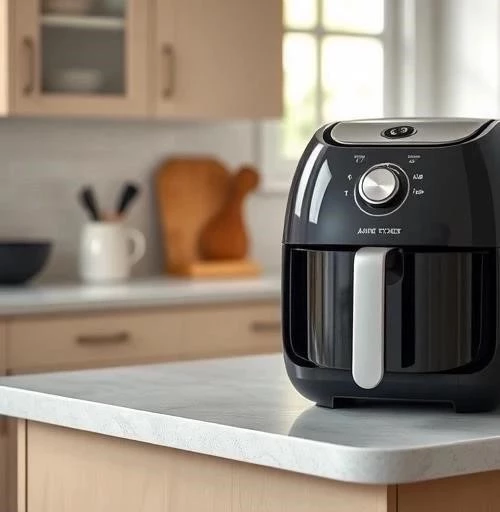
An air fryer may look like a compact countertop gadget, but inside it behaves like a tiny, enthusiastic oven: it draws in air, heats it quickly, and sends hot air back out through vents. So the right question is not only where to put it, but also what kind of surface should be beneath it. Choose well, and your appliance can cook happily without scorching a counter, wobbling during use, or blowing heat into a cabinet.
The ideal base: level, solid, and heat-resistant
Set your air fryer on a flat, stable countertop or table that can comfortably support its weight. The surface should not rock, tilt, or flex when you pull out the basket. A level base helps the appliance sit securely and keeps food and cooking oil where they belong. Before settling on a spot, check the air fryer’s weight and footprint, including the space needed to slide out its basket.
Heat resistance matters, too. The appliance’s exterior and underside may become warm during cooking, while escaping hot air can heat the area around it. A sturdy stone, tile, stainless-steel, or other heat-tolerant counter is often a suitable choice, provided the manufacturer’s instructions allow it. If your counter is delicate, unusually heat-sensitive, or easily marked, use a protective mat only if it is approved for the appliance and does not block any vents. A mat is a shield, not a magic force field: it cannot make an unsafe location safe.
Give hot air room to breathe
Air fryers need breathing space. Leave clearance around the unit, especially near its exhaust vents, and do not push it flush against a wall. Hot air can damage paint, wallpaper, cabinets, or nearby objects; restricted airflow may also cause overheating. Some manufacturers recommend roughly 13 cm (about 5 inches) between the appliance and a wall or overhead surface, but models differ. Your manual is the final word: follow its stated clearances and vent directions rather than relying on a universal number.
Keep the top of the fryer clear as well. A shelf or wall cabinet directly above it can trap heat, collect steam, or be harmed by repeated exposure. If the only available counter spot is beneath an overhang, check the manual’s required top clearance and make sure the space stays open during cooking. Never tuck a running fryer inside a cupboard, appliance garage, or other enclosed nook.
Places that look convenient—but aren’t
- The stovetop: It may seem like ready-made counter space, but a burner can be switched on by mistake, and residual heat can harm the fryer or its cord. Keep the appliance off the cooking range.
- Beside a sink: Water, splashes, and electricity are a poor combination. Choose a dry spot away from the sink and avoid handling the plug with wet hands.
- Near curtains, paper, or tea towels: Keep flammable items well away from hot surfaces and exhaust. A dangling towel can drift into the wrong place at exactly the wrong moment.
- On a soft or unstable surface: Beds, sofas, rugs, and wobbly carts are not suitable cooking stations. The fryer needs firm support and clear airflow—not a cushion.
- At the edge of a counter: Leave enough room to pull out the basket safely without risking a bump, spill, or fall.
Plan for the basket, the cord, and the cook
Think of the whole cooking routine, not just the appliance’s footprint. You need room to open the basket, set it down briefly, and handle hot food without reaching across a burner or brushing against a wall. Keep the power cord away from hot surfaces, sharp edges, and walkways, and plug the fryer directly into an appropriate outlet unless the manufacturer says otherwise. Do not let the cord hang where a child, pet, or passing elbow could catch it.
Also consider what sits nearby. Avoid crowding the fryer with another appliance, because neighboring devices can obstruct ventilation or be exposed to heat. If you move the unit to use it, place it on a prepared, dry, heat-safe surface before switching it on. Never run it while holding it, balancing it on a tray, or perched on an improvised stack of boards.
A quick “landing-zone” check
- Is the surface level, solid, dry, and able to support the fryer?
- Does the manual permit this surface, and is any protective mat suitable for the model?
- Are the side, rear, and top clearances in line with the manufacturer’s instructions?
- Are vents unobstructed and directed away from walls, curtains, and other appliances?
- Can you reach the controls and remove the basket without stretching or knocking anything over?
If every answer is yes, your air fryer has a sensible place to land. In short, put it on a stable, heat-tolerant, level surface with open space around its vents—not on a stovetop, beside water, under a cramped cabinet, or near anything flammable. Treat the appliance like a small oven rather than a harmless box, and your countertop can remain the stage for dinner instead of becoming part of the recipe.



1 Comment. Оставить новый
I like the way this turns countertop placement into a question of airflow, not just furniture. “Give hot air room to breathe” is the quiet star here: an air fryer needs a little personal space, much like a tiny dragon with a very specific lease agreement. The practical reminders about checking the manual and not trusting a mat to fix an unsafe setup make the advice feel both memorable and grounded.