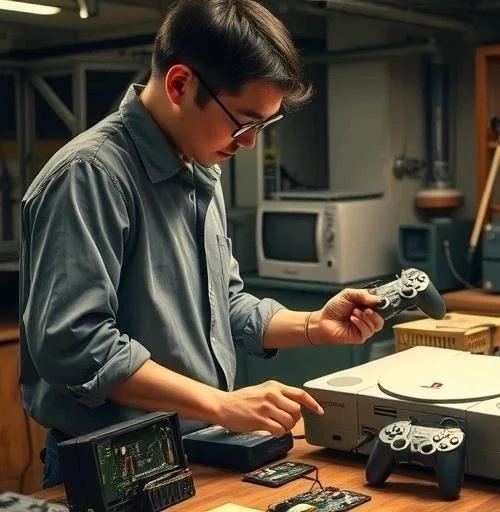
PlayStation did not spring fully formed from one inventor’s imagination. It began as an awkward partnership, survived a spectacular corporate breakup, and became a console because a small group of Sony engineers persuaded a giant company to take a risk. So, who created PlayStation? The clearest answer is Sony—with engineer and executive Ken Kutaragi as its most important champion and the person most often called the “father of PlayStation.”
But a game console is never just one person’s machine. PlayStation was shaped by engineers, designers, managers, game developers, and a surprising early connection to Nintendo. Its origin story is less a straight line than a level full of unexpected turns;
The unlikely beginning: Sony and Nintendo
In the late 1980s, Nintendo ruled much of the home-console market. Sony, meanwhile, was a major electronics company with experience in audio, television, and digital technology—but it had not yet become a household name in video games. Ken Kutaragi, a Sony engineer with a strong interest in digital sound, saw an opportunity where others saw an unfamiliar business.
Kutaragi had worked on a sound chip for Nintendo’s Super Nintendo Entertainment System, or SNES. The collaboration gave him a closer view of what games could become: not merely pictures moving on a television, but experiences built from sound, graphics, and interactive design. He believed Sony could bring its technical strengths to the next generation of games.
The companies began exploring a CD-ROM add-on for the SNES. The project was intended to let Nintendo’s cartridge-based console use the larger storage capacity of compact discs. At the time, a CD could hold dramatically more data than a typical game cartridge, making room for richer music, speech, animation, and other ambitious ideas. The proposed system became associated with the name “Play Station”—originally written as two words.
It was a promising idea, but the partnership rested on a difficult question: who would control the software and the money? The companies did not agree on the business terms. In 1991, Sony presented its work on the CD-based project at the Consumer Electronics Show. Soon afterward, Nintendo announced a separate arrangement with Philips. The public reversal stunned Sony and left the joint console project in pieces.
The breakup that made PlayStation possible
For a moment, the failed partnership looked like the end of the story. Sony could have decided that video games were someone else’s territory and returned to familiar products. Kutaragi argued the opposite: the setback proved that Sony needed to build a complete game system of its own, rather than remain a technical partner whose future depended on another company’s decisions.
His proposal was not automatically welcomed. A console would require years of work, large investment, and a new relationship with game publishers. It would also place Sony in direct competition with established companies. Kutaragi’s determination mattered, but so did support from senior leadership. Sony president Norio Ohga became an important backer of the project, helping it survive internal doubts and gain the resources to move forward.
The failed Nintendo deal did not simply turn one finished machine into another. It provided experience, a technical starting point, and a powerful lesson about control. Sony now had to create its own hardware, its own development tools, its own publishing relationships, and a clear identity for the system.
A team, not a lone inventor
Sony formed Sony Computer Entertainment in 1993 to lead its new games business. The organization brought together people from different parts of Sony, including engineers and staff with experience in entertainment and software. Kutaragi became the central technical and strategic figure. His work and persistence helped turn the PlayStation from an internal proposal into a real product.
Other contributors shaped the console in essential ways. Engineers developed its hardware and graphics capabilities; designers worked on the machine’s physical form and controllers; executives built the business structure; and external studios created the games that would give the system a reason to exist. The PlayStation’s success depended on all of these groups working together.
That distinction matters. Saying “Ken Kutaragi created PlayStation” is a useful shorthand, but it can make a collaborative achievement sound like a solo invention. A more accurate description is that Sony created and released PlayStation, while Kutaragi was its leading architect and advocate.
Why the original PlayStation felt different
The first PlayStation was designed around CD-ROMs and 3D graphics. Those choices helped make the console feel like a break from the cartridge era. CDs offered more room for music and cinematic sequences, while the hardware was built to handle the polygon-based 3D worlds that were becoming a major creative frontier.
“More powerful” did not automatically mean “more successful.” A console needs games people want to play, tools developers can use, and a price customers can accept. Sony worked to make the system attractive to game creators and to present it as a fresh platform rather than a continuation of someone else’s product. Its compact discs also made games easier to manufacture in large quantities than many cartridge-based releases, though this brought its own commercial and security challenges.
The name carried a trace of the original partnership. “Play Station” began as a description of the proposed Nintendo add-on; once Sony pursued its own console, the name was brought along and eventually joined into the familiar single word, PlayStation. A name born in a collaboration that failed became the label for a competing empire.
From prototype to living-room landmark
Sony launched the original PlayStation in Japan on December 3, 1994. It arrived in North America on September 9, 1995, and in Europe later that month. The timing placed Sony in a fast-changing market, where players were becoming curious about three-dimensional adventures, more elaborate soundtracks, and games that could feel closer to interactive films.
The console’s library helped turn technical promise into everyday excitement. Developers used its disc format and 3D capabilities to build racing games, role-playing adventures, platformers, fighting games, and experimental projects. The machine did not invent 3D gaming, nor did it single-handedly create the CD-ROM era. Its achievement was to make these technologies central to a successful, widely recognized home-console platform.
Just as important was Sony’s approach to the audience. The company helped present video games as part of contemporary youth culture and entertainment, not only as children’s toys. That broader image, combined with a strong library and a growing network of developers, helped PlayStation find a place in living rooms around the world.
What Ken Kutaragi contributed
Kutaragi’s role went beyond suggesting a machine with a CD drive. He pushed Sony to take games seriously as a business and helped guide the technical direction of the system. He later led the development of subsequent PlayStation hardware and became one of the best-known figures in Sony’s games division.
His story is often told as a tale of a determined engineer fighting cautious executives. There is truth in that dramatic version, but the larger picture is more interesting: Kutaragi needed allies. Norio Ohga’s support mattered; Sony’s engineers had to make the hardware work; company teams had to build a new business; and independent developers had to believe that making games for Sony was worth their time. Vision opened the door. Collaboration carried the console through it.
Was PlayStation created by Nintendo?
No. Nintendo was involved in the early CD-ROM partnership that helped inspire the project, but it did not create or release the PlayStation console. After the partnership collapsed, Sony continued independently, established Sony Computer Entertainment, and launched its own system. Nintendo’s role belongs to the prehistory of PlayStation, not to the ownership of the finished product.
Quick answer
- Company that created and launched PlayStation: Sony, through Sony Computer Entertainment.
- Key individual behind the project: Ken Kutaragi, often called the father of PlayStation.
- Important executive supporter: Norio Ohga, who helped the proposal gain backing inside Sony.
- Early connection: A proposed Sony–Nintendo CD-ROM project that fell apart before Sony developed its own console.
- First release: Japan, December 3, 1994.
The short answer—and the better one
If someone asks, “Who created PlayStation?”, answer Sony. If they ask who fought hardest to make it happen, say Ken Kutaragi. And if they ask how it became a cultural landmark, the answer is a whole team: engineers, leaders, designers, developers, and players who welcomed a new kind of console.
PlayStation’s origin is a reminder that technology often advances through detours; A failed partnership became a starting point. A sound engineer’s conviction became a corporate gamble. And a machine first imagined as an accessory to another company’s console grew into a platform that changed Sony—and the video-game industry—forever.