
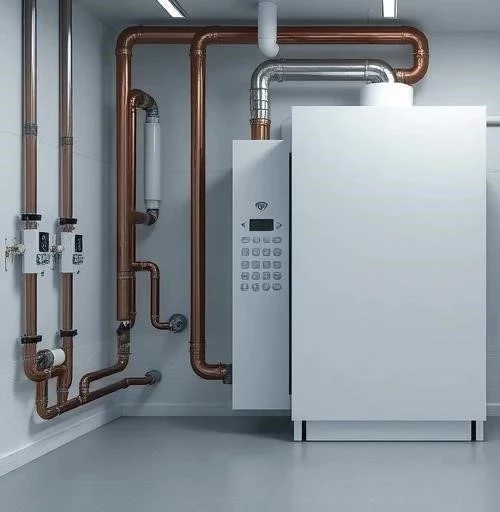
A reliable heating plant must continue to supply heat when its main equipment fails, loses power, or cannot meet demand. Boiler-house protection therefore combines safe equipment, a clearly defined backup heat source, and controls that respond to changing conditions. A backup boiler may be a gas boiler, an electric boiler, or another compatible unit. When correctly selected and configured, this arrangement supports uninterrupted heating without requiring an operator to respond to every routine fault in person.
Planning a Resilient Heating System
Design begins with the building’s heat demand, the characteristics of the primary and secondary units, and the consequences of a service interruption. The reserve should cover the required load for the expected operating conditions; it need not always duplicate the full capacity of the main plant. A suitable power reserve, fuel availability, electrical capacity, and space for maintenance all affect the design. In an autonomous boiler house, the choice of equipment should also reflect the reliability of local utilities and access to technical support.
Heat supply redundancy is useful only when the equipment and control sequence work together. The system should define which unit starts first, how the reserve is tested, and what happens if both sources are unavailable. Switching between heat sources can be initiated after a fault, a loss of output, or a temperature decline. Automatic transfer should use verified operating conditions and include limits that prevent repeated starts, unnecessary switching, and unsafe operation.
Automation and Operating Logic
Boiler-house automation coordinates heat production, circulation, and safety functions. A boiler controller receives data from temperature sensors and other instruments, compares readings with configured limits, and issues commands to the equipment. Smart heating control can adapt operating schedules to outdoor conditions, occupancy, and demand. Heating automation should remain understandable to service staff: settings, alarms, and operating states need clear labels, while manual control should be available for authorized maintenance and emergency procedures.
Climate automation may adjust the supply temperature in response to weather or indoor conditions. Load management can stage boilers, pumps, and other devices so that only the capacity required at a given time is used. This can improve boiler-house energy efficiency, reduce unnecessary cycling, and help maintain stable temperatures. These functions must not override safety interlocks. A demand for heat is never a reason to ignore a detected fault or bypass a protective shutdown.
Monitoring and Safety
Equipment monitoring relies on suitable sensors and regular checks. Temperature sensors help identify overheating, insufficient heat, or abnormal differences between supply and return lines. Pressure monitoring can reveal a failing pump, a closed valve, or a loss of water in the circuit. A circulation pump should be monitored for operating status and, where practical, flow. Heat-transfer-fluid leak protection may combine pressure trends, leak detectors, and visual inspection; no single instrument replaces maintenance;
For a gas boiler, flame control confirms that combustion is established and remains stable. A gas leak detector should be installed and maintained according to the equipment design and applicable requirements. Overheat protection and freeze protection address different risks: the first limits excessive temperatures, while the second helps prevent damage during cold conditions or prolonged shutdowns. Safe boiler-house operation also depends on ventilation, clear access, correct commissioning, and periodic inspection by qualified personnel.
Power, Alerts, and Remote Access
A loss of mains electricity can disable controls, pumps, and communications even when a backup boiler is available. Backup power should therefore be planned for the loads that are essential to safe operation. An uninterruptible power supply can support control devices and communications for a limited period; it is not automatically a substitute for a generator or a complete power system. Its capacity, battery condition, and expected runtime should be checked as part of the maintenance plan.
An alert system should distinguish warnings from shutdown alarms and identify the affected equipment. An emergency alarm can notify staff of a critical condition, such as a gas leak, high temperature, loss of pressure, or failed heat source. Remote boiler-house control and heating dispatching allow authorized personnel to review status, acknowledge alerts, and make permitted adjustments. Remote access should use authentication, controlled permissions, secure connections, and a documented procedure for loss of communications. Operators should know which actions require an on-site inspection.
Testing the Reserve
Reserve equipment cannot be assumed to work simply because it is installed. A planned test should verify automatic start-up, switching between heat sources, circulation, alarm delivery, and return to normal operation. Tests must follow manufacturer instructions and avoid creating risk for occupants or equipment. Staff should record results, investigate faults, and confirm that setpoints still match the building’s needs. A practical plan includes routine visual checks, scheduled servicing, and periodic review after renovations or changes in heat demand.
When designed as an integrated arrangement, a reserve heat source supports emergency heating while preserving safety and predictable operation. The combination of clear control logic, verified instruments, adequate reserve capacity, and trained personnel makes boiler-house protection more dependable. Smart control can assist operators, but it does not replace engineering judgment, preventive maintenance, or compliance with local safety requirements.

5 Comments. Оставить новый
The discussion of switching logic highlights practical considerations, including fault detection and avoiding unnecessary starts. More detail on testing procedures could further clarify how reliability is maintained.
The article clearly explains why backup heat sources and coordinated controls are important for reliable boiler-house operation. Its emphasis on matching reserve capacity to actual demand is useful.
The article gives a balanced introduction to redundancy and automated heat-source transfer. It also appropriately notes that backup equipment must be considered alongside the reliability of local utilities and technical support.
This overview connects equipment selection with fuel availability, electrical capacity, and maintenance requirements. Those factors provide a helpful framework for planning a resilient heating system.
The article presents automation as part of an integrated system rather than a standalone feature. Its explanation of how sensors and controllers support operating decisions is straightforward.