
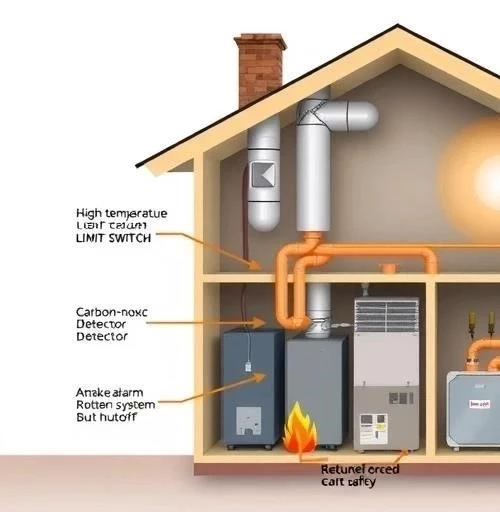
In a large house, warm air is a quiet river: it crosses rooms, climbs stairwells and disappears into ducts. When that river stops—or grows too hot—comfort can turn into risk. A reliable air heating system therefore needs an emergency plan as carefully designed as its floor plan. Good air heating for a home is not just about temperature; it is about noticing trouble early and responding safely.
Build a safety net, not a single switch
The heat generator should be paired with automatic heating-system controls that watch several conditions at once. A temperature sensor near the heat exchanger can trigger overheating protection if heat rises beyond its safe limit. A thermostat regulates ordinary comfort; it should not be mistaken for an emergency safeguard. Separate limits can command an emergency shutdown, stopping the burner or other heat source before damage spreads. This is heat-exchanger protection by design, not by luck.
Airflow matters just as much. The heating fan, ducts and filters work as one circulation path. If a blocked filter or closed damper chokes the flow, the exchanger may overheat while distant rooms turn cold. Air-circulation monitoring can detect an abnormal fan speed or pressure drop and shut down heat production. Regular air filtration protects equipment as well as occupants, but filters must be changed on schedule.
When warning becomes action
A smoke detector and a carbon-monoxide detector should be placed and maintained according to their instructions, with alarms audible throughout the home. These devices support fire safety; they do not replace code-compliant installation, ventilation or professional inspection. On a detected hazard, the system should sound an alarm, isolate the heat source and follow a safe shutdown sequence. Never silence a warning and restart the unit until its cause is understood.
Plan, too, for a power outage. Backup power may keep controls, alarms and the fan operating briefly, but it must be correctly sized and installed. If power is lost, the heater should fail safely: no uncontrolled fuel supply, no trapped heat, and a clear fault signal when electricity returns. A written response plan helps everyone know what to do.
Design for the whole house
Heating a large home means accounting for long ducts, multiple zones and rooms that respond at different speeds; Ask a qualified installer to test airflow, verify safety limits and explain each alarm. Schedule heating-system maintenance before the cold season; keep service records and never bypass a sensor. Safe operation is a partnership between sound design, attentive occupants and timely repairs. The best emergency protection is almost invisible: the system senses a problem, stops safely and tells you why.



6 Comments. Оставить новый
The filter discussion is a smart touch. A neglected filter can seem like a minor chore, but here it becomes part of the larger story of airflow, equipment protection, and safe heat.
The backup-power point opens an important question: which devices must keep working during an outage, and for how long? That’s a useful prompt for homeowners to discuss with an installer before winter arrives.
The distinction between everyday temperature control and an emergency limit is especially useful. It’s a small detail with big consequences—like knowing the difference between a speedometer and a brake.
I like the article’s central idea: a heating system needs more than a thermostat; it needs a safety net. The image of airflow as a shared pathway makes the risks easier to picture without softening their seriousness.
This turns invisible household infrastructure into something readers can actually imagine: sensors watching, fans moving air, alarms standing guard. A clear reminder that comfort is built on quiet, coordinated work.
I appreciate the practical warning not to silence an alarm and simply restart the unit. That advice gives the piece a grounded urgency: investigate the cause first, then let a qualified professional help.