
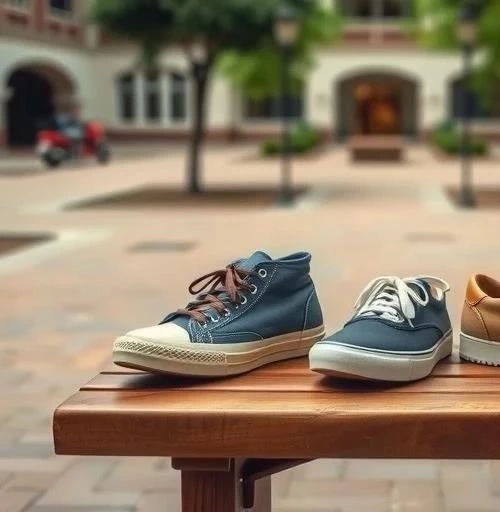
Imagine a student hurrying across a rain-darkened campus: lecture notes in one hand, coffee in the other, and a thousand tiny decisions ahead. The shoes on their feet may look ordinary. Their family tree is not. It runs through nineteenth-century rubber workshops, tennis courts, basketball arenas, running tracks and the long, inventive walk from one classroom to the next.
University sneakers are practical objects with unusually ambitious pasts. They were designed, at different moments, for factories, sport, rebellion and speed. Today, they are expected to handle a seminar, a long commute, a library shift and perhaps an evening out—all without demanding a second pair in the backpack. The good news: a useful, well-made campus sneaker does not have to cost €200. The more interesting news is how it became a campus essential at all.
Before sneakers, there were “plimsolls”
For centuries, everyday shoes were usually leather, heavy, and built around a fairly simple promise: keep the foot covered. The invention of vulcanised rubber in the nineteenth century changed that story. By heating rubber with other materials, makers could produce a more durable, flexible substance—one that could grip the ground and bend as its owner moved.
Rubber-soled shoes began appearing in the 1800s. Early versions were practical but not especially refined: many had no left or right shoe, and the canvas uppers were basic. In Britain, low rubber-soled shoes became known as plimsolls, a name often linked to the line marked on ships to show how deeply they could sit in the water. The detail is poetic, even if the exact origin of the name is debated. These were shoes for leisure and exercise, not yet the all-purpose uniform of student life.
The crucial idea was already there: a soft, relatively quiet sole could make movement easier. A student crossing a stone courtyard today is benefiting from the same broad principle as an early wearer stepping onto a gym floor. The materials have changed. The need to get somewhere comfortably has not.
1910s: the shoe enters the gym—and popular culture
In the early twentieth century, American companies began making canvas-and-rubber shoes for a growing sports market. Keds introduced a widely marketed canvas sneaker in 1916. The word sneaker caught on because rubber soles made it possible to move more quietly than in hard-soled shoes. It was a name with a little mischief built in: the wearer could practically sneak up on the world.
Converse released the basketball shoe that would become the Chuck Taylor All Star in 1917. Its high canvas upper and rubber toe cap were shaped around the demands of the court, not a lecture theatre. Yet the design’s clear lines and sturdy simplicity travelled easily beyond sport. That is an early lesson in sneaker history: a shoe may be invented for one kind of movement, then adopted for another.
By the time mass education and organised sport were expanding, sneakers made sense for young people who wanted affordable footwear they could use in more than one setting; They were lighter and less formal than leather shoes, and their sporty appearance signalled a modern outlook. The campus sneaker was not fully born, but it had found its first language: comfort, practicality and a hint of identity.
From athletic equipment to everyday uniform
In the decades that followed, sports footwear grew more specialised. Companies developed different shoes for tennis, basketball, running and training. Adidas was founded in 1949; Puma followed as a separate company the same year. In Japan, Onitsuka Tiger began making athletic shoes in 1949. New brands and technologies helped turn footwear into a field of competition, experimentation and increasingly visible logos.
This specialisation affected ordinary wardrobes too. A student no longer had to think of a sneaker as one generic rubber-soled shoe. There were court styles with flatter soles, running shoes with more cushioning, and training designs intended for quick changes of direction. The distinction between sports equipment and streetwear began to blur. A shoe made for athletes could become a favourite for people whose daily challenge was a long walk between lecture halls.
In the 1960s and 1970s, running became a major cultural and commercial force. Blue Ribbon Sports, established in 1964, later became Nike. Nike introduced its own branded footwear in the early 1970s, and the company’s waffle-pattern running sole became one of the period’s memorable innovations. The pattern was designed to offer traction while keeping the shoe relatively light. It also made a useful point: even the underside of a sneaker could be a place for invention.
As running shoes became more visible, cushioning and technical language moved into everyday conversation; Air-cushioned designs appeared in Nike footwear in the late 1970s, with Air Max models bringing the visible-air idea to prominence in 1987. Basketball helped create another lasting chapter. The Air Jordan line began in 1984, transforming a performance shoe into a powerful symbol of sport, fashion and personal style.
How the campus became a sneaker runway
Universities are unusually good places for a shoe to prove itself. A campus compresses a whole day into a small map: a bus stop, a lecture room, a café, a staircase, a library, another lecture room, then the walk home; Students notice shoes not only because of how they look, but because of how they feel after several hours and several thousand steps.
By the late twentieth century, sneakers had moved far beyond the gym. Basketball culture, music, skateboarding and street fashion all contributed to their rise. Some students preferred clean leather court shoes; others chose bright runners or canvas classics. Skate-inspired designs brought grippy soles and reinforced construction into everyday wardrobes. Sneakers could be practical, collectible, expressive—or all three before lunch.
The campus also made the sneaker democratic. A pair did not require a sports scholarship or a membership card. It could be worn by a first-year student, a lecturer, a barista on a shift between classes or someone simply trying to cross town without sore feet. The shoe’s original athletic purpose became only one part of its meaning.
The €200 question: what should a student actually buy?
Under €200 is a generous ceiling, not a target. The best choice is not automatically the most expensive one. For university life, think about the distance you walk, the weather you face, your wardrobe, and whether you need one pair to do everything or a specialist pair for sport. A sneaker that looks brilliant online but rubs your heel on day one is not a bargain; it is a small, portable regret.
- €40–€80: the everyday canvas classic. Simple canvas sneakers are often light, easy to style and relatively affordable. They suit dry weather, short commutes and casual outfits. Their limits are equally simple: thin soles may feel tiring on long walking days, and canvas can be slow to dry when soaked.
- €70–€120: the dependable all-rounder. This range often includes familiar court-inspired or basic running-inspired models. Look for a comfortable fit, a secure heel, a flexible forefoot and an outsole with useful grip. At this level, a shoe can cover most campus routines without making a dramatic claim about your personality.
- €100–€160: more cushioning or more specialised design. Some walking-friendly running shoes, sturdier leather styles and technically detailed models sit here. They may suit students who cover long distances or need a particular feel underfoot. More technology is not automatically better: fit still outranks marketing vocabulary.
- €160–€200: premium materials, special editions or advanced features. This bracket may bring softer materials, higher-end construction or a sought-after design. It can be worthwhile if the shoe fits your needs and will be worn often. It is not a guarantee of comfort, durability or a magical improvement to exam results.
Prices vary by country, season, retailer and model. Older colourways and previous-season releases can be significantly cheaper than new launches. If your budget is €200, consider treating that figure as a maximum for the whole decision—not as permission to buy the priciest pair in the shop. A comfortable €90 sneaker plus a rain shell or a second pair of socks may serve you better than an expensive shoe with a fashionable name.
A fitting-room test for future historians
- Try both shoes on. Feet are not always identical, and a quick try-on of one shoe can miss an awkward fit. Wear the kind of socks you expect to use on campus.
- Leave room at the toes. Your toes should be able to move without being squeezed, while the heel stays reasonably secure. A shoe that is too short will not become generous through optimism.
- Walk, turn and take the stairs. If possible, spend several minutes moving around. Notice rubbing, slipping, pressure points and whether the sole feels stable. A sneaker should feel comfortable now, not merely promising.
- Match the shoe to your actual day. A breathable runner may be excellent for long walks but less suited to heavy rain. A leather court style may shrug off a light drizzle more easily, but it can feel warmer. No material is perfect in every season.
- Check the return policy and care instructions. Fit can feel different after a longer walk. Keep the receipt and packaging until you are sure the pair works for you, and follow the maker’s cleaning guidance.
Comfort is not a technology badge
Modern sneaker descriptions can sound like a laboratory has joined a poetry club: foam compounds, stability systems, engineered mesh, energy return. Some technologies genuinely affect weight, cushioning or support. But the foot does not read the product page. It responds to shape, pressure, movement and time.
For general campus wear, a stable, comfortable fit is usually more important than chasing a particular technical feature. If you have persistent foot pain, a medical condition or specific support needs, a general fashion guide cannot diagnose the cause. Ask a qualified health professional for personalised advice, and use the shoe that works for your body rather than the one with the loudest campaign.
Also consider the route between classes. Smooth indoor corridors, wet paving and uneven paths ask different things of an outsole. A deeply patterned trail shoe might be unnecessary for a mostly indoor day; a very smooth sole may feel less reassuring on rainy stone. The right amount of grip is not glamorous, but it can make a Tuesday less eventful.
Buying with a longer timeline in mind
The history of sneakers is also a history of materials and production. Canvas, leather, rubber, synthetic textiles and foams each have different strengths and environmental costs. No single label tells the whole story. If sustainability matters to you, look for clear information about materials, repair options, manufacturing and take-back schemes, and be wary of vague claims that promise a shoe is simply “green.”
One of the most practical ways to make a purchase last is to wear it appropriately and care for it. Let wet shoes dry naturally, away from intense direct heat. Brush off loose dirt, clean according to the care label and avoid unnecessary washing that could damage materials or adhesives. Rotating between two pairs, if your budget allows, can give each pair time to air out. And when a sole or seam fails, check whether repair is possible before deciding the shoe is finished.
Cost per wear is a useful student calculation. A €120 pair worn three times a week for a year may be better value than a €55 pair that becomes uncomfortable after a month. But the calculation only works if the sneaker genuinely fits, suits your life and gets worn. The finest shoe in a wardrobe is still a poor investment if it stays in its box.
Three campus characters, three sensible choices
The long-distance commuter
If your day includes a train platform, a lengthy walk and several flights of stairs, prioritise a secure fit and cushioning that feels comfortable to you. A running-inspired everyday sneaker may be a better companion than a thin-soled fashion classic. Try it late in the day if possible, when feet may be slightly larger, and take a real walk before committing.
The studio-to-seminar student
If you move between workshops, lectures and social plans, a low-profile court sneaker can be versatile and easy to combine with different clothes. Look for a shape that does not pinch and materials you can maintain. Neutral colours are adaptable; a brighter pair can be just as useful if it makes getting dressed feel more like your own decision.
The wet-weather wanderer
If your campus is rainy or your route crosses muddy paths, pay attention to upper material, tread and drying time. A water-resistant finish may help in light showers, but it does not make every sneaker waterproof. For serious rain, dedicated waterproof footwear may be the wiser tool. The university shoe need not be forced to perform every job in the wardrobe.
The sneaker’s next chapter
Today’s university sneaker is a descendant of the quiet rubber-soled shoe, the basketball high-top, the running experiment and the streetwear classic. It carries traces of all of them, even when it is plain white and slightly scuffed. Its history is not a straight march toward more expensive technology. It is a repeating conversation between sport, design, daily movement and the people who choose what to wear.
So, when you shop below €200, you are not merely selecting foam and fabric. You are deciding which parts of that history suit your own route. Perhaps you want a canvas shoe with a century of simple charm, a court style that looks composed in the library, or a cushioned runner for a campus that seems to have been designed by someone who dislikes short distances.
Choose for your feet first, your routine second and the trend cycle a distant third. Keep the receipt, walk a little, and let comfort make its case. The perfect university sneaker is not the one that tells the most dramatic story in the shop. It is the one that quietly helps you write your own—from the first lecture of the morning to the last walk home.
7 Comments. Оставить новый
A thoughtful look at an everyday object we rarely examine. Now every quiet rubber-soled step feels like a small footnote to a much bigger history.
The shift from heavy leather to flexible rubber feels like a quiet revolution: less armor, more movement. A small design change that helped people make the world their walkway.
The student with coffee and lecture notes is instantly recognizable. I never thought about how much a good shoe contributes to an ordinary day until this article made the pavement part of the story.
That debated plimsoll origin is a lovely reminder that even shoe names have mysteries tucked inside them. Footwear history has more plot twists than I expected.
I love the idea that a sneaker carries a little industrial history beneath every step. The campus walk suddenly feels like a journey through time—with a lecture at the destination.
There’s something wonderfully human about an invention moving from factory floors and sports grounds into everyday routines. Sneakers didn’t just change shoes; they changed the pace of daily life.
The ship-line explanation for “plimsolls” is vivid enough to make me imagine a tiny fleet of shoes bobbing across a campus quad. A fascinating piece of footwear lore.