
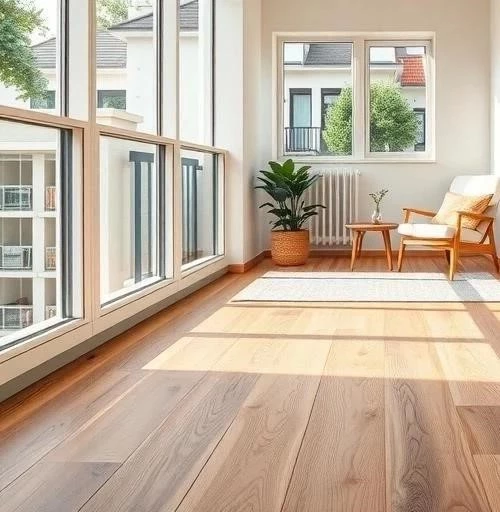
A balcony is a small room with a big personality: in the morning it may feel like a greenhouse, and by nightfall like a refrigerator. Choosing engineered flooring for it means looking beyond colour and asking what the floor will face—moisture, temperature fluctuations, sunlight and daily wear. The right balcony flooring can make the space feel like a quiet extension of the home, not a compromise.
Start with the balcony’s climate
A heated balcony, a glazed balcony and an open balcony are three different worlds. On a heated, well-insulated balcony, indoor conditions are usually easier to manage. A glazed balcony still experiences humidity swings and strong sun. An open balcony is exposed to rain and frost; ordinary engineered flooring is generally not designed for those conditions. Choose outdoor decking made for exterior use instead.
Moisture resistance does not mean waterproof. Wood responds to changes in humidity, so ventilation, insulation and sound weatherproofing matter as much as the board itself. If water regularly reaches the floor or condensation collects on the glazing, solve that problem before choosing a finish.
Look inside the board
Engineered board construction is designed to balance wood’s beauty with greater dimensional stability. A multilayer board usually has a real-wood top layer bonded to a stable base, with the grain direction arranged to help resist movement. Ask the supplier about the core, bonding quality and suitability for seasonal changes—not just the decorative surface.
Wood species affects both appearance and performance. Oak is a popular, practical choice; other species may be softer or react differently to sunlight. Check UV resistance if the balcony gets long hours of direct sun: even a good finish cannot promise that natural wood will never change colour.
Board thickness matters, but so does the thickness of the useful wear layer. A thicker surface may allow more future refinishing, while the full board thickness affects how it meets thresholds and doors. Match the product to the intended installation and the manufacturer’s guidance.
Finish: the floor’s weather jacket
A protective finish helps guard the surface against dirt, spills and everyday scuffs. Wood oil gives a natural, low-sheen look and can be refreshed locally, but it needs regular care. Floor lacquer forms a more continuous film and is easier to wipe clean; scratches may be harder to repair invisibly. For a sunny balcony, compare maintenance needs as carefully as colour.
Installation is part of the choice
Successful installation of engineered flooring begins with subfloor preparation. The base should be dry, level, clean and stable. A plywood subfloor can provide a suitable fixing surface when the system calls for it, but it must be installed correctly and kept dry. Follow the flooring maker’s instructions for acclimation, adhesive or floating installation, and underlay.
During balcony installation, leave the specified expansion gap at walls and fixed objects. A perimeter gap allows normal movement; a larger expansion joint may be needed at a doorway or across a long run. Never wedge the floor tightly beneath frames or trim. Those small details give the boards room to respond to changing conditions.
Make the decision with the whole room in mind
Engineered flooring can be an attractive alternative to laminate when you want a real-wood surface and are prepared to manage its care. A parquet board for a balcony can create a distinctive pattern, but the product still needs to suit the balcony’s climate. Consider the complete floor covering for the balcony: insulation, substrate, finish, thresholds and exposure all work together.
For wooden floor care, sweep grit away, wipe spills promptly and use cleaners approved for the finish. Avoid soaking the boards. With sensible maintenance and conditions within the maker’s limits, the service life of the flooring can be long and graceful. Choose for the balcony you actually have—not the one in the catalogue—and your floor can turn a narrow ledge into a little landscape of its own.


6 Comments. Оставить новый
The phrase “moisture resistance does not mean waterproof” deserves its own little warning sign above every balcony renovation. Clear, helpful advice without pretending wood is invincible.
The article treats the balcony as a space with its own rules, rather than a smaller version of the living room. That perspective makes the advice memorable—and potentially saves readers from an expensive mismatch.
This makes flooring feel almost like choosing a travel coat: the right one depends on the climate it will face. The explanation of board layers gives readers a good question to take to a supplier.
I liked the practical shift from choosing a colour to asking what the floor must endure. It turns a decorating decision into a smarter conversation about moisture, sunlight and construction.
A useful reminder that a balcony is less a room than a tiny weather system. The distinction between glazed and open spaces makes the flooring advice feel grounded in real life.
A thoughtful guide that leaves room for beauty while keeping expectations realistic. I especially appreciated the point that even a good finish cannot freeze wood in its original colour.