
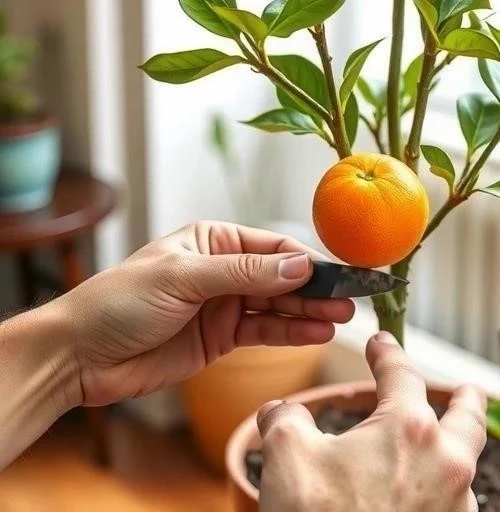
Grafting joins a shoot or bud from a chosen orange variety, called the scion, to the rooted plant, called the rootstock. The rootstock provides the roots and lower trunk; the scion grows into the fruiting canopy. It is a practical way to reproduce a named variety, since an orange grown from seed may differ from its parent and can take many years to bear fruit.
Choose the right materials
Use a healthy citrus rootstock with a firm stem about as thick as a pencil. A young orange or another compatible citrus seedling is often suitable, although compatibility and growth can vary. The plant should be actively growing, well-watered but not waterlogged, and free of pests or disease. Do not graft onto a weak, recently repotted, or stressed plant.
Take scion wood from a healthy, known orange tree. Select a mature, firm shoot from the previous growth flush, not a soft, newly emerging tip. It should have several plump buds and be roughly the same thickness as the rootstock where the pieces will meet. If you cannot graft immediately, wrap the scion in a barely damp paper towel, seal it in a clean bag, and keep it cool for a short time. Do not let it dry out or sit in water.
You will need a sharp grafting knife, clean ties or grafting tape, and, if available, grafting wax or sealant for exposed cuts. Disinfect the blade before use and between plants. A clean, sharp cut is easier to join and less likely to crush the tissue. Work carefully, cutting away from your hands, and keep the blade out of reach of children.
When to graft
For most home growers, spring or early summer is a convenient time, when the plant is actively growing and can form callus tissue. Warm, stable conditions help the graft unite; avoid cold drafts, extreme heat, and periods when the tree is under stress. Indoor citrus may grow at other times, but successful joining still depends on healthy active tissue. The plant’s condition matters more than the calendar alone.
A simple method: cleft grafting
- Prepare the rootstock. Choose a straight section of stem and cut it cleanly at a suitable height, commonly several inches above the soil. Remove leaves or side shoots near the cut. The height is flexible: a lower graft makes a compact plant, while a higher graft leaves more trunk below the canopy.
- Make the cleft. With the clean knife, split the center of the cut stem downward about 1–2 inches. Keep the split straight. If the stock is very small, make a shallow cleft so that it does not split farther than intended.
- Shape the scion. Cut a piece with two or three healthy buds. At its lower end, make two smooth sloping cuts to form a narrow wedge. Avoid touching the cut surfaces, as oils and dirt can interfere with contact.
- Fit the pieces. Insert the wedge into the split. The important point is to align the thin green cambium layers just beneath the bark. If the scion and stock are different widths, line up the cambium along at least one side rather than centering the scion. This contact is essential for the union to form.
- Secure and seal. Wrap the joint firmly with grafting tape or a suitable stretch tie so the pieces cannot move. Cover exposed cut surfaces if needed, while leaving the buds uncovered. The wrap should hold the graft in place without crushing the stem.
Another option is budding, in which a single bud from the desired variety is inserted beneath the bark of the rootstock. It uses less scion material and is common in citrus nurseries, but requires careful handling and bark that lifts readily. For a first attempt, choose one method and practise the cuts on spare twigs before working on the plant.
Care after grafting
Place the tree in bright, indirect light and protect it from wind and sudden temperature changes. Keep the potting mix evenly moist, not saturated; standing water can damage roots. Avoid strong fertilizer immediately after grafting. Check the plant regularly, but do not loosen or twist the joint to test it. Depending on conditions, buds may begin to swell over the following weeks, though timing varies.
Once the scion is clearly growing and the union is stable, loosen or remove non-degradable wrapping before it constricts the stem. Some grafting tapes stretch or break down; follow the product directions. Remove shoots that emerge from the rootstock below the graft, since they can compete with the chosen variety. Retain the new scion growth and support it if it is fragile. Gradually return the tree to its usual light conditions.
Common problems
- The scion shrivels: It may have dried out, the cuts may not have aligned, or the joint may not have been sealed or secured well.
- The graft stays green but does not grow: Buds can remain dormant for a while. Give the plant time and maintain steady care rather than repeatedly disturbing the joint.
- The union fails: Possible causes include dull or dirty tools, poor cambium contact, movement, unsuitable conditions, or incompatible plant material. Try again with fresh scion wood and a healthy rootstock.
- Shoots grow below the graft: These come from the rootstock. Remove them promptly so they do not take over the plant.
Grafting takes practice, and not every attempt succeeds. Using compatible citrus material, keeping tools clean, matching the cambium layers, and preventing the joint from drying or moving will improve the chances. Label the graft with the variety and date so its progress can be tracked.


7 Comments. Оставить новый
This is a well-organized introduction to orange grafting, with useful details on materials, preparation, and suitable growing conditions.
The article gives a helpful overview of timing and emphasizes that the plant’s condition matters alongside the season.
The advice to avoid grafting stressed or unhealthy plants is clear and helps set realistic conditions for the process.
The reminders about cleaning tools and handling a grafting knife safely are relevant additions to the gardening instructions.
The explanation of why seed-grown oranges may differ from their parent makes the benefits of grafting understandable.
The article clearly explains the purpose of grafting and the roles of the scion and rootstock. The preparation advice is useful for home growers.
The guidance on choosing healthy plant material and keeping scion wood from drying out is practical and easy to follow.