
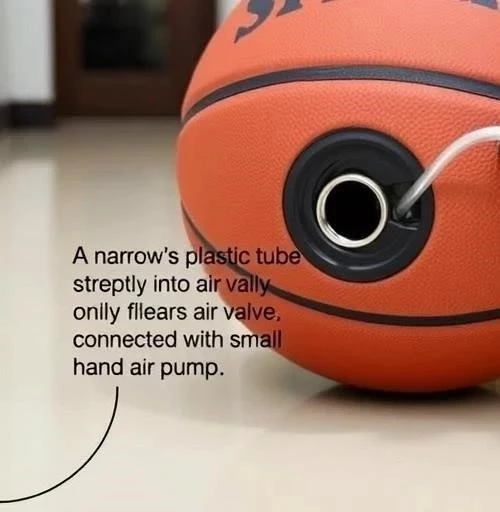
A basketball is normally inflated through its small valve with a ball-pump needle. If the needle is missing, resist the temptation to push a random object into the valve: the opening and its inner rubber parts can be damaged, and a poor connection may let air escape. The safest workaround is a purpose-made needle-free ball-inflation adapter that fits the valve and connects to a hand pump.
What you will need
- A hand pump or low-pressure ball pump;
- A flexible, needle-free adapter made for inflating sports balls;
- A little clean water to moisten the adapter tip;
- A pressure gauge, if available, and the ball’s recommended pressure.
Step-by-step instructions
- Find the valve. It is a small round opening, usually set into one of the ball’s panels. Wipe away dirt so it cannot get pushed inside.
- Check the adapter. Use a soft, narrow adapter specifically designed for ball valves. It should connect securely to your pump and have no sharp edges, cracks, or loose pieces.
- Moisten the tip. Put a drop of water on the adapter. This helps it slide and reduces friction. Do not use oil, grease, or solvent; these may harm the valve or bladder.
- Insert gently and straight. Hold the adapter in line with the valve and ease it in only as far as its instructions specify. Do not twist, lever it sideways, or force it. If it will not enter with light pressure, stop and check that the adapter is the correct type.
- Pump slowly. Use short, controlled strokes. Keep the connector steady and watch for air escaping around it. If the fit is loose, stop rather than pumping harder.
- Check firmness and pressure. Remove the adapter carefully, then measure the ball with a gauge if possible. Follow the pressure printed on the ball or in its manufacturer’s instructions. Many basketballs are used around 7.5–8.5 psi, but the correct range varies by model; do not treat that range as a universal target.
- Test the bounce. If the ball is still soft, repeat in small increments and check again. Avoid overinflating: excess pressure can affect handling, damage the ball, or put stress on its seams.
What if you do not have an adapter?
A rubber cone attachment supplied with some pumps may press against a ball valve, but it often cannot open the valve or make an airtight seal. You can try it only if it fits naturally and stays in place without force. Pump gently; stop immediately if air leaks, the cone slips, or the valve begins to deform. The dependable solution is to borrow or buy the correct ball adapter, or ask a sports shop or recreation center to inflate the ball.
A drinking straw, pen tube, paper clip, screwdriver, or other improvised object is not a reliable substitute. A straw may seem to fit, but it may not open the valve, may collapse under pressure, or may leave a fragment inside. Never cut, enlarge, or pry at the valve. Avoid using a high-pressure air compressor or an aerosol can: airflow can be difficult to control, and a sudden burst may overinflate the ball or damage it.
Useful tips
- Use a hand pump for better control, and keep the ball stable while inflating.
- Do not push an adapter farther in just because air is not flowing. Stop, remove it gently, and verify that it is intended for basketball valves.
- If the ball loses air quickly after inflation, the valve may be dirty, worn, or damaged. Repeatedly forcing an ill-fitting connector can make the leak worse.
- Store the ball at the pressure recommended by its maker, and check it before play rather than relying only on how hard it feels.
Bottom line
You can inflate a basketball without a metal needle by using a compatible, soft needle-free ball adapter and a controlled hand pump. If you have no suitable adapter, do not improvise with sharp or rigid objects. Borrow the right fitting or get help from a shop; protecting the valve is safer and usually quicker than trying a risky shortcut.

3 Comments. Оставить новый
The steps are easy to follow, and the warning that basketball pressure varies by model is important. A pressure gauge and the manufacturer’s recommended range are sensible safeguards.
Clear, practical advice, especially the reminder to use an adapter made for ball valves rather than improvising with other objects. The gentle-insertion and pressure-checking tips are helpful.
This is a useful guide for anyone who has misplaced a pump needle. I appreciate the emphasis on stopping if the adapter does not fit easily, since forcing it could damage the valve.