
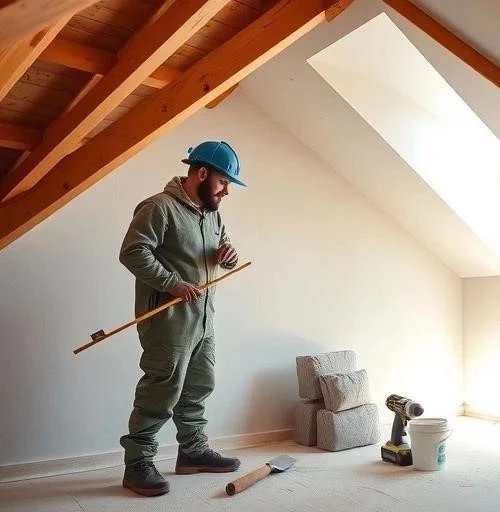
Attic renovation requires more than a smooth finish. Attic humidity, sloped attic walls and temperature changes can cause condensation on walls, damage finishes and encourage mold. Before leveling attic walls, identify the moisture source and check that the roof and wooden roof structures are sound. A moisture meter helps assess damp areas; readings should be checked again after the room has dried.
Prepare the room and surface
Surface preparation begins with removing loose coatings, dust and traces of mold. Use antiseptic treatment where appropriate, following the product instructions. Wall waterproofing may be needed in exposed areas, but it must suit the wall assembly. A vapor barrier and effective attic ventilation help manage moisture; they do not replace repairs to leaks. Select moisture-resistant materials intended for finishing rooms with high humidity, and follow the manufacturer’s guidance for the whole system.
Select tools for the chosen finish
For plaster, a laser level or spirit level helps establish a true plane. Fix plastering beads securely, then use a plastering rule to draw the mix across them; a trowel and spatula are useful for applying and smoothing material. Leveling with guides is appropriate when the substrate is uneven. Cement plaster or moisture-resistant plaster can be suitable in some conditions, provided the structure can carry the load and the product is compatible with the base. Apply a deep-penetrating primer as specified. Reinforcing mesh can reduce cracking at joints and transitions when installed in the required layer.
Consider an alternative wall system
Moisture-resistant drywall offers a lighter finish, but it is not waterproof. Framed wall cladding can help accommodate sloping surfaces and services, while allowing space for insulation and building layers. Choose corrosion-resistant fixings and keep the specified vapor-control layer continuous. Do not trap dampness behind boards: confirm the assembly’s design before closing the frame.
Check before finishing
Tool choice depends on wall material, the required accuracy and the finish. Keep levels, rules and measuring tools clean, and verify alignment at several points. Let each layer dry as directed before coating or decorating. Good ventilation, suitable materials and careful moisture control provide lasting protection from mold and help keep attic walls even.


3 Comments. Оставить новый
The article gives a clear overview of moisture-related risks in attic renovations and appropriately emphasizes identifying the source of dampness before finishing the walls. The distinction between waterproofing and vapor control is useful.
This is a useful introduction to leveling sloped attic walls while accounting for humidity and ventilation. The note that moisture-resistant drywall is not waterproof is particularly important.
The practical guidance on surface preparation and tool selection is helpful. It is also sensible to remind readers to check product compatibility and follow manufacturer instructions, especially when choosing plaster or a wall assembly.