
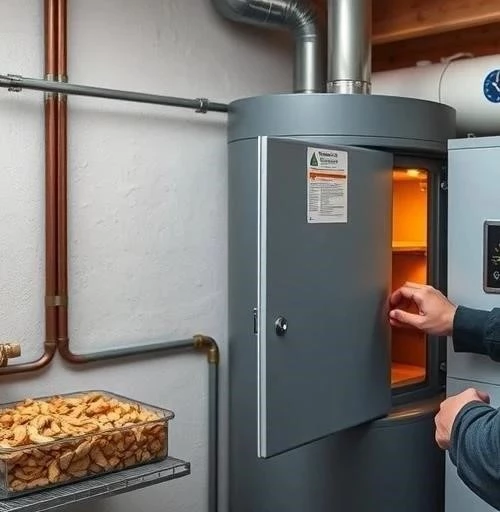
A boiler overhaul restores worn parts, but it does not automatically restore low-cost heating. After repair, a pellet boiler needs careful pellet boiler control: settings must match the burner, fuel, chimney and building. Correct automation tuning can reduce heating costs, improve reliability and prevent a newly repaired system from wasting fuel.
Start with inspection and safe commissioning
Before changing the boiler operating mode, ask a qualified technician to complete equipment diagnostics. Check seals, electrical connections, safety devices, the auger mechanism and flue passages. Confirm chimney draft and inspect boiler sensors; inaccurate readings can lead to poor controller setup and unnecessary fuel consumption. Record the initial settings so they can be restored if adjustments make performance worse.
Set fuel and air together
Pellet feed and air supply must be balanced. Adjust fuel dosing and combustion tuning in small steps, following the manufacturer’s instructions and checking the flame, exhaust and ash after each change. Too much fuel may leave unburned pellets; too little air can cause smoke and deposits. Excess air can carry heat up the chimney. Have a specialist verify combustion with suitable instruments rather than relying on flame appearance alone.
Pellet quality matters as much as settings. Use fuel of the recommended size and moisture level, and consider its ash content. Poor-quality pellets can block the feed path, alter burner modulation and raise fuel consumption. Clean the burner and heat exchanger as specified; never compensate for dirty equipment by simply increasing power.
Match heat output to demand
Use power adjustment and modulation to match heat production to the building’s needs. A boiler that repeatedly starts and stops may use more fuel and wear faster. Where supported, set a stable minimum output and adjust the temperature curve to outdoor conditions. Choose a coolant temperature that keeps rooms comfortable while meeting the system’s requirements; avoid abrupt changes that cause overheating or cold rooms.
Review schedules and zones as part of heating system optimization. Heating automation can lower output when spaces are unoccupied, while weather compensation may prevent excessive heating on mild days. Check that radiators or underfloor circuits are balanced and that thermostats do not conflict with the boiler controller.
Measure, maintain and refine
Track pellet use, indoor comfort and runtime for several days after each adjustment. Compare like-for-like weather periods: a lower daily pellet total is not a saving if rooms are colder. These records show whether settings improve heating efficiency and boiler efficiency, and help identify changes in fuel quality or system performance.
Regular technical maintenance supports energy saving and fault prevention. Remove ash at the recommended intervals, clean heat-transfer surfaces, inspect the auger and test sensors. Also check pipe insulation, windows and doors: heat loss reduction can deliver savings without stressing the burner. If smoke, alarms, unstable flames or unusual noises appear, stop experimenting and contact a service professional.
The goal after a boiler overhaul is dependable comfort at the lowest safe fuel use—not the lowest setting at any cost. With measured controller setup, clean equipment and a suitable operating schedule, pellet savings can be sustained throughout the heating season.

5 Comments. Оставить новый
I appreciate the clear explanation of how pellet quality, airflow, and fuel dosing work together. It makes an otherwise technical topic easier to understand.
Helpful article for homeowners who want to avoid wasting fuel. The advice to make small adjustments and verify combustion with proper instruments is responsible and reassuring.
The focus on maintenance is important. Cleaning the burner and heat exchanger before changing power settings is sensible advice for improving efficiency and reliability.
A useful overview of boiler commissioning and heat-output adjustment. It explains that stable operation depends on matching the system to the building, not simply turning up the power.
A practical guide that emphasizes why boiler settings should be adjusted carefully after an overhaul. The reminder to consult a qualified technician and record the original settings is especially useful.