
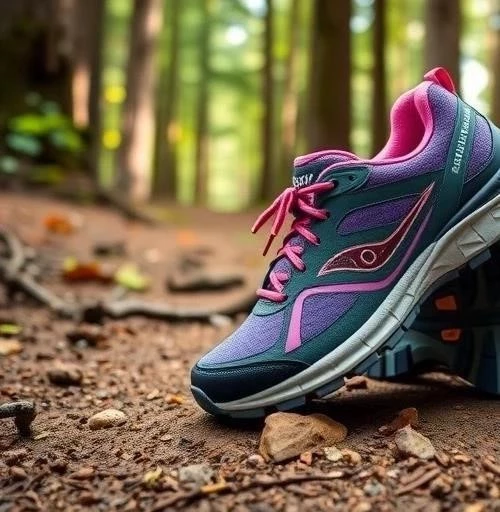
Trail shoes must do more than cushion a runner: they need to grip changing surfaces, protect the foot from impact, and remain comfortable over uneven ground. Saucony addresses these demands through a combination of midsole foams, outsole design, underfoot protection, and upper construction. The exact package differs between models and model years, so the technologies below should be understood as a guide rather than a claim that every women’s shoe includes every feature.
Cushioning: comfort balanced with control
Saucony uses several foam families across its range. PWRRUN is a versatile cushioning material intended to balance softness, responsiveness, and durability. PWRRUN+ is a lighter, springier option used in some models, while PWRRUN PB is a more energetic foam found in selected performance-oriented designs. Their presence in a particular trail shoe depends on its purpose and generation.
For longer outings, cushioning can help reduce the harsh feel of repeated impacts and make rough terrain more manageable. Yet maximum softness is not automatically best off-road. A runner also needs to sense the ground and place each step accurately. A shoe designed for technical trails may therefore prioritize stability and protection over a plush, high-stack ride. Trying the shoe on is useful: foam feel varies with body weight, pace, terrain, and personal preference.
Traction for changing terrain
Many Saucony trail models use PWRTRAC rubber and an outsole with raised lugs. The rubber compound is intended to provide grip, while lug depth and spacing influence how the shoe behaves on dirt, loose gravel, mud, and rock. Deeper, more widely spaced lugs can help shed soft ground; a less aggressive pattern may feel smoother on hard-packed paths and occasional road sections.
No outsole can guarantee traction on every surface. Wet rock, slick roots, and steep descents remain challenging, and worn lugs lose effectiveness. Choosing a pattern to match the routes you actually run is more useful than assuming that the most aggressive tread is always the safest choice.
Protection and stability underfoot
Trail shoes may include a rock plate or other protective layer between the foot and outsole. This can reduce the sting of sharp stones, but it may also make a shoe feel firmer or less flexible. Protection is especially valuable on rocky routes; on smooth forest trails, some runners may prefer a more direct, flexible feel.
Stability also comes from the platform, heel and midsole geometry, not from one feature alone. A broad, secure base can help on uneven ground, but a shoe cannot replace careful footing. Saucony’s trail lineup includes models aimed at different balances of cushioning, agility, and protection, so comparing intended use is important.
Fit, upper, and women’s-specific details
Engineered mesh uppers are used in many running shoes to combine support with ventilation, while overlays or reinforced zones can help secure the foot. A dependable fit matters on descents: excess movement can cause rubbing or toe impact. Check that the heel feels held, the midfoot is secure, and there is enough room in front of the toes for longer runs and downhill sections.
Women’s versions are offered in women’s sizing and may differ in fit or available width, but construction varies by model. Do not assume that every shoe is based on one universal women’s foot shape. Try the intended size with running socks, and consider swelling during long efforts. A familiar model name may also change in materials or fit between editions.
Choosing the right technology
- For rocky, technical routes: prioritize secure fit, dependable lugs, and suitable underfoot protection.
- For long distances: look for cushioning that remains comfortable without making the shoe feel unstable.
- For mixed road and trail: a less aggressive outsole may offer a smoother transition between surfaces.
- For wet or muddy conditions: assess lug pattern and rubber, while remembering that no shoe removes the need for caution.
The strongest Saucony trail choice is not simply the shoe with the longest technology list. It is the model whose cushioning, grip, protection, and women’s fit suit the runner’s terrain and distance. Since specifications can change between seasons, check the current product description and, where possible, test the shoe on a surface similar to your usual trails.
8 Comments. Оставить новый
The article presents the technologies as a guide rather than a universal specification, which is important when product lines change. A model-by-model comparison would make the overview even more useful.
The section on traction wisely avoids promising that any shoe will grip every surface. Wet rock and slick roots can remain hazardous, even with an aggressive outsole.
The discussion of outsole wear is a useful practical point. Grip depends not only on the original lug design but also on how much the tread has been used.
The advice to try a shoe on makes sense because cushioning can feel different depending on the runner and the terrain. It gives readers a sensible next step beyond comparing technology names.
This overview is clear for readers who are new to trail shoes. I especially like that it connects foam choices with the trade-off between impact comfort and ground feel.
The article makes a useful distinction between cushioning and stability. It is a good reminder that a softer ride is not necessarily the safest or most comfortable choice on technical trails.
The explanation of lug depth and spacing is practical. Matching an outsole pattern to the surfaces you run on is more helpful than treating trail traction as a single feature.
I appreciate the qualification that Saucony’s foam technologies vary by model and year. That detail helps keep the overview informative without implying that every women’s trail shoe has the same construction.