
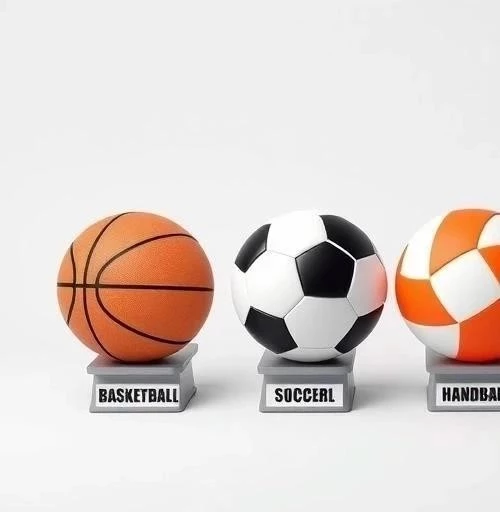
When comparing sports balls, “football” here means the association football, or soccer, ball. The short answer is that a regulation basketball is generally the heaviest of the four. A volleyball is the lightest. Footballs and handballs fall between them, and their weight ranges can overlap, so their exact order depends on the ball’s type and size.
Standard weights at a glance
- Basketball: A full-size men’s ball, size 7, typically weighs 580–620 grams. A women’s size 6 ball is lighter, usually 510–550 grams.
- Handball: A regulation size 3 ball for men weighs about 425–475 grams. Size 2 balls, commonly used in women’s competition, weigh about 325–375 grams.
- Football (soccer): A size 5 match ball weighs 410–450 grams.
- Volleyball: A standard indoor ball weighs 260–280 grams.
These are typical competition specifications, not the weight of every ball sold. Exact requirements can vary by governing body, age group, playing format and equipment category.
How the weights compare
For commonly used adult balls, the usual order from heaviest to lightest is: size 7 basketball, men’s size 3 handball, size 5 football, and indoor volleyball. The basketball is clearly heavier than the other three in these examples. It may weigh roughly twice as much as a volleyball, though the precise difference depends on the models being compared.
The middle of the ranking requires more care. The permitted weights for a men’s handball and a size 5 football overlap between 425 and 450 grams. A handball at the upper end of its range can be heavier than a football; one at the lower end can be lighter. It is therefore more accurate to say that the two are similar in weight than to claim that every handball is heavier than every football.
Ball size also matters. A women’s size 2 handball has a lower specified weight range than a size 5 football, while youth handballs are smaller and lighter still. Likewise, a size 6 basketball is lighter than a size 7 ball, but is still usually heavier than a regulation football or handball.
Why the balls have different weights
Each ball is designed for a different style of play. Basketballs need to bounce predictably on a hard court and be large enough to grip and handle. Their size and construction contribute to their relatively high weight. Handballs must be held, passed and thrown, so their size and surface are suited to hand control. Footballs are designed for foot play and for controlled flight when kicked. Volleyballs are comparatively light to make repeated striking and extended rallies practical.
Materials, internal pressure and construction also affect how a ball feels. Two balls that meet the same weight specification may not feel identical: one may be softer, firmer, more textured or differently balanced. The sensation of heaviness is not determined by mass alone. Diameter, grip and the way a ball moves during play influence perception, but they do not change its measured weight.
What about outdoor or recreational balls?
Store-bought balls do not always match official match specifications. Recreational models, training balls, beach volleyballs, mini-balls and children’s balls may differ in size, materials and weight. A wet or waterlogged ball can also become heavier than it was when dry. For a precise comparison, check the product label or weigh each ball on the same scale, rather than relying only on its appearance or feel.
Age and competition rules are particularly important. Young players often use smaller equipment to make handling easier and safer. A child’s basketball, for example, should not be compared with a full-size adult basketball as if they were the same standard. The same principle applies to junior footballs and handballs.
Among typical adult competition balls, the basketball is the heaviest and the volleyball is the lightest. A regulation men’s handball and a size 5 football are close in weight, and their official ranges overlap; In short: basketball is usually heaviest; volleyball is lightest; football and handball sit in between, with no absolute ordering for every ball. For an exact answer about particular equipment, compare the stated weights and sizes of those specific balls.

7 Comments. Оставить новый
The comparison is clearly organized and makes the distinction between typical weights and regulation ranges easy to understand.
The headings and short sections make the information straightforward to scan.
Clarifying that “football” means soccer helps prevent confusion for readers from different regions.
Including different basketball and handball sizes gives readers a better sense of how equipment categories affect weight.
The comparison is helpful, especially where it avoids presenting a single fixed ranking for balls with overlapping weight ranges.
The article provides specific examples while noting that ball weights can vary by size and competition category.
The explanation of overlapping handball and football weight ranges adds useful nuance to the comparison.