
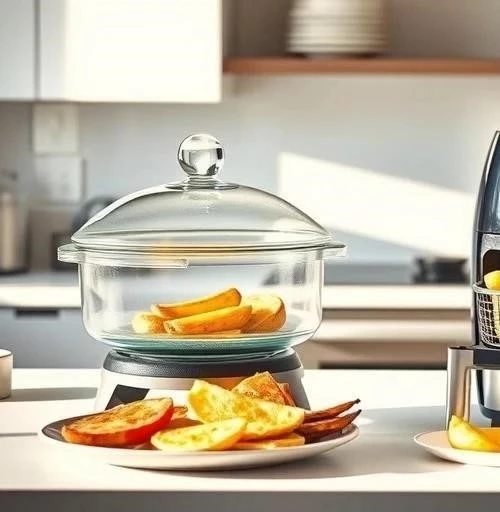
Air fryers and aerogrills are often presented as different appliances, but the names do not always describe two clearly separate technologies. Both generally cook by circulating hot air around food. This can produce a browned, crisp surface with little or no added oil. In many shops, “aerogrill” is used for a broad range of compact convection cookers, while “air fryer” usually refers to a model designed around a basket. The best choice depends less on the label than on the appliance’s design, capacity and controls.
How they work
A typical air fryer has a heating element and fan above a removable drawer or basket. Hot air moves rapidly around food, and the basket allows air to reach several sides. Shaking or turning food during cooking can improve evenness. Many models offer preset programs, a timer and adjustable temperature.
An aerogrill may use a bowl-shaped cooking chamber with a lid containing the heater and fan. Food is placed on a rack, tray or other accessory. Some designs are relatively simple; others include several shelves or attachments. The larger chamber can make it easier to cook different kinds of food, but results depend on airflow, arrangement and the particular model. Product names overlap, so checking the specifications and interior layout is more useful than relying on terminology alone.
Main differences in everyday use
- Capacity and shape: A basket air fryer is convenient for portions of chips, vegetables, fish or chicken pieces. A bowl or oven-style aerogrill may offer more room for larger items or several layers, although a stated capacity does not guarantee that all the space can be used efficiently.
- Cooking speed: Compact appliances often heat quickly and need less preheating than a full-size oven. A tightly packed basket, however, can restrict airflow, and multiple shelves may require rotating food for consistent browning.
- Versatility: Both types can roast, reheat and bake some foods. Aerogrill models with racks or additional accessories may support a wider range of layouts. Air fryers may provide familiar programs and straightforward operation. Features vary substantially between models.
- Cleaning and storage: A removable basket can be simple to wash, especially when its coating is suitable for the dishwasher. A bowl, lid, racks and accessories may mean more parts to clean. Compare dimensions and consider where the appliance will be stored.
- Oil and texture: Neither appliance needs deep-frying oil. A small amount can help some foods brown, but the result will not be identical to food cooked in a deep fryer. Moisture, recipe, food quantity and airflow all affect crispness.
Which one should you choose?
Choose a basket-style air fryer if you usually cook modest portions, value a compact footprint and want a simple appliance for quick weekday meals. It is especially practical when the main tasks are crisping frozen foods, roasting vegetables or cooking small servings of meat. Check the usable basket area, not only the advertised litre capacity, and consider whether you will need to cook in batches.
An aerogrill may suit a household that wants a larger or more flexible cooking chamber, uses racks, or regularly prepares different foods. Before buying, check whether the fan distributes heat evenly across the available levels, whether accessories are included, and how easily the bowl and lid can be cleaned. A large chamber can be less convenient for a single serving and may take up more counter space.
What to compare before buying
Look at usable capacity, power, temperature range, timer, control type, noise, exterior dimensions and replacement-part availability. Automatic programs are convenient but do not replace checking food during cooking. Reviews can help identify practical details such as uneven browning or difficult cleaning. Do not assume that a higher wattage alone means better results; airflow and chamber design matter too.
There is no universal winner. Many air fryers and aerogrills rely on the same basic principle, and the distinction is often a matter of form and features. For compact portions and easy everyday use, a basket air fryer is often the more convenient option. For greater flexibility or a roomier chamber, an aerogrill-style model may be preferable. Compare the actual design with the meals you plan to cook, rather than choosing by name alone.


7 Comments. Оставить новый
The explanation of airflow and food arrangement is informative and relevant. It gives readers a practical basis for understanding possible differences in cooking results.
The article is easy to follow and presents the terminology carefully. Its focus on specifications, interior layout and intended use makes the comparison useful.
The article clearly explains why the terms “air fryer” and “aerogrill” can overlap and why comparing specific designs is more useful than relying on product labels.
The article offers a helpful starting point for comparing these appliances, with clear explanations of how their layouts can affect everyday use.
This is a balanced overview that avoids presenting one appliance type as universally better. It appropriately emphasizes the role of individual models and cooking needs.
The discussion of capacity and airflow adds useful context, especially the point that stated capacity may not reflect how efficiently an appliance cooks.
The descriptions of basket and bowl-style appliances make the main design differences easy to understand. The neutral tone helps keep the comparison practical.