
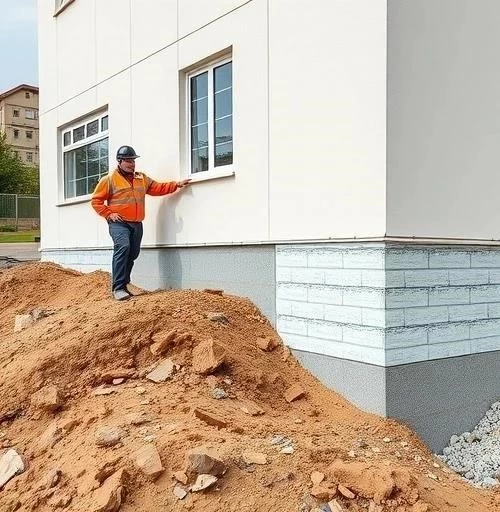
A plastered facade is a thin, elegant coat—and an excellent witness to what happens below it. On challenging sites, the real design begins underground. Expansive clay, collapsible soil, and low-bearing-capacity ground respond differently to rain, loading, and seasons. These ground movements can produce building settlement, wall distortion, and cracks in the finish. The facade cannot stop the earth from moving, but a carefully designed system can tolerate small movements and help keep water out.
Read the site before choosing the finish
Start with a geotechnical investigation, not a catalogue. The site’s geological conditions, groundwater level, drainage, and soil layers affect foundation behavior. Expansive soil can swell as it absorbs water and shrink when it dries; frost heave can lift shallow foundations in winter. Collapsible soil may settle after wetting, while weak soil may compress under load. Ask the engineer to assess likely movement and the structure’s response. A facade detail selected without this information is a guess dressed as design.
Build a system, not a cosmetic layer
An exterior insulation and finish system must be specified as a compatible whole. Insulation may be mineral wool or expanded polystyrene, selected for fire, moisture, and project requirements. Correct insulation fixing matters: anchors, adhesive, substrate preparation, and layout must follow the system supplier’s instructions. Over the boards, installers apply a reinforced base coat with facade mesh embedded in the correct position. A facade primer then prepares the surface for the decorative render.
Good workmanship cannot compensate for a moving structure, but it can prevent avoidable failures. The base coat should be continuous, mesh overlaps properly, and corners and openings need reinforced details. Keep the plinth—the building’s most exposed lower zone—designed for impact and splash water. Plinth waterproofing, suitable finishes, and effective site drainage reduce moisture at the wall base. Never bury the facade edge in soil or bridge a drainage detail with render.
Allow movement; manage moisture
Where the building design calls for an expansion joint, carry it through the facade system; do not cover it with mesh or render; Joints, flashings, drips, and window sills direct water away from vulnerable edges; Protecting the facade from moisture is especially important where groundwater or poor drainage may keep the base damp. On a site prone to frost heave, however, drainage and foundations—not a thicker finish—are the primary safeguards.
Inspect the facade after the first heating season and after severe weather. Hairline cracks, bulges, or damp patches deserve investigation: they may signal a local finish defect, water entry, or wider structural movement. Repair the cause before recoating. Durable facade performance comes from matching the installation method to the substrate, respecting movement joints, and coordinating the facade engineer with the geotechnical and structural teams. On difficult ground, the best finish is not the one that hides every warning; it is the one designed to live honestly with the building.
6 Comments. Оставить новый
A useful reminder that cracks can be messages from below, not merely blemishes above. The article turns the facade into a kind of seismograph for the decisions made at foundation level.
The most convincing finish is often the one that has quietly prepared for trouble. By connecting soil behavior to water management and workmanship, this piece gives prevention the drama it deserves.
The plinth gets its rightful moment in the spotlight. It is the building’s muddy hem, taking the splash and scuff of daily life—and deserves details chosen for reality, not just the render.
This makes technical coordination feel refreshingly tangible. “Compatible whole” is the phrase I would take into a project meeting before anyone starts choosing colors.
I like the article’s quiet insistence that a facade is more than its visible finish. It is almost a weatherproofing orchestra: drainage, mesh, insulation, and the ground all have to play in time.
The line “a guess dressed as design” is a keeper. It neatly captures why soil reports belong at the beginning of a facade conversation, not in the folder nobody opens until cracks appear.