
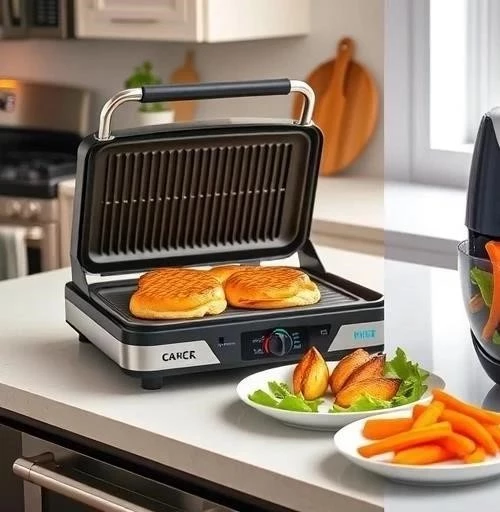
They both promise crisp, delicious food without the drama of a charcoal barbecue. Both sit on a countertop, plug into a wall, and can make a Tuesday dinner feel a little more exciting. Yet an electric grill and an air fryer are not interchangeable twins. One creates bold, direct contact with hot plates; the other sends a fast-moving storm of hot air around your food. The better choice depends less on which appliance sounds more futuristic and more on what you actually like to eat.
Two appliances, two kinds of heat
An electric grill cooks food against heated ridged or flat plates. In a contact model, the top plate usually presses down on the food, cooking both sides at once. The result is familiar grill character: browned stripes, a seared surface, and a hint of barbecue-style drama. Some models open flat, giving you a larger cooking surface for vegetables, eggs, or several small portions.
An air fryer—often called an air grill in some markets—is essentially a compact convection oven. A heating element warms the air, and a fan drives it around the food in a basket or chamber. That moving heat can make chips, breaded bites, and vegetables crisp outside while staying tender inside. It does not usually press food against a hot surface, so it won’t create the same sear or classic grill marks.
The dinner test
- Choose an electric grill for: steaks, burgers, chicken breasts, fish fillets, panini, and vegetables you want visibly seared. It excels when the meal’s headline is “something hot off the grill.”
- Choose an air fryer for: frozen fries, nuggets, wings, roasted vegetables, and small batches of crunchy snacks. It’s especially handy when you want crispness without heating a full-size oven.
- Either can handle: sausages, tofu, and many vegetables, though the texture will differ. A grill gives direct browning; an air fryer gives a more all-over, roasted finish.
Picture a courgette slice. On a grill, it lands on a hot ridge and picks up dark stripes, like a tiny landscape map. In an air fryer, it tumbles through circulating heat and emerges more evenly browned. Neither result is automatically better; they simply tell different culinary stories.
Convenience: speed, space, and cleanup
Both appliances can be quick, but their rhythms are different. A contact grill often heats rapidly and cooks thin foods in just a few minutes. Since it cooks from both sides, you may not need to turn every piece. An air fryer typically needs a little space around the food for air to flow, and you may need to shake the basket or turn ingredients halfway through. Overfilling it can leave you with a crowded, patchy batch rather than a crisp one.
Counter space matters. A compact grill may store easily, while a large air fryer can take up more room than its cheerful shape suggests. On the other hand, an air fryer’s basket or shelves can be useful for cooking a batch of several different items. Check the usable cooking area, not only the advertised capacity: a basket that holds a mountain of food may still crisp best when it’s only partly full.
Cleanup depends on the design. Removable grill plates and drip trays are a blessing; fixed plates with trapped grease are much less charming. Air-fryer baskets often collect crumbs and oil, and their nonstick coating needs gentle handling. In either case, follow the maker’s instructions, let parts cool, and avoid abrasive tools that can damage the surface.
Health, taste, and the smoke question
Neither appliance makes every dish healthy by magic. An air fryer can use little added oil for foods that are naturally suited to it, but a basket of processed snacks is still a basket of processed snacks. A grill can let some fat drain away, yet the ingredients, portion size, and cooking method still matter. For both appliances, use only the oil and accessories recommended by the manufacturer.
Grilling fatty foods may create smoke or splatter, so ventilation and a drip tray are useful. Air fryers generally contain cooking inside a chamber, but they still need clear space around vents and should not be crowded against a wall. Follow the appliance’s safety guidance, especially for placement and cleaning.
A quick decision guide
- Love char, sear, and sandwiches? Pick an electric grill.
- Want crisp snacks and roasted sides with minimal fuss? Pick an air fryer.
- Cook for several people? Compare the actual cooking surface and batch size; neither label guarantees enough room.
- Short on storage? Measure the appliance and its accessories before buying.
- Unsure? Write down the five meals you make most often. Choose the machine that suits at least three of them.
The verdict
If your ideal supper has sear marks and the satisfying sizzle of a steak or panini, an electric grill is the clearer match. If your week revolves around quick, crunchy sides and small roasted portions, an air fryer will probably earn more counter space. The best appliance is not the one with the loudest promise; it’s the one you’ll reach for on an ordinary evening.
And if your kitchen has room for both, they make an unusually good team: let the grill handle the main event, while the air fryer prepares the crisp supporting cast. Dinner, in other words, gets two different kinds of heat—and a much better plot.

7 Comments. Оставить новый
I like that this doesn’t crown one appliance king. It asks the better question: what kind of dinner do you want to come home to?
The courgette is a smart little test subject. One slice, two machines, two entirely different landscapes of browning—suddenly appliance shopping feels like a delicious science experiment.
Useful, clear, and unexpectedly evocative. The best takeaway is that the appliance should follow the food you crave, not the other way around.
A countertop appliance guide with the rare gift of not pretending every gadget can do everything. My imaginary weeknight menu is already choosing sides—and leaving room for both.
The comparison makes heat feel like a personality trait: the grill is a bold handshake, the air fryer a whirlwind in a tiny kitchen. That image makes the practical differences easy to remember.
The writing turns heat transfer into a vivid kitchen duel: hot plates versus a miniature weather system. I’ll never look at a basket of fries quite the same way.
That distinction between direct contact and circulating air is the article’s secret ingredient. It explains why “crispy” and “grilled” are not rival words so much as different dinner ambitions.