
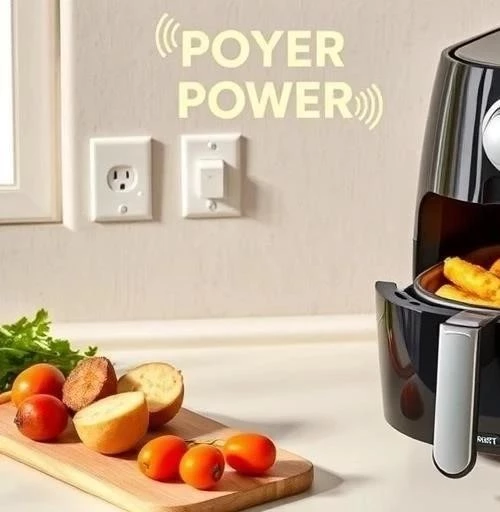
An air fryer is a tiny weather system for dinner: a fan drives hot air around the food, and a heating element keeps that air at temperature. The wattage tells you how quickly the appliance can create and restore that heat. Choose too little power for a big basket and supper may take its time; choose more than you need and you may simply spend extra energy heating a small load. The right number depends on the size of the fryer, the portions you cook, and the electrical supply in your kitchen.
The quick answer
For most homes, a useful guide is 1,400–1,800 watts for a compact or medium air fryer, and around 1,800–2,200 watts for a large basket or family-size model. Small, single-person appliances may work well at about 1,000–1,400 watts. These are practical ranges, not a promise that every appliance in a category will cook identically. Always check the manufacturer’s specifications, capacity, and cooking instructions.
- 1–2 litres: roughly 1,000–1,400 W; suited to snacks or one modest serving.
- 3–5 litres: roughly 1,400–1,800 W; a flexible choice for couples and small households.
- 6 litres and above: roughly 1,800–2,200 W; useful for larger portions, with the exact need depending on design.
- Dual-basket or oven-style models: may draw more power, especially when several zones run together. Check the stated maximum load.
Why the basket matters more than the headline
Wattage is the appliance’s electrical appetite, not a direct score for crispness. A 2,000-watt model is not automatically twice as good as a 1,000-watt one. The air path, fan, heating element, basket shape, temperature control, and how densely the food is packed all affect the result. A powerful unit with a crowded basket can still produce pale, uneven fries. A well-designed smaller fryer, used in sensible batches, can do a remarkably cheerful job.
Think of the basket as a small stage. If food is piled into a mountain, hot air cannot circulate freely around every piece. A larger appliance often needs more power because it heats more air and more metal, but it also invites you to cook more food at once. Leave room for airflow, shake or turn food when the recipe recommends it, and avoid covering vents. Good circulation can matter as much as another few hundred watts.
Match power to the way you cook
If you mainly reheat a pastry, roast a handful of vegetables, or make a single serving of frozen snacks, a compact model is usually enough. It may heat quickly and occupy less counter space. For regular family dinners—chicken portions, potatoes, or vegetables for several people—a medium or large model in the ranges above is more convenient. You can cook a fuller batch without dividing dinner into as many rounds.
For frequent large batches, choose capacity first, then confirm that the wattage and cooking performance suit it. Two models with the same capacity can behave differently, so reviews and clear manufacturer guidance are useful; If speed matters, look for evidence about preheating and real cooking times, rather than assuming the highest wattage will win every race. Frozen food, thick cuts, and a loaded basket all take longer than a small, thin portion.
What will it cost to run?
Power is measured in watts; electricity bills are usually based on kilowatt-hours. Divide the wattage by 1,000, then multiply by the time in hours and your electricity rate. For example, a 1,700 W fryer running at full power for 30 minutes would use up to 0.85 kWh (1.7 × 0.5). Actual consumption may be lower because the heating element can cycle on and off after reaching the set temperature. Your tariff determines the cost.
A higher-wattage model does not necessarily use more electricity for every meal. It may cook a larger batch or reach temperature faster; meanwhile, a smaller appliance may need several rounds for the same dinner. Compare the whole task, not just the number on the label. Avoid choosing an oversized unit that you will routinely heat for one tiny snack, but do not buy an undersized one if it means repeated cooking.
Check your kitchen before buying
Look at the appliance’s rated voltage and maximum wattage, and use it only with a suitable outlet as the manufacturer directs. A powerful fryer can draw substantial current. Do not run it through an unsuitable extension lead, overload a shared circuit, or place it where hot exhaust is blocked. If you are unsure whether your outlet or circuit can safely support it, ask a qualified electrician. Safety is more important than a tempting wattage figure.
A simple buying rule
For a reliable all-round choice, start with about 1,500–1,800 W for a medium 3–5 litre air fryer. Go lower for occasional single portions and higher for a genuinely large capacity or frequent family cooking. Then compare usable basket space, controls, cleaning, noise, warranty, and the maker’s recommended portions. In short: pick the basket that fits your table, the power that fits the basket, and the appliance that fits your kitchen. Wattage should support your cooking—not become the whole recipe.

6 Comments. Оставить новый
A useful little antidote to wattage envy. The article makes clear that a bigger number isn’t a magic crispness button—a lesson that could save both counter space and electricity.
Clear, lively, and grounded in real kitchen behavior. The reminder about crowded baskets is especially welcome: even hot air needs room to do its work.
The basket-as-stage metaphor deserves a spotlight. It explains why piling in more food can sabotage crispness without burying the point in technical jargon.
I appreciate the way the advice scales with household size and cooking habits. It feels less like shopping for a machine and more like choosing the right-sized weather for dinner.
This is refreshingly practical: ranges, caveats, and a nudge to check the appliance’s own specifications. It gives readers a compass, not a fake guarantee.
I like how this turns wattage from a kitchen-number mystery into something you can actually use. The “tiny weather system” image is memorable—and a good reminder that airflow matters as much as raw power.