
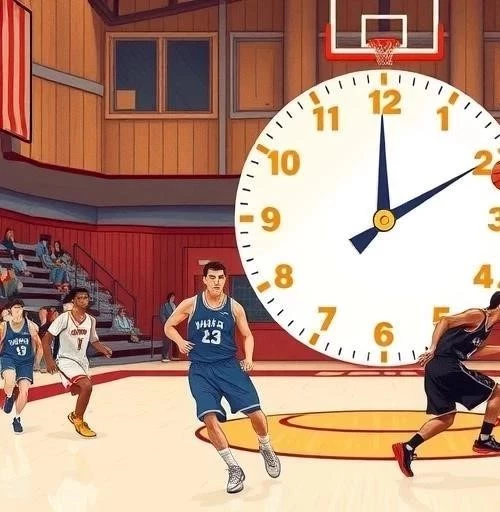
A basketball game has a set playing time, but the time shown on the game clock is not the same as the time a spectator spends watching. The length depends on the competition’s rules, and the clock stops for events such as fouls, timeouts, reviews, and breaks between periods. As a result, a game scheduled for 40 or 48 minutes commonly takes around two hours in real time.
Official playing time by competition
There is no single duration used in every league. The main formats are:
- NBA: Four quarters of 12 minutes, for 48 minutes of regulation play.
- FIBA competitions: Four quarters of 10 minutes, for 40 minutes of regulation play. These rules are used in many international games and national leagues.
- NCAA college basketball: Men’s games are generally played in two 20-minute halves, totaling 40 minutes. Women’s games use four 10-minute quarters, also totaling 40 minutes.
- Some school, youth, and recreational leagues: Periods may be shorter, and local rules determine the exact format.
These figures describe regulation time, not the full event. They also do not mean that the ball is in play continuously for that many minutes. The game clock is stopped whenever the rules require play to pause.
Why the clock stops
The clock usually stops when a referee calls a foul or violation, when the ball goes out of bounds, and during timeouts. It may also stop for substitutions, free throws, video reviews, or other official decisions. In the final minutes of a close game, stoppages can become especially frequent: teams may call timeouts, commit tactical fouls, and take longer to complete free throws. This can extend the event substantially beyond the nominal playing time.
There are also scheduled intervals. Depending on the competition, these include short breaks between quarters or halves, a longer halftime, and sometimes a brief pause before overtime. Televised professional games may include additional commercial breaks. The length of these intervals differs by league and broadcast arrangement.
Typical elapsed time
As a general guide, many professional games last about two to two and a half hours from tip-off to the final result. An NBA game often takes roughly two hours or more, despite having 48 minutes of regulation time. FIBA and other 40-minute games may be somewhat shorter, but a close finish, numerous reviews, or overtime can bring their total length into a similar range. College games also vary; many take around two hours, with broadcast schedules and stoppages affecting the total.
These are estimates rather than guarantees. A fast-moving game with few fouls and timeouts may finish sooner. A match with frequent free throws, injuries, reviews, or a tight final score may last longer. The announced start time is therefore not a reliable indication of when the game will end.
Overtime and tied scores
If the teams are tied at the end of regulation, most major competitions add an overtime period. In the NBA, FIBA, and NCAA rules, an overtime period is five minutes. If the score remains tied, another five-minute period is played, and the process continues until a winner is determined. Each extra period adds its own stoppages and interval, so even one overtime can noticeably extend the event. Multiple overtimes can make a game last well beyond the usual estimate.
Playing time versus time spent watching
It is useful to distinguish three different measures:
- Regulation time: The scheduled length on the game clock, such as 40 or 48 minutes.
- Actual live action: The time during which play is taking place. This is less than the regulation figure because the clock and play pause.
- Elapsed event time: The period from the opening tip to the end, including stoppages, breaks, and any overtime.
When someone asks how long a basketball game lasts, they may mean any of these. For planning purposes, the elapsed event time is usually the most useful measure. Allow about two hours for many games and more time for a televised contest, a close finish, or overtime. Venue entry, pregame introductions, and travel are separate and can add to the overall time spent attending.
In brief
A basketball game has 40 minutes of regulation play under FIBA rules and in most college formats, while an NBA game has 48 minutes. Because the clock stops and scheduled breaks are included, the event normally lasts much longer than its playing-time total. Around two hours is a practical estimate for many games; the exact duration depends on the league, pace, stoppages, broadcast, and whether overtime is needed.

6 Comments. Оставить новый
The overview is informative and practical. The provided text appears to end mid-word, so the final section may be incomplete.
The article clearly distinguishes regulation playing time from the total time a basketball game takes to watch. The league-by-league examples make the differences easy to understand.
The explanation of clock stoppages is useful, especially the note that pauses often become more frequent near the end of a close game.
The organized headings and concise descriptions make this a helpful introduction to basketball game duration across several competitions.
The distinction between the game clock and elapsed viewing time is central to the topic and is explained in accessible terms.
The article appropriately notes that school and recreational leagues may follow different formats, rather than suggesting that all games have the same length.