
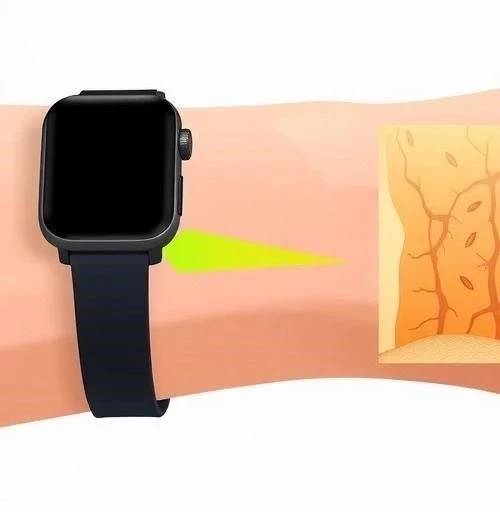
Apple Watch does not listen to the heart or directly count its electrical signals during an ordinary pulse reading. Instead, it shines light into the wrist and measures how blood flow changes the light that returns. This optical method, called photoplethysmography (PPG), is the basis of the watch’s everyday heart-rate readings. Understanding it explains both why the system is convenient and why its results can sometimes be imperfect.
The optical sensor: light in, information out
On the back of the watch, green light-emitting diodes flash against the skin. Nearby photodiodes measure how much light is reflected back. Blood absorbs green light, so the amount reaching the detectors changes as blood volume in the tiny vessels beneath the skin rises and falls with each pulse. The watch’s sensor records these repeating changes as a signal.
Software then filters the signal to reduce irrelevant variation and identifies its recurring peaks. The time between peaks helps the watch estimate beats per minute: more closely spaced pulses mean a higher rate; wider spacing means a lower one. In simple terms, the watch detects the pulse wave created by each heartbeat—not the heart’s electrical activity itself. That distinction matters: an optical pulse reading and an electrocardiogram (ECG) are related measurements, but they are not interchangeable.
Why the watch uses different light and measurement modes
During many workouts, Apple Watch uses green light because the changing blood flow produces a useful signal, even while the wearer is active. The LEDs can flash hundreds of times per second, and the watch adjusts their intensity to suit the wearer and conditions. For background readings, it may use infrared light, which is less visible and can be more energy-efficient. The exact pattern depends on the model, activity, and software.
Some models also include an electrical heart sensor. When the wearer places a finger on the Digital Crown, the body completes an electrical circuit between the wrist and the finger. The watch can then record an ECG waveform for a short period. This is a separate feature from routine optical tracking: the green-light sensor estimates pulse rate, while the ECG sensor records electrical signals. An ECG-capable model does not turn every everyday heart-rate reading into an ECG.
How readings are used
Apple Watch can measure heart rate during workouts and at intervals while the wearer is still. It also takes readings during activities such as walking, depending on settings and conditions. During exercise, frequent measurements help display current heart rate and support workout summaries. Between workouts, less frequent checks conserve battery power. The watch may take additional readings when it detects a change in activity or needs more information.
Heart-rate data can contribute to other estimates, such as calories burned, resting heart rate, and recovery information. These are calculations based on multiple inputs, not direct measurements of every aspect of health. A number on the display is therefore best understood as an estimate produced from a sensor signal and software—not as a perfect account of every heartbeat.
Why a reading can be inaccurate
Optical sensing depends on a clear path between the sensor and the skin. A loose band lets the watch move and admit outside light; a very tight or uncomfortable fit can also be unsuitable. For a workout, Apple recommends wearing the watch snugly on top of the wrist, with the back in contact with the skin. It can be loosened after exercise.
Movement is another challenge. Repeated wrist motion, gripping equipment, or activities that flex the wrist can create signals that resemble or obscure the pulse. Cold weather may reduce blood flow near the skin. Tattoos, skin characteristics, and changes in how the watch sits can affect the light signal, too. These factors do not mean the watch is useless; they explain why a reading can lag, fluctuate, or occasionally be missing. A chest-strap monitor, which detects electrical activity, may be more suitable when highly consistent exercise data is important.
What the measurement can—and cannot—tell you
Apple Watch is valuable because it can collect heart-rate information conveniently over time. Trends may help users notice changes and decide when to seek advice. Yet a single reading cannot establish a diagnosis, and a normal number does not rule out a medical problem. The watch is not a substitute for clinical equipment or professional assessment. If a reading seems implausible, check the fit, stay still, and repeat it; if symptoms such as chest pain, fainting, or severe shortness of breath occur, seek urgent medical help rather than relying on the watch.
In short, Apple Watch estimates heart rate by using light to track pulse-related changes in blood volume beneath the wrist. Its practical strength is repeated, convenient monitoring; its limitation is that optical sensing is sensitive to fit, movement, and circulation. Knowing the difference helps users treat the data as useful evidence—not as an infallible verdict.

7 Comments. Оставить новый
The step-by-step description of green light, reflected light, and changing blood volume makes the basic principle easy to understand without oversimplifying it.
The discussion of different measurement modes adds helpful context about why the watch may use green or infrared light. A brief note about factors that can affect signal quality would make the overview even more complete.
The explanation of how software identifies repeating peaks helps connect the sensor hardware to the beats-per-minute estimate. It gives readers a useful picture of how the raw signal becomes a number.
The article explains the technology accessibly while also acknowledging that optical measurements are not the same as an ECG. That caveat makes the overview more responsible and informative.
I appreciate the article’s measured wording about infrared readings and energy efficiency. Noting that behavior can vary by model, activity, and software avoids presenting one pattern as universal.
The explanation clearly distinguishes an optical pulse reading from an ECG. That distinction is important because readers might otherwise assume the watch measures the heart’s electrical activity during every ordinary reading.
This is a clear introduction to photoplethysmography, especially for readers unfamiliar with the term. The comparison between pulse-wave detection and electrical heart sensing is the article’s most useful clarification.