
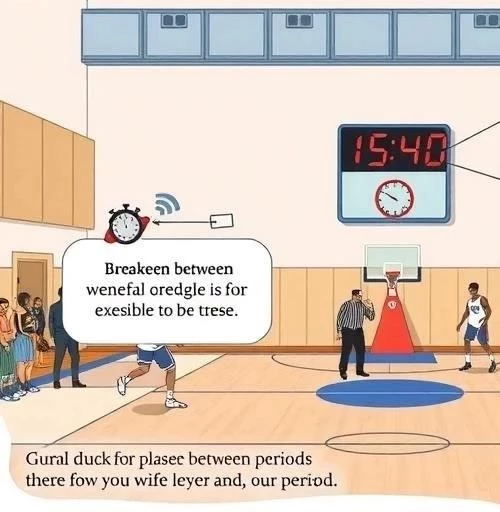
A basketball game has a set amount of playing time, but the time shown on the game clock is not the same as the time that passes in real life. The clock stops for certain events, and breaks, timeouts, reviews and overtime add to the total. The exact length also depends on the league.
Official playing time by league
Under FIBA rules, used in international competitions, the Olympics and many domestic leagues, a game consists of four 10-minute quarters. That makes 40 minutes of regulation playing time. In the NBA, each of the four quarters lasts 12 minutes, for a total of 48 minutes.
The game is divided into two halves: the first half is made up of quarters one and two, and the second half consists of quarters three and four. Some other competitions use different periods. For example, many U.S. high-school games have four 8-minute quarters, although local rules can vary. Check the competition’s regulations if you need the precise format.
| Competition | Periods | Regulation time |
|---|---|---|
| FIBA | 4 × 10 minutes | 40 minutes |
| NBA | 4 × 12 minutes | 48 minutes |
| Many U.S. high schools | 4 × 8 minutes | 32 minutes |
How long are the breaks?
In FIBA games, the breaks between the first and second quarters and between the third and fourth quarters are two minutes. Halftime, between the second and third quarters, is 15 minutes. The NBA also has a 15-minute halftime; its shorter quarter breaks are generally around two to two and a half minutes, depending on the game and broadcast arrangements.
There are also intervals before the game and before overtime. These are not part of regulation playing time, but they contribute to the time spectators spend at the arena or watching a broadcast. Ceremonies, warm-ups and television coverage may extend the overall event further.
Why does a 40- or 48-minute game take much longer?
Basketball uses a stop-clock system: the clock pauses during many interruptions, so the full game does not run continuously. Stops may occur when a referee calls a foul, the ball goes out of bounds, a team requests a timeout, or play is reviewed. The clock also stops for some late-game situations and administrative delays. Free throws, substitutions and restarting play take additional real-world time.
As a result, a FIBA game with 40 minutes on the clock commonly takes around 1.5 to 2 hours from start to finish. An NBA game, with 48 minutes of regulation time and more stoppages and commercial breaks, often lasts about 2 to 2.5 hours. These are useful estimates, not guarantees: a close finish, many fouls, reviews or extra periods can make a game longer.
What happens if the score is tied?
If the teams are tied at the end of regulation, they play an overtime period; In both standard FIBA and NBA games, overtime lasts five minutes. There is a short break before it begins, and the clock stops during play just as it does in regulation. If the score is still tied after five minutes, another overtime is played. This continues until one team is ahead when a period ends.
Overtime is added to the scheduled playing time, not substituted for part of it. One five-minute extra period therefore means at least five more minutes on the game clock, plus the interval and any stoppages. Multiple overtimes can push the real-world duration well beyond the usual estimate.
So, how long should you allow?
The short answer is 40 minutes of regulation time in FIBA basketball and 48 minutes in the NBA. Those figures describe the time played on the clock, not the total event. For planning, allow roughly two hours for many FIBA games and around two to two and a half hours for an NBA game, with extra time if the matchup is close or goes to overtime.
When someone asks how long a basketball match lasts, the most helpful response is to give both numbers: the official game-clock duration and the likely elapsed time. The first is fixed by the league’s rules; the second depends on how often play stops and whether the game needs overtime.


5 Comments. Оставить новый
The table is a handy way to compare the standard game lengths at a glance. Mentioning high-school variations is useful for readers checking a particular competition.
I appreciate the explanation of how quarter breaks and halftime affect the total event length. The article makes the different league formats easy to understand.
This is concise and informative, especially the reminder that rules can vary by competition. It gives readers a good starting point for estimating how long a game will last.
The comparison between FIBA and NBA playing time is clear and useful. It is especially helpful to distinguish regulation minutes from the much longer time a game takes to watch.
A straightforward answer to a common question. Explaining that the clock stops during play helps clarify why a 40- or 48-minute game can take much longer in real life.