
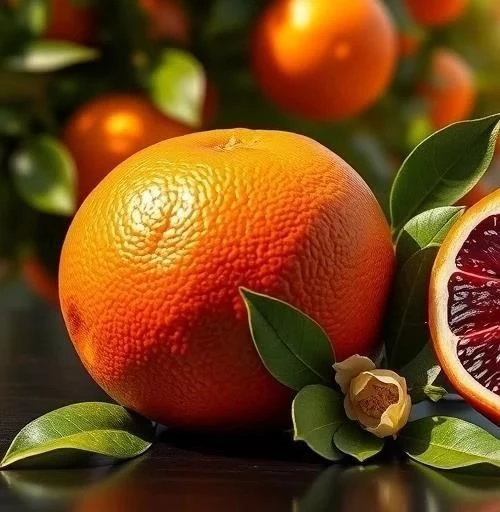
The blood orange is a naturally occurring type of sweet orange, known for flesh that ranges from orange streaked with red to deep crimson. Its unusual colour is not the result of food colouring or deliberate mixing with another fruit. It developed through natural variation, then was preserved and spread through cultivation.
A natural change in the orange
Sweet oranges themselves have a long history of cultivation and are believed to have originated in Asia before spreading west along trade routes. At some point, an orange tree produced fruit with reddish flesh. Such differences can arise when a plant’s genetic material changes by chance. If the fruit is useful or appealing, growers can reproduce the tree by grafting branches onto rootstocks, keeping the distinctive trait in later trees.
The precise place and date of the first blood orange are not known with certainty. The Mediterranean region, especially Sicily, became strongly associated with the fruit, and some of its best-known forms were developed and grown there. The climate helped make these oranges distinctive, but it did not create the variety on its own: inherited characteristics also matter.
Why the flesh turns red
The colour comes mainly from anthocyanins, pigments also found in foods such as berries and purple grapes. Most common sweet oranges contain little or none of these pigments in their flesh. In blood oranges, the relevant genes allow anthocyanins to build up as the fruit develops and ripens.
Cool nights and warm, sunny days can encourage stronger pigment formation. This is one reason blood oranges often colour especially well in places with suitable winter conditions. The degree of redness varies with the variety, growing location, weather and stage of ripeness. A fruit may therefore have red patches rather than an evenly coloured interior. Its peel can remain mostly orange, although some varieties develop a reddish blush.
Different varieties
Several cultivated varieties are commonly sold. Moro oranges can become very dark inside and are often noted for their intense colour. Tarocco oranges are typically sweet and may have a more moderate, uneven blush. Sanguinello oranges are another traditional type, valued for their flavour and red-toned flesh. These names refer to cultivated varieties, not to separate species.
Blood oranges are not simply oranges crossed with grapefruit, raspberries or another red fruit. They belong to the sweet-orange group. Their colour is an inherited feature that growers maintained through propagation, while selective cultivation helped establish varieties with desirable taste, size and appearance.
From local fruit to international crop
As trade and agriculture expanded, blood oranges reached markets beyond their traditional growing areas. Today they are cultivated in several warm regions, including parts of Europe, North Africa and the Americas. Harvest timing depends on the variety and local conditions, so the fruit is generally associated with the cooler months in many markets. Modern transport has made it easier to find them elsewhere, though availability remains seasonal.
Farmers continue to choose and propagate trees that produce reliable crops and appealing fruit. This is a continuation of a much older practice: noticing a useful natural difference and reproducing it. The modern blood orange is therefore both a product of chance variation and a history of careful cultivation.
What makes it distinctive
Its flavour is often described as sweet, with a sharper or berry-like note, though taste varies among varieties and growing conditions. The pigments do not guarantee a particular flavour, and a redder orange is not automatically riper or sweeter. The fruit can be eaten fresh or used in juice, salads, sauces and desserts, where its colour adds visual contrast.
In short, the blood orange came about through a natural genetic change in cultivated sweet oranges. Anthocyanin pigments give its flesh the characteristic red tones, while climate can influence how strongly those pigments appear. Growers preserved the variation by propagating selected trees, and centuries of cultivation turned a rare-looking fruit into a familiar seasonal variety.


7 Comments. Оставить новый
The article usefully notes that the amount of red colour can vary between fruits and growing conditions.
The explanation of anthocyanins makes the source of the fruit’s colour accessible to a general reader.
The discussion of grafting helps explain how growers preserve distinctive traits across generations of trees.
The historical overview is measured, especially in acknowledging that the origin of the first blood orange is uncertain.
The sections provide a clear structure, moving from the fruit’s history to the reasons for its colour.
The article clearly explains how blood oranges developed and distinguishes natural variation from deliberate hybridisation.
The article separates the influence of climate from inherited characteristics without treating either as the sole cause.