
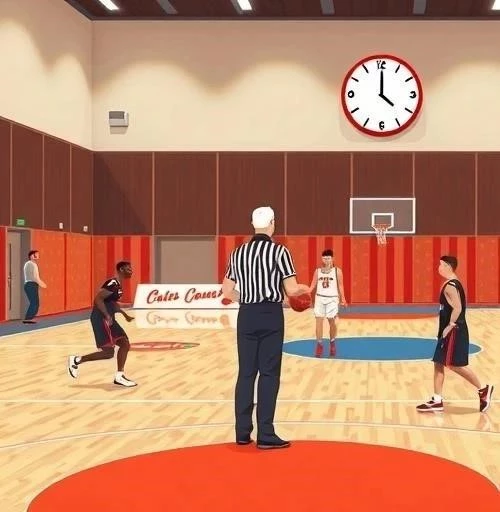
Short answer: a standard adult basketball game in Russia has 40 minutes of playing time‚ but spectators should usually allow about 1.5 to 2 hours for the whole event. The difference exists because the clock stops frequently‚ and the game includes scheduled breaks‚ timeouts and other interruptions. A close or unusually eventful match can last longer.
The official playing time
Most Russian professional and amateur competitions use the international rules established by FIBA. Under these rules‚ a game consists of four quarters‚ each lasting 10 minutes. That adds up to 40 minutes on the game clock—not 40 minutes of uninterrupted real time.
The clock runs while the ball is in play‚ but stops for certain events. These include fouls‚ free throws‚ substitutions‚ timeouts and situations when the ball goes out of bounds. It also stops at the end of a quarter. As a result‚ the minutes shown on the scoreboard do not translate directly into minutes on a spectator’s watch.
Scheduled breaks between quarters
- Between the first and second quarters: a short interval‚ generally 2 minutes.
- At halftime: 15 minutes between the second and third quarters.
- Between the third and fourth quarters: another short interval‚ generally 2 minutes.
So the standard breaks between the four quarters add about 19 minutes to the 40 minutes of playing time. This gives a theoretical total of roughly 59 minutes from the start to the end of regulation if the clock never stopped during play. In reality‚ it does stop‚ so the match takes substantially longer.
There may also be a short pre-game interval before the opening tip and additional time for teams to leave or return to the court. Those minutes are not part of the four quarters. Organisers may also schedule ceremonies‚ presentations or entertainment‚ which affect the event’s overall duration but not the official length of the game.
Why a 40-minute game often takes 90–120 minutes
Basketball has many clock stoppages‚ and their combined effect is significant. A foul can lead to free throws; a timeout pauses play; and officials may review a close call or confirm what happened near the end of a quarter. Substitutions and delays restarting play also add time. The final minutes are often especially slow because teams use timeouts and commit tactical fouls to manage the score.
For that reason‚ a straightforward game may finish in around 1 hour 30 minutes‚ while many professional matches take closer to 1 hour 45 minutes or 2 hours. These are practical estimates‚ not fixed limits. A game with frequent fouls‚ many timeouts‚ injuries or video reviews may go beyond two hours. A fast‚ low-interruption game can finish sooner.
What happens if the score is tied?
If the score is tied at the end of the fourth quarter‚ the teams play overtime. Under standard FIBA rules‚ each overtime period lasts 5 minutes‚ with a short interval before it begins. If the score remains tied‚ further five-minute periods are played until there is a winner. Each overtime adds not only five minutes of game-clock time but also real time for stoppages and the interval‚ so a close match can last considerably longer than the usual estimate.
Does the answer depend on the competition?
For most Russian adult games‚ including professional competitions played under FIBA rules‚ the 4 × 10-minute format is the useful standard. However‚ rules can vary in youth‚ school or recreational tournaments: quarter lengths‚ halftime periods and local procedures may be different. The event’s regulations are the best guide when an exact schedule matters. Do not confuse this format with the NBA‚ where quarters are 12 minutes; that is not the standard duration for a FIBA-rules game in Russia.


4 Comments. Оставить новый
This is practical information for anyone planning to attend a game. The estimate of 1.5 to 2 hours is more useful than the 40-minute rule alone, and the note that close matches may take longer adds appropriate context.
The explanation is easy to follow and makes clear that interruptions, rather than extra playing periods, account for much of the difference in duration. It would also be helpful to distinguish regulation games from matches that go to overtime.
The distinction between game-clock time and the actual event duration is useful. It explains why a 40-minute game can occupy much more time for spectators without making the official playing-time figure misleading.
The article clearly connects FIBA’s four-quarter format with the scheduled intervals. Including the halftime and quarter breaks gives readers a helpful baseline before accounting for stoppages during play.