
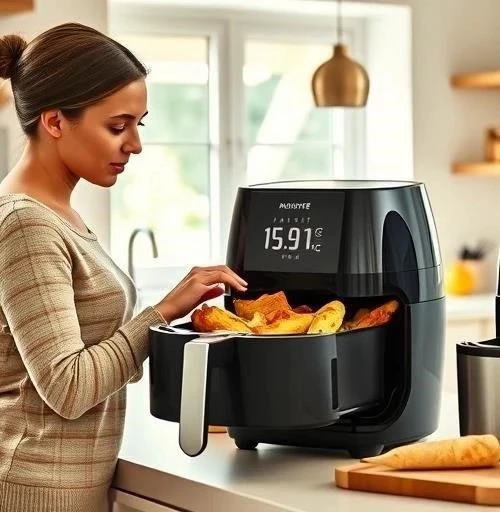
An air fryer can roast, bake and crisp food using rapidly circulating hot air. Choosing one is easier when you consider how many people you cook for, what you plan to make and how much counter space you have. Compare practical features rather than relying on a large number of presets or a fashionable design.
Choose the right capacity
Capacity is usually the first decision. Compact models suit one or two people and small kitchens, but may require cooking in batches. A larger basket can be more convenient for families or for preparing several portions at once. Check the usable cooking area as well as the stated volume: a deep basket may hold plenty of food but leave little room to spread it out.
For crisp results, ingredients generally need space around them so hot air can circulate. If you often cook chips, vegetables or several pieces of chicken, choose a basket wide enough to arrange them in a single layer. Consider the appliance’s external dimensions too, and measure the space where it will sit and where it will be stored.
Pick a suitable design
Basket-style models are compact and straightforward. They work well for small portions and foods that benefit from shaking during cooking. Oven-style models often include shelves or trays, making it possible to cook different foods at the same time. They take up more room and may need more cleaning. Some appliances combine air frying with functions such as baking or grilling; choose these only if you expect to use them.
Check controls and performance
Look for clear temperature and timer controls, a readable display and settings that are easy to adjust. Preset programs can be convenient, but they are not essential: cooking time varies with portion size, food thickness and starting temperature. A broad temperature range is useful if you also plan to bake or gently reheat food. Check that the timer can be adjusted while cooking and that the appliance signals when the cycle ends.
Wattage can indicate the electrical power required, but it does not alone determine cooking quality. A well-designed airflow system and a suitable basket shape matter too. Read the manual for guidance on preheating, shaking or turning food, and whether the appliance needs space around its vents. Check that your kitchen outlet can support its stated power requirements.
Consider cleaning and safety
Removable baskets and trays simplify cleaning. Check whether their non-stick coating is durable and whether the parts are dishwasher-safe; hand washing may help preserve a coating. Smooth interiors and fewer hard-to-reach corners can also make maintenance easier. Never assume every removable component can go in a dishwasher—follow the manufacturer’s instructions.
Useful safety features include a stable base, cool-touch handles, automatic shut-off and protection against overheating. The exterior and exhaust can become hot, so the unit should be kept away from walls, curtains and other heat-sensitive items. Check the cord length and position before buying, and use the appliance on a stable, heat-resistant surface.
Compare cost and warranty
Set a budget that includes useful accessories, not just the appliance. Compare warranty length, repair options and the availability of replacement baskets or trays. Independent reviews can reveal recurring issues such as uneven cooking, noisy operation or difficult cleaning. Give more weight to consistent feedback about everyday use than to isolated complaints or promotional claims.
Quick checklist
- Capacity and basket area match typical portions.
- The appliance fits your counter and storage space.
- Controls, cleaning requirements and safety features are practical.
- The warranty and replacement parts are acceptable.
The best choice is the model that suits regular cooking habits and is easy to clean and store. A larger unit is not automatically better, and extra functions are worthwhile only when they meet a real need.


1 Comment. Оставить новый
The guide offers a practical overview of key considerations, especially capacity, cooking space and appliance dimensions. Its emphasis on choosing features based on how you plan to cook is useful.