
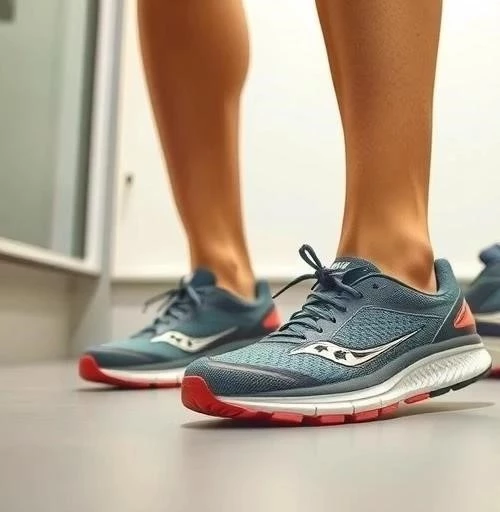
Finding a comfortable shoe when your foot is narrow involves more than selecting a smaller size. A shoe that is too short can press on the toes, while a standard-width shoe may let the heel lift or the foot slide during movement. Saucony makes shoes primarily for running, and many models can also suit some gym activities. The right choice depends on the shape of your foot, the workout, and the fit of the particular model and version.
Start with the activity
“Fitness” can mean treadmill running, brisk walking, strength training, circuit workouts, or classes with lateral steps. These activities place different demands on footwear. Running shoes are designed mainly for forward movement and cushioning; some have tall, soft soles that may feel less steady when lifting weights or moving quickly from side to side. A shoe suitable for a treadmill session may therefore be a poor choice for a varied gym workout.
- For running or treadmill work: look for a running model whose heel and midfoot hold securely, with enough room for the toes to spread.
- For walking and general gym use: prioritize a comfortable, secure fit and a sole that feels stable for the exercises you perform.
- For lifting or lateral training: test the shoe during controlled side-to-side movements and loaded exercises. If the sole feels high, soft, or unstable, consider footwear designed specifically for training.
Saucony’s running families may include options such as Ride, Guide, Kinvara, or Endorphin, depending on the season and market. Their cushioning, structure, and ride differ, and they are not interchangeable gym shoes. Names and specifications can change between generations. Treat a model name as a starting point, not a guarantee of a narrow fit;
Measure both feet and choose length first
Measure your feet near the end of the day, when they may be slightly larger. Wear the socks you expect to use for workouts. Measure both feet while standing, and use the longer foot to determine the starting size. Leave a small amount of space in front of the longest toe; toes should not touch the front when you stand or move downhill. Do not compensate for a roomy shoe by choosing a shorter size if that causes pressure at the toes.
Length and width are separate fit dimensions. A shoe can be the correct length but too broad around the heel, instep, or midfoot. Conversely, a narrow-feeling toe box may reflect the shoe’s shape rather than its stated width. Check Saucony’s current size chart and the product’s width options for the exact model. Availability of narrow widths varies by model, region, and season, so confirm the listing rather than assuming every shoe is offered in multiple widths.
Assess the fit in several areas
Heel
The heel should feel held without painful pressure or rubbing. Walk, jog lightly, and rise onto your toes. A small amount of movement can occur, but repeated lifting or slipping suggests that the heel shape or overall volume may not suit you. A secure heel is especially important on a narrow foot, because excess movement can cause blisters and make the shoe feel unstable.
Midfoot and instep
The laces should let you secure the shoe without pulling the eyelets excessively close together or creating pressure on the top of the foot. The midfoot should feel supported, not squeezed. If the shoe remains loose even when laced firmly, it may have too much internal volume. If tightening creates numbness, tingling, or painful pressure, try another fit rather than simply pulling harder.
Toe box
Your toes should be able to spread naturally; A narrow foot does not automatically require a sharply tapered toe box: the foot still needs room at the front. Check for pressure on the little toe, contact with the upper, or a feeling that the foot is pushed forward during movement. A shoe that feels secure at rest but constricting after a few minutes may not be suitable for a workout.
Use lacing as a small adjustment
Different lacing patterns can improve hold when a shoe is only slightly loose. If the model has an extra eyelet near the ankle, a heel-lock or runner’s-loop lacing pattern may reduce heel movement. Lacing the middle section more snugly can help the midfoot feel secure, while leaving the forefoot less tight can preserve toe comfort. These adjustments cannot correct a shoe that is substantially too wide or has the wrong shape. Check that the laces do not create pressure or restrict circulation.
Try the exact model and version
Fit can vary between Saucony models, and even between revisions of the same model. Changes to the upper, lining, lacing, or sole can alter how a shoe feels. Reviews can help identify patterns, but descriptions such as “runs narrow” are subjective and may refer to a different version or a different kind of foot. Whenever possible, try both shoes in person. If ordering online, check the retailer’s return and exchange terms before wearing them outdoors.
Test shoes later in the day, with workout socks and any orthotic or insole you normally use. Stand, walk, jog briefly if appropriate, and perform gentle side steps. The foot should not slide forward or sideways, and there should be no sharp pressure, numbness, or rubbing. Compare both feet, since one may need more room. Keep the shoes on long enough to notice discomfort that does not appear during the first few seconds.
Common mistakes to avoid
- Buying a smaller size to fix width: this can crowd the toes and cause discomfort.
- Choosing by brand reputation alone: Saucony models have different shapes and intended uses.
- Relying only on the size printed in an old pair: sizing can vary by model, version, and brand.
- Assuming a running shoe is ideal for every gym session: cushioning and stability requirements depend on the activity.
- Ignoring heel slip or numbness: these are signs to reassess the fit, not problems to endure until the shoe breaks in.
- Removing the insole to create extra space without testing: this can change support and fit. Follow the shoe maker’s guidance if using a replacement insole.
A practical selection checklist
- Identify the main activity and choose a shoe category suited to it.
- Measure both feet and select length based on the longer foot.
- Check the exact Saucony model’s width availability and current size information.
- Confirm that the heel and midfoot stay secure without painful lace tension.
- Make sure the toes have adequate room and the foot does not slide during movement.
- Compare fit in the socks and inserts you will use, and verify the return policy if buying remotely.
The best Saucony option for a narrow foot is not necessarily the smallest size or the most structured model. It is the shoe that matches the workout, holds the heel and midfoot comfortably, and leaves the toes enough room. If no available version provides that combination, trying a different Saucony model—or a shoe from another brand with a narrower last—is more appropriate than relying on excessive tightening.
7 Comments. Оставить новый
The section on lateral movements and lifting highlights stability as an important consideration beyond cushioning.
The distinction between running and gym activities is useful. It explains why one shoe may not be suitable for every workout.
Measuring both feet while standing and wearing workout socks is a straightforward suggestion that can help make comparisons more consistent.
The article appropriately notes that fit can vary between models and versions, rather than relying on a brand or model name alone.
The advice to prioritize shoe length before width is practical, especially for people trying to find a secure fit for narrow feet.
The guidance is balanced and avoids treating all Saucony running shoes as interchangeable options for gym training.
This provides a clear starting point for choosing footwear based on activity and fit. Trying a shoe during relevant movements is a sensible final check.