
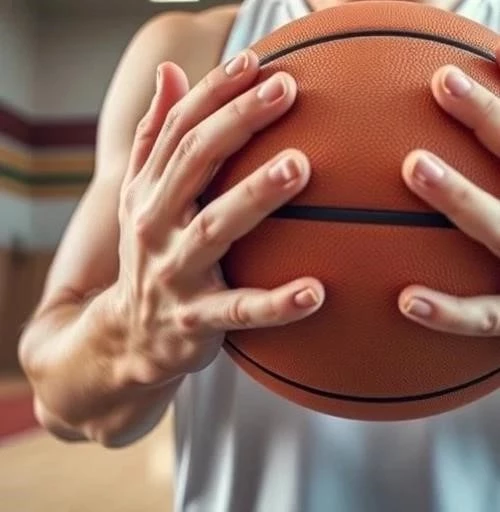
A sound basketball grip is the foundation of control. It helps you pass, dribble and shoot without squeezing the ball or relying on your palm. Correct hand placement lets your fingers guide the ball, while a relaxed wrist supports quick, repeatable movement; The aim is not to clamp the ball tightly, but to keep it balanced and ready to move.
Set your hands
For a right-handed shot, place your shooting hand under and slightly behind the ball, with the index and middle fingers pointing toward its center. Spread your fingers comfortably; do not force them wide. The ball should rest on the pads of your fingers and the base of the palm, leaving a small space between the palm and ball. Your guide hand rests lightly on the side. For a left-handed shot, reverse the positions.
Check the grip step by step
- Hold the ball around chest height and keep your shoulders relaxed.
- Spread your fingers evenly over the surface. Your thumb and little finger should help stabilize the ball, not pinch it.
- Center your shooting hand behind the ball so that your forearm, wrist and middle fingers line up toward the target.
- Place the other hand on the side. It steadies the ball, but should not push it forward during the shot.
- Lift the ball smoothly and finish with your shooting wrist relaxed and fingers directed toward the basket.
Why the palm matters
If the ball sits deep in your palm, your fingers cannot control its release as well. That often makes the shot less consistent and encourages a stiff, two-handed push. Keeping a little space under the palm gives the fingertips room to impart backspin. Do not exaggerate the gap, though: a grip that is too loose makes the ball unstable. Comfort and control matter more than copying someone else’s exact finger spread.
Adapt the hold to the skill
For passing, hold the ball securely with both hands, fingers spread on its sides and thumbs behind it. This gives you control while you look for a teammate; release with the fingers, not a shove from the palms. For dribbling, use the pads of your fingers to push the ball down and guide its rebound. Avoid slapping it with a flat hand, and keep your wrist flexible. In either skill, stay relaxed enough to react quickly.
Practice and self-check
Use a ball that fits your hands and practise slowly before adding speed. Try one-handed form shots close to the basket, checking that the guide hand stays quiet and the ball leaves your fingertips smoothly. Then practise catching, passing and dribbling with the same relaxed control. If your hands hurt, your fingers are cramped, or the ball constantly slips, reset your grip rather than squeezing harder. A correct hold should feel secure, balanced and repeatable; that is why patient practice is more useful than simply gripping as tightly as possible.

9 Comments. Оставить новый
The instructions are easy to follow because they move from setting the hands to checking alignment and finishing the shot. Including the left-handed adjustment also makes the guidance more useful to a wider range of players.
I found the emphasis on balance especially helpful: a grip can be too tight, but it can also be too loose to stabilize the ball. That qualification makes the advice realistic and encourages players to prioritize control over copying a rigid model.
The explanation makes a useful distinction between a relaxed, controlled grip and simply squeezing the ball harder. The step-by-step guidance is practical, especially the reminder that the guide hand should steady the ball rather than push it.
I appreciate that the article connects hand placement to the ball’s release and backspin instead of treating grip as an isolated detail. The advice to leave a small space beneath the palm is clear, while the warning not to exaggerate that gap keeps it balanced.
The practical checks—lining up the forearm, wrist, and middle fingers and keeping the guide hand light—give readers concrete things to observe while practicing. Those details make the advice more actionable than a general instruction to shoot with good form.
This article offers clear fundamentals without making the technique sound more complicated than it needs to be. Its guidance on relaxed shoulders, a lightly placed guide hand, and a controlled finish gives players a coherent starting point for practice.
The comparison between shooting and passing grips is a useful feature because it recognizes that one hand position does not suit every basketball skill. The explanation stays focused on control and gives a sensible reason for using both hands when passing.
This is a helpful explanation for beginners who may assume a firmer grip automatically improves control. The article reasonably emphasizes comfortable finger placement and a relaxed wrist, which can support a more repeatable shooting motion.
The article clearly explains why a ball buried in the palm can interfere with fingertip control. I also like that it avoids prescribing an exact finger spread, since hand size and comfort can vary from player to player.