
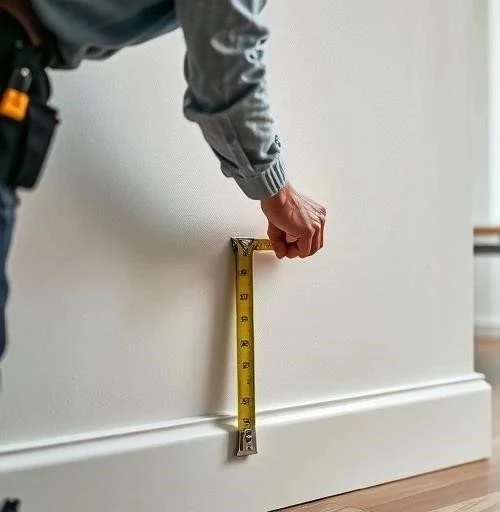
Installing a plastic floor skirting board in an office is not only a finishing task. A well-fitted board protects the lower wall, gives the room a neat floor finish and can conceal cables. Uneven walls make the job more demanding: wall deviations and wall curvature may leave gaps between the skirting and the wall. Careful preparation and a suitable fixing method matter more than simply pressing the board into place.
Choose the right profile and plan the work
PVC skirting is a practical option for commercial spaces because it is durable, easy to clean and available with a cable channel. Before office skirting installation, check the floor type, the wall surface and the route of any wiring. Measure each wall, note corners and doorways, and buy enough profile, connectors and end caps. A flexible skirting board can follow gentle curves, but it cannot correct severe hollows or loose plaster.
Plan cable routing before fitting the profile. Keep power and data cables arranged safely, and do not overload the channel. Confirm that the cover can be removed after installation; this is important when office wiring may need maintenance. The chosen commercial skirting should suit both the expected foot traffic and the cleaning routine.
Prepare the surface and mark the walls
Surface preparation starts with removing dust, grease, loose paint and protruding plaster along the floor line. Fill substantial holes and allow repairs to dry. Wall marking helps identify high and low points: hold a straightedge or the skirting against the wall, mark where it touches, and note where the wall recedes. This reveals whether the profile can sit evenly or whether a different fixing method is needed.
Do not expect the board to hide every defect. It can help with hiding wall defects near the floor, but forcing a rigid profile against pronounced hollows can distort it and create visible gaps. Where possible, correct the wall first. For small irregularities, choose a flexible profile or fix the board at closer intervals so it follows the surface without bowing.
Fixing methods and installation tools
Useful installation tools include a tape measure, pencil, level, fine-tooth saw, mitre box, drill and screwdriver. For reliable skirting attachment on masonry, use wall plugs and screws, selecting their size for the substrate. Drill through the designated fixing area and tighten carefully; excessive force may deform the profile. Mounting clips offer a removable finish, but they work best when the wall is reasonably sound and the clips are positioned to accommodate its contours.
Liquid nails can be suitable on clean, stable surfaces, especially where drilling is undesirable. However, adhesive makes later removal difficult and may not bridge large gaps. Follow the product instructions, support the board while it cures, and avoid using adhesive to disguise serious wall irregularities. In all cases, test a short section before proceeding around the whole room.
Corners, joints and final checks
Measure and cut each length carefully. Accurate cutting of skirting reduces waste and makes corner joints less noticeable. Use an internal corner piece at an inside turn and an external corner piece at an exposed outside edge. A skirting connector joins straight runs; end caps finish open ends. Dry-fit every piece first, since a small measuring error can become obvious across a long office wall.
Finally, check the board’s contact with the flooring. A neat adjacency to the floor covering should allow for normal floor movement and should not trap debris. Close the cable channel, inspect joints and fasteners, and confirm that no sharp edges remain. With sound preparation, appropriate fixings and patient fitting, plastic skirting can deliver durable office interior finishing even where the walls are not perfectly straight.
3 Comments. Оставить новый
The advice to plan cable routing before fitting a board with a cable channel is especially practical for office spaces. Keeping future access in mind helps make the installation easier to maintain, rather than treating the skirting as a purely decorative finish.
This is a clear, reasoned overview of the decisions involved in fitting PVC skirting. I appreciate that it distinguishes between minor wall irregularities, which a flexible profile may accommodate, and more serious defects that should be repaired first.
The article makes a useful point that preparation matters as much as the choice of skirting board. Checking for wall hollows before installation can prevent a rigid profile from being forced out of shape and leaving visible gaps.