
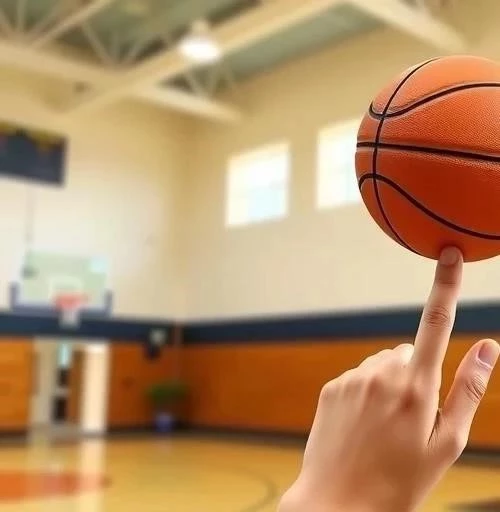
Spinning a basketball on one finger looks like a trick of speed, but it is mostly a skill of controlled balance; The ball keeps turning because it has angular momentum; your fingertip does not “hold it up” so much as make small adjustments beneath its center. That is why practising a clean launch and a steady contact point matters more than trying to move your finger as fast as possible. With short, regular sessions, most beginners can build the coordination step by step.
Choose suitable equipment
Start with a properly inflated basketball that is dry and clean. A ball with clearly defined channels is helpful: the grooves provide a predictable reference for your fingers and make it easier to launch the ball without wobbling. You do not need a special ball, but an extremely slippery, wet, or poorly inflated one makes learning harder. Practise over a clear, level surface, away from glass, lamps, and other people. If the ball drops, it should have room to bounce safely.
Learn the balance point first
Before attempting a spin, find the ball’s approximate center. Hold it with both hands and locate the point at the top where it balances most evenly. Place the tip of your index finger there. Keeping the finger near the center is essential: if contact is off-center, the ball tilts and is likely to roll off. You can practise simply balancing a stationary ball for a few seconds, using your free hand to steady it. This trains the feel of the contact point without adding the challenge of a fast rotation.
Practise a controlled launch
Hold the ball in your non-dominant hand, with the other hand ready to spin it. Bring it to about chest or shoulder height. Use your dominant hand to give the ball a firm, quick turn while your other hand guides it upward. Aim for a smooth, nearly vertical launch rather than a high toss. As the ball rises, bring your index finger underneath its center and make light contact. The finger should be upright, with the joint slightly relaxed—not rigidly locked.
At first, do not worry about keeping the ball spinning for a long time. Concentrate on three things: a consistent launch, contact near the center, and a ball that stays roughly level. If the ball immediately falls, catch it and try again rather than chasing it with a bent finger. Repeating a controlled motion is more useful than repeatedly rescuing a poor one.
Build rotation and balance gradually
Once you can make contact reliably, add speed to the launch. A faster, clean rotation usually gives you more time to balance the ball, but force alone will not solve an inaccurate release. Watch the ball’s top and grooves: if it wobbles strongly, the launch may be tilted or your finger may be too far from the center. Adjust the release first. When the ball turns smoothly, make small corrections with your hand under it. Keep your finger beneath the ball rather than pushing sideways, since a sideways push can make it tip.
When one-finger contact becomes steady, practise extending the duration in small increments. Aim first for one or two seconds, then gradually for five, and only then for longer. It is perfectly reasonable to begin with a brief balance and catch the ball safely. Consistency across several attempts is a better measure of progress than one lucky, long spin.
Use a sensible practice routine
Practise for about 10–15 minutes at a time, several days a week. Begin with a few stationary-balance attempts, then make a series of controlled launches, and finish by repeating the version that feels most stable. Take short breaks if your fingertip or wrist becomes uncomfortable. Repetition helps coordination, but practising while tired often makes the launch less accurate and reinforces poor habits. A simple record of your best controlled spin can help you notice gradual improvement.
Common problems and fixes
- The ball wobbles immediately: Check that the launch is close to vertical and that your finger meets the center. Reduce the force until you can release it cleanly.
- The ball rolls off your fingertip: You may be contacting it off-center, or your hand may be moving sideways. Reset the balance point and keep the finger under the ball.
- The spin dies quickly: Give the ball a quicker, smoother initial turn. Avoid trying to create rotation by rubbing or rapidly circling your finger after contact.
- Your finger hurts: Stop and rest. Do not balance the ball on a sharp nail or force a painful position. A fingertip should make comfortable contact; persistent pain deserves attention rather than more practice.
Safety and realistic expectations
A basketball is heavy enough to hurt if it lands on a foot or strikes someone, so keep the practice area clear and do not attempt the trick near fragile objects. Avoid spinning on a sharp or injured finger. Also, do not compare your early attempts with edited videos or demonstrations by experienced players: they have already developed timing and touch. The skill can take many sessions to learn, and progress may be uneven.
The key principle
Learning to spin a basketball on your finger is less about strength than about repeatable technique. Find the center, launch the ball smoothly, meet it with a relaxed upright fingertip, and correct small imbalances without pushing it sideways. Practise briefly and consistently, and increase the challenge only when the previous step feels controlled. That deliberate approach gives you a reliable foundation—and makes the eventual long spin far more satisfying.
5 Comments. Оставить новый
The explanation of angular momentum makes the skill easier to understand than a list of steps alone. I especially like the emphasis on controlled balance rather than finger speed, since that gives beginners a useful principle to focus on while practising.
The recommendation to use short, regular practice sessions is sensible for a coordination-based skill. The progression from balancing a stationary ball to attempting a controlled launch also makes the learning process feel manageable for beginners.
The advice to start by finding the ball’s balance point is practical and well reasoned. Separating that exercise from the spin itself gives learners a chance to develop coordination gradually instead of trying to manage several difficult movements at once.
The equipment and practice-area suggestions add useful safety context to the instructions. A dry ball and clear space may seem like small details, but they can make practice more predictable and reduce the chance of damage or injury.
This is an accessible introduction because it explains why an off-center contact point causes the ball to tilt. That connection between technique and result helps readers troubleshoot mistakes rather than simply repeat the instructions without understanding them.