
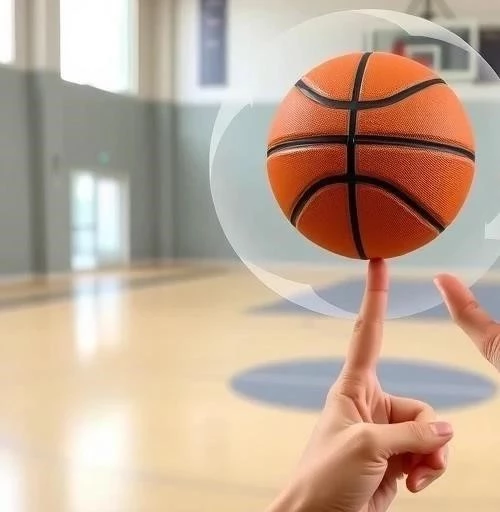
Spinning a basketball on one finger is a balance skill, not a test of strength. The key is to give the ball a steady rotation and keep its center of mass above your fingertip. Although the trick looks effortless when performed well, learning it takes patience and repeated practice. A controlled start is more useful than a hard, wild toss.
Choose and prepare the ball
Use a properly inflated basketball with a clean, dry surface. A ball that is too soft is harder to spin consistently, while a slippery or wet ball can slide off your hand. Begin with a regular basketball rather than a very small novelty ball, since its size helps you feel the balance point. Practice over a clear, soft area, away from furniture and other people.
Learn to create spin
- Hold the ball with both hands at about chest height. Spread your fingers comfortably and keep your wrists relaxed.
- Turn the ball so its seams are visible. Seams can help you guide the motion and locate a stable point, though you do not have to balance exactly on one.
- Use one hand to push the ball upward while the other hand gives it a quick, smooth rotation. A flick from the fingers and wrist creates spin; a forceful shove usually sends the ball off course.
At first, do not try to catch the ball on your finger; Toss it a short distance, let it rotate, and catch it with both hands. Repeat until the spin is consistent. This separates the hardest parts of the trick: generating rotation and balancing the ball.
Find the balance point
Once the toss is controlled, raise your index finger and place its tip under the center of the spinning ball. Keep your finger upright, your elbow slightly bent, and your eyes on the ball’s center. Make small adjustments with your hand beneath it rather than chasing it with large movements. If the ball tilts, guide your finger gently toward the side that is dropping.
Build duration safely
Start by aiming for a brief balance, then gradually increase the time. Practice for a few minutes at a time and take breaks if your wrist or finger becomes uncomfortable. Do not force a painful joint or attempt the trick near someone’s face. If the ball falls, reset calmly; repeated, controlled attempts teach more than risky, powerful throws.
Common mistakes
- Too little spin: the ball wobbles and falls quickly. Add a clean wrist-and-finger flick.
- Throwing too high: a high toss makes the catch difficult. Use a short, predictable lift.
- Stiff hands: tension limits quick corrections. Keep your arm relaxed.
- Watching the wrong spot: focus on the ball’s center, not only on your fingertip.
Master the motion in stages: steady spin, accurate placement, then longer balance. That method works because each repetition improves control without adding unnecessary force. With patient practice, the ball will stay centered for longer—and the trick will look smooth rather than rushed.
3 Comments. Оставить новый
This is a clear, reasoned guide that emphasizes control over force, which is central to learning the skill. The advice to practice a consistent toss before attempting a fingertip balance should help readers identify what needs improvement. The article could be even more useful with a brief note on how to position the fingertip safely, but its overall approach is accessible.
The article gives beginners a sensible way to approach the trick by separating the spin from the balance. That progression makes the task feel manageable, and the reminders about a dry ball and clear practice space add useful practical context. The guidance on making small corrections is especially helpful because it discourages overreacting when the ball starts to tilt.
The instructions are practical and well sequenced, moving from preparation to spin and then balance. I also appreciate that the article frames practice as gradual rather than promising an instant result. Its advice to use gentle adjustments instead of chasing the ball offers a useful principle readers can apply as they build consistency.