
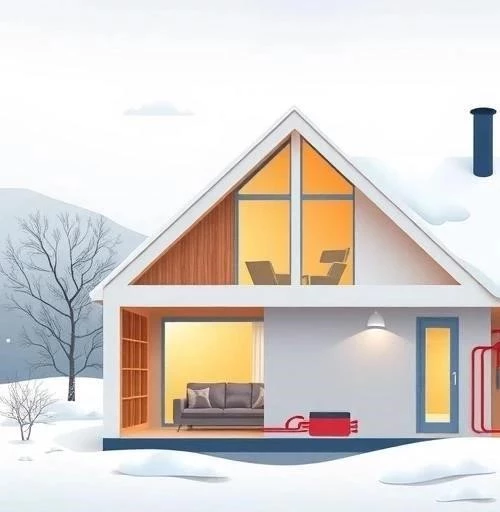
Yes—when a home is well insulated and its heating system is designed for low operating temperatures. Low-temperature heating can improve comfort, reduce energy use and make a house easier to supply with renewable energy. But it is not a universal upgrade: the right choice depends on heat loss, local climate, equipment costs and how the building is used.
What low-temperature heating means
A conventional boiler may heat water to a high temperature, while a low-temperature system delivers useful warmth with cooler water. In practice, heating with a supply temperature of 35–55 °C is common, though the ideal temperature varies. Larger emitters transfer heat more effectively: underfloor water heating is a natural match, while low-temperature radiators may need more surface area than existing ones. Comfort can be steady and even, but the system usually responds more slowly to sudden changes.
Choosing a heat source
A heat pump is often the first option to consider. An air-source heat pump is relatively straightforward to install; geothermal heating can be efficient but typically requires a larger initial investment and site work. A heat pump’s coefficient of performance describes how much heat it delivers per unit of electricity. Seasonal efficiency matters more than a single test figure, so compare performance under your climate conditions of operation.
A condensing boiler can also work efficiently with cooler return water, and may suit homes where a heat pump is impractical. Solar collectors can contribute heat, especially alongside a storage tank or thermal accumulator, but output changes with the season. Solar energy may also power heat-pump equipment. A combined heating system can bring together these sources and a backup heater, provided the controls are designed carefully.
Start with the building
Before replacing equipment, assess the building’s heat loss. Insulation, airtightness, windows and ventilation all affect the heating load. Improving home insulation and adding heat-recovery ventilation can reduce demand, allowing smaller emitters and a lower supply temperature. A passive house requires very little heat, but existing homes can still benefit from staged upgrades.
For an energy-independent home, combining on-site generation, storage and efficient demand management can reduce reliance on centralized networks. Full independence is difficult: winter heat demand may coincide with low solar output, and backup power or another heat source may be needed. Energy-efficient heating is therefore as much about reducing demand as choosing equipment.
Design, controls and costs
A private-house heating system needs correct sizing, hydraulic balancing and weather-compensated controls. Smart heating management can adjust operation to outdoor conditions and household schedules. A buffer tank can stabilize operation in some systems; it is not automatically necessary, since an oversized or poorly configured tank may add heat loss. Thermal energy storage helps shift operation, but its value depends on the system and tariff.
- Calculate heat loss room by room before selecting equipment.
- Check that radiators or floor circuits can meet demand at lower water temperatures.
- Compare installation, maintenance and electricity or fuel costs.
- Ask for seasonal performance estimates, not just headline efficiency figures.
Modernizing a heating system can reduce heating bills, but payback depends on energy prices, installation costs, available incentives and climate. Heating without gas can provide greater independence from centralized networks, though no solution guarantees complete autonomy. Environmentally friendly heating and a smaller carbon footprint are strongest when efficient equipment is paired with a low-carbon energy supply and a well-insulated building.
Low-temperature heating is worth considering when the building and emitters can deliver enough warmth at lower temperatures. First reduce heat loss, then choose and balance the equipment. A properly designed system can improve comfort, support renewable energy and reduce running costs; a poorly sized one may disappoint, whatever its heat source.
Related search terms
низкотемпературное отопление; энергоэффективное отопление; энергонезависимый дом; автономное отопление; тепловой насос; геотермальное отопление; воздушный тепловой насос; солнечные коллекторы; солнечная энергетика; водяной тёплый пол; низкотемпературные радиаторы; температура теплоносителя; отопление с температурой подачи 35–55 °C; конденсационный котёл; буферная ёмкость; тепловой аккумулятор; система отопления частного дома; гидравлическая балансировка; погодозависимая автоматика; умное управление отоплением; теплопотери здания; теплоизоляция дома; энергоэффективность здания; возобновляемые источники энергии; комбинированная система отопления; снижение расходов на отопление; отопление без газа; независимость от централизованных сетей; сезонная эффективность; коэффициент преобразования теплового насоса; модернизация отопительной системы; климатические условия эксплуатации; окупаемость системы отопления; экологичное отопление; пассивный дом; накопление тепловой энергии; вентиляция с рекуперацией тепла; снижение углеродного следа.




1 Comment. Оставить новый
A clear, useful overview that rightly puts the building’s heat loss before the choice of heating equipment. The distinction between heat-pump performance and seasonal efficiency is especially helpful, as is the reminder that low-temperature systems may need larger radiators or more gradual temperature adjustments. A practical starting point for homeowners comparing options.