
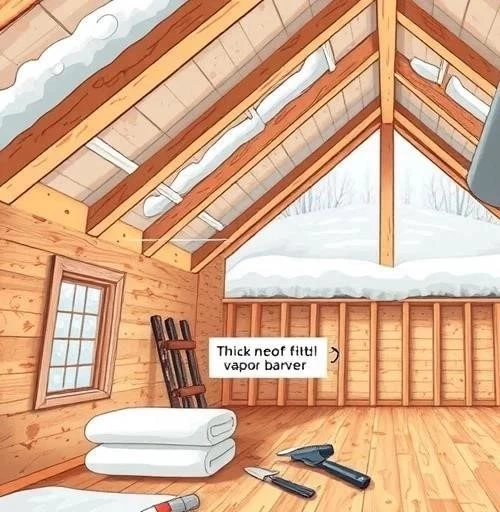
In the North, a ceiling is not merely the room’s lid; it is a quiet border between a warm home and a sky that can feel like an open freezer. Smart ceiling insulation can reduce heat loss, ease the burden on home heating and improve energy efficiency. The trick is to spend carefully where performance matters, rather than simply buying the thickest product on the shelf.
Choose the assembly before the insulation
First identify what lies above: a cold attic, another heated room, or the roof itself. For a cold attic, insulating the floor—ceiling joists—is often cheaper than insulating the roof slopes. This approach to insulating floors and ceilings uses less material and leaves the attic accessible. In a pitched roof, however, the whole assembly must be designed together: insulation, vapor barrier, waterproofing and ventilation gap all have distinct jobs.
Buy for climate, not for the label
Mineral wool is a dependable, fire-resistant option and fits neatly between wooden beams. Cellulose insulation, or “ecowool,” can fill awkward cavities with fewer gaps when professionally blown in. Expanded polystyrene may suit some flat or masonry ceilings, but it needs a suitable fire-safe design. Compare the full installed cost, not just the price per pack: cutting waste, delivery and extra framing can turn an apparent bargain into an expensive one.
Choose insulation thickness for your climate zone and local building rules. If the budget is tight, insulate the attic hatch and perimeter first, then add layers when funds allow. A modest, continuous layer is usually better than a thick blanket interrupted by cold bridges. A foil-faced insulation product can help when correctly installed, but reflective foil is not a substitute for adequate insulation or an air space where the system requires one.
Keep moisture out of the wrong places
Warm indoor air carries moisture. A well-sealed vapor barrier on the warm side helps prevent it from reaching cold layers, where the dew point may turn it into condensation. Waterproofing protects against leaks from outside; it does not replace vapor control. Seal joints, edges, pipes and wiring carefully. This seam sealing is inexpensive, yet it can prevent drafts, damp insulation and costly repairs. Preserve the specified ventilation gap so moisture can escape instead of being trapped.
Save on labor without building in trouble
- Measure joist spacing and ceiling area before ordering; buy only a small cutting allowance.
- Do demolition, cleaning and simple air sealing yourself, but ask a specialist to check complex roof details.
- Never compress soft insulation or block eaves ventilation to save a few sheets.
- Inspect for leaks and wiring hazards before covering the ceiling.
During ceiling installation, continuous coverage matters more than fancy finishes. Careful planning, sound moisture control and a sensible material choice make a budget renovation warmer, support a healthy indoor microclimate and protect the structure from freezing. The best economy is not the cheapest ceiling today, but a durable one that keeps heat indoors for many winters.



6 Comments. Оставить новый
A refreshingly budget-aware guide: it points toward sensible first steps rather than demanding a perfect renovation all at once. The ceiling may be out of sight, but the savings—and the comfort—won’t be.
The distinction between a cold attic and an insulated roof is especially helpful. Before buying materials, it pays to ask what the space above the ceiling is meant to be—storage, shelter, or simply a very cold hat for the house.
A useful reminder that “thicker” is not automatically “smarter.” Continuous coverage sounds less glamorous than a mountain of insulation, but cold bridges are patient little escape artists.
The strongest idea here is that insulation is a system, not a fluffy product in a bag. The attic hatch gets its moment in the spotlight—and rightly so: a tiny, neglected door can behave like a chimney for expensive heat.
This is practical without pretending every home has the same anatomy. I’d welcome an accompanying checklist for spotting air leaks and checking ventilation, since the quiet details often matter as much as the insulation itself.
I like the article’s “buy for climate, not for the label” approach. It treats the ceiling less like a shopping problem and more like a small piece of building science, where gaps and moisture can undo an otherwise generous layer.