
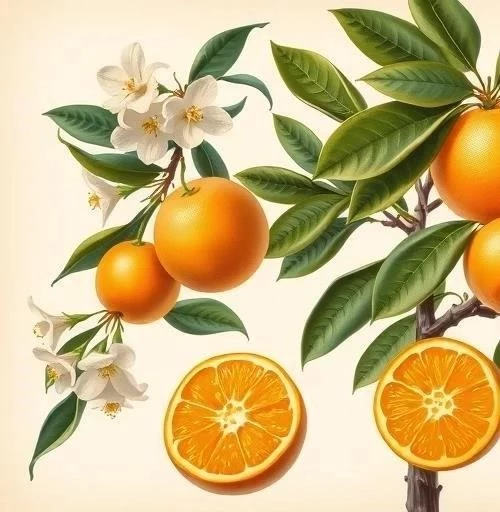
An ancient citrus hybrid
The sweet orange, known scientifically as Citrus sinensis, did not arise as a completely separate wild species. It is generally understood to be an ancient hybrid of the mandarin (Citrus reticulata) and the pomelo (Citrus maxima). The exact circumstances of its formation are unknown. The two parent citrus plants contributed different characteristics: the mandarin is associated with sweetness and orange colour, while the pomelo helped provide larger fruit and abundant juice.
This origin reflects a wider pattern in citrus evolution. Many familiar citrus fruits have complex histories involving natural cross-pollination, repeated hybridisation and human cultivation. Their names and present-day varieties can therefore conceal relationships that are not obvious from appearance alone. The sweet orange is one particularly successful result of this long process.
Where and when it developed
Historical and botanical accounts associate the orange’s early cultivation with China. Reports commonly place it there by around 2,500 years ago, although the dates attached to early citrus cultivation vary among sources. The fruit was valued for its flavour and usefulness, and generations of growers selected trees with desirable qualities. This gradual selection helped establish cultivated oranges as a dependable food crop rather than a chance hybrid.
As cultivation expanded, people moved orange trees and fruit along trade routes. Citrus plants could be propagated by planting seeds or by grafting, a technique that allows growers to reproduce trees with particular characteristics. The movement of plants and knowledge carried oranges beyond their early growing regions. Over centuries, cultivation spread through parts of Asia, the Middle East and the Mediterranean world.
From a regional fruit to a global crop
Oranges became known in Europe through contact with Asian and Middle Eastern trade networks. Their spread was gradual, and different types of orange were introduced at different times. Warm climates suited the trees best, so commercial growing developed especially in tropical and subtropical regions. Later, maritime trade and migration brought citrus plants to additional parts of the world, where local climates and farming practices shaped new orchards.
The orange’s history is therefore not a single event or a story of one person deliberately creating a fruit. It began with hybridisation between related citrus plants and continued through cultivation, selection and exchange. Natural cross-pollination could produce new combinations, while growers preserved and multiplied trees that gave useful fruit. These processes unfolded over many generations.
Why the orange became so familiar
The fruit combines several practical qualities: it is juicy, has a sweet-tart taste, and its peel offers some protection during handling and transport. These features helped make it useful as both fresh food and an ingredient. Today, oranges are grown in many warm regions and appear in numerous cultivars, which differ in size, sweetness, colour, seed content and season.
In brief, the orange came about through the ancient hybridisation of mandarin and pomelo, probably in Asia, followed by long-term cultivation and movement between regions. Its present-day prominence is the result of both biological inheritance and human choices: people carried the trees, selected varieties and established orchards wherever growing conditions allowed.


1 Comment. Оставить новый
The article gives a clear overview of the sweet orange’s hybrid origins and the spread of its cultivation. It also appropriately notes that some details, including early dates, vary across historical accounts.