
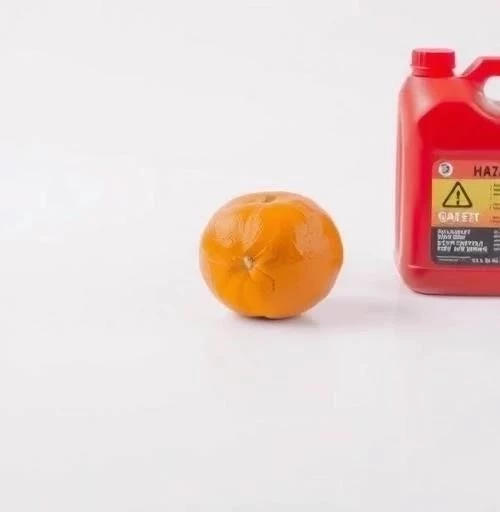
Short answer: Mixing orange juice with gasoline does not create a new explosive or magically turn the liquid into napalm. It does, however, leave you with a dangerously flammable, contaminated mixture that can release harmful vapors. Do not try this as an experiment. If the liquids have already been combined, keep people away and treat the situation as a fuel spill.
What is in each liquid?
Gasoline is a complex blend of volatile hydrocarbons. It evaporates readily, and its vapor can ignite from a flame, spark, hot surface, or other ignition source. Orange juice is mostly water, with natural acids, sugars, and small amounts of pulp and aromatic compounds. These ingredients have very different properties from gasoline.
Because gasoline and water do not mix uniformly, the liquids will generally separate into layers after being combined. Shaking may make the mixture look cloudy or temporarily dispersed, but it does not make the liquids permanently compatible or chemically transform them. Pulp and other solids may also remain suspended for a while and then settle. The exact appearance depends on the products and conditions, but appearance is not a reliable way to judge safety.
Does the mixture become explosive?
No special explosive reaction occurs simply because orange juice and gasoline meet. The juice does not supply a mechanism that makes the gasoline detonate, and mixing ordinary food ingredients with fuel does not create a dependable explosive. That distinction does not mean the mixture is safe: gasoline itself is a serious fire hazard. Its vapors can travel and ignite at a distance, while a spill can spread fuel over surfaces and make an accidental fire more likely.
Online claims that orange juice and gasoline can be turned into napalm are misleading and should not be treated as instructions or reliable chemistry. A movie scene, viral post, or dramatic demonstration is not proof of what a mixture can do. Do not attempt to thicken, ignite, heat, or otherwise modify gasoline. Such experiments can cause severe burns, poisoning, fires, or death, and may be illegal.
Why is it dangerous even without a reaction?
- Fire and vapor: Gasoline vapors are highly flammable. A nearby ignition source can start a fire, and flames may spread quickly.
- Breathing and contact: Vapors can cause headache, dizziness, nausea, or irritation. Fuel can irritate skin and eyes; swallowing it can cause serious injury, especially if it enters the lungs.
- Contamination: The juice is no longer food, and the fuel is no longer suitable for ordinary use. Do not taste, drink, or reuse either liquid.
- Environmental harm: Gasoline can contaminate soil and water. Never pour the mixture into a sink, toilet, storm drain, or onto the ground.
What should you do if it has happened?
Do not shake the container, move it unnecessarily, or try to separate the liquids. Keep flames, smoking, engines, and other possible ignition sources away, and do not handle the mixture in an enclosed space. If there is a noticeable spill, strong odor, or any concern about fumes, move away to fresh air, keep other people and pets clear, and contact your local fire department or hazardous-materials service for advice. Do not put the mixture in household rubbish or take it to a collection point unless the service specifically tells you how to transport it.
If fuel gets on skin, remove contaminated clothing and wash the area with soap and water. If it gets in the eyes, rinse gently with clean water and seek medical advice. Anyone who feels unwell after breathing vapors should get to fresh air and contact emergency services or a poison-control center. If gasoline is swallowed, seek urgent medical help; do not induce vomiting.
The takeaway
Orange juice and gasoline do not combine to produce a special explosive. They form an unpredictable, contaminated mixture, while the gasoline remains highly flammable and hazardous. The safest “experiment” is not to perform it: learn about liquids and flammability through supervised demonstrations using materials designed for classroom use, never fuel or improvised mixtures.



5 Comments. Оставить новый
I appreciate the straightforward correction of the online claims and the reminder not to experiment with gasoline.
Concise and informative. The distinction between an explosive reaction and an ordinary but serious fuel hazard is valuable.
A helpful, responsible overview that avoids sensationalizing the topic while still taking the danger seriously.
Clear, practical explanation that separates the chemistry from the real fire hazards. The safety warning is especially useful.
The explanation of why the liquids separate is easy to follow, and the caution about vapors makes the risks clear.