
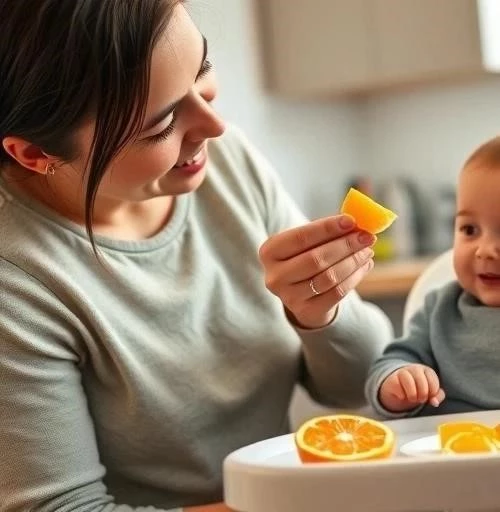
Most babies can try orange when they are developmentally ready for solid foods, usually at about 6 months. It is generally not recommended to start solids before 4 months. Readiness matters as well as age: a baby should be able to hold their head steady, sit upright with support, reach for food and swallow it rather than push it out with the tongue; If these skills are not yet present, wait and ask a health professional if you are unsure.
How to offer orange safely
For a first taste, wash the fruit, remove the peel and all seeds, and offer a small amount of soft fruit. You can mash it or mix a little pulp into a familiar food, such as plain porridge. As your baby develops chewing and handling skills, offer soft, age-appropriate pieces while they sit upright and are closely supervised.
Orange segments can be slippery, and their membranes may be difficult for a baby to manage. Do not give a whole orange, a round slice, or an intact segment to a young baby. Remove tough membranes and any seeds, and cut the fruit in a way that matches your child’s eating skills. There is no single shape that is right for every age: follow current local guidance on safe food sizes, and check with a pediatrician or feeding specialist if your baby has difficulty chewing or swallowing.
How much is enough?
Begin with a small taste and let your baby decide whether to eat it. There is no need to persuade them to finish a portion. Breast milk or infant formula remains the main source of nutrition during the first year; complementary foods gradually add variety and nutrients. Orange can be part of a varied diet, but it does not need to be given every day.
Whole fruit is preferable to juice. In general, fruit juice is not recommended for children under 12 months unless a health professional advises it. Juice is less filling than whole fruit and can expose teeth to frequent sugar and acid. Do not put juice in a bottle or use it instead of breast milk or formula.
Acidity, irritation and allergy
Orange is acidic. Some babies may develop temporary redness around the mouth or on the skin where juice has touched it. This can be irritation rather than a food allergy. Wipe the skin gently and stop offering the fruit if the reaction is uncomfortable or keeps returning; seek medical advice if you are concerned.
A true allergic reaction can include hives away from the area of contact, swelling of the lips or face, repeated vomiting, coughing, wheezing or difficulty breathing. Seek urgent emergency help for breathing problems, collapse, or swelling of the tongue or throat. If symptoms appear after eating, stop feeding and contact a healthcare professional for advice. A known food allergy or a history of severe reactions is a reason to discuss introduction with your child’s clinician.
Practical tips for the first serving
- Offer orange when your baby is well and alert, seated upright, and watched by an adult.
- Start with a small amount of plain fruit; avoid added sugar, honey and concentrated juice.
- Introduce it in a form your baby can manage, and do not leave pieces within reach when unattended.
- If your baby refuses it, try again another day without pressure.
In short, many babies can have a small amount of safely prepared orange at around 6 months, once they are ready for solids. The safest texture depends on the individual child’s development. For advice tailored to prematurity, feeding difficulties, growth concerns or medical conditions, consult a pediatrician.
2 Comments. Оставить новый
The article gives a clear overview of when and how to introduce orange, with useful reminders about readiness and supervision. Its emphasis on whole fruit over juice is also helpful.
The guidance is practical and measured, especially regarding texture, seeds, and individual feeding skills. Consulting a health professional when there are feeding concerns is a sensible inclusion.