
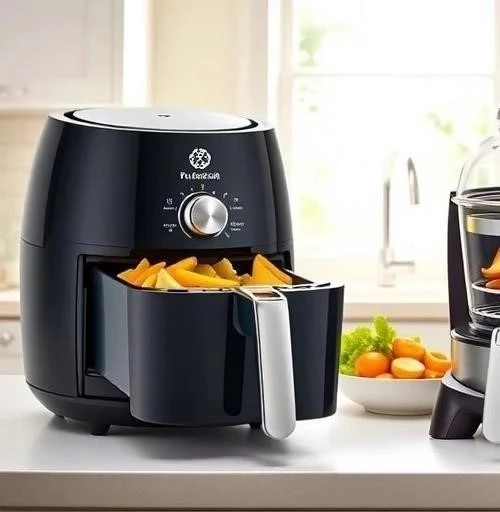
Both appliances promise crisp food with less oil than deep-frying, and both cook by circulating hot air. That similarity makes the choice confusing: in some product listings, “air grill” and “air fryer” describe almost the same kind of appliance. In others, they refer to different designs. The best choice therefore depends less on the name and more on the appliance’s construction, capacity, and the meals you plan to make.
How they work—and why the names overlap
An air fryer usually has a heating element and a fan that move hot air around food in a compact cooking chamber. Many models use a pull-out basket; others are oven-shaped and have shelves. The concentrated airflow helps brown the outside of foods such as potatoes, vegetables, or chicken. Despite the word “fryer,” it does not deep-fry food: a small amount of oil may improve browning, but a bath of oil is not required.
Traditionally, an air grill is a round, often glass bowl with a lid containing a heater and fan. Food sits on a rack inside, and the hot air circulates around it. This design can make it easy to see the food cooking, while the bowl may provide more room for certain whole cuts or dishes. However, modern appliances sold as air grills can look and work much like air fryers. The labels are not applied consistently, so compare the actual specifications rather than assuming the name guarantees a particular function.
Key differences at a glance
| Feature | Air fryer | Traditional air grill |
|---|---|---|
| Typical design | Basket or oven-style chamber | Glass bowl with a lid and rack |
| Best-known strength | Quick, convenient portions and crisp results | Flexible cooking in a spacious, visible bowl |
| Practical consideration | Basket size and usable cooking area matter | The bowl may take more counter and storage space |
| Cleaning | Basket and accessories need washing | The bowl and rack can be bulky to handle and clean |
When an air fryer is the better choice
Choose an air fryer if you want a straightforward appliance for everyday sides, snacks, and modest portions. A basket model is often easy to load, shake, and unload, and its compact cooking chamber can heat food efficiently. An oven-style model may suit you better if you need shelves or want to cook several items at once. Either way, check the usable capacity: the advertised volume does not necessarily tell you how much food can be spread out in a single layer. Overcrowding restricts airflow and can leave food less evenly browned.
An air fryer is also a sensible option for someone who values simple controls and a small footprint. But a small basket can be inconvenient when cooking for a large household, because food may need to be prepared in batches. If you mostly cook soups, stews, or other moist dishes, neither appliance is a replacement for a pot or multicooker.
When an air grill makes more sense
A traditional bowl-style air grill may be preferable if you like the see-through cooking chamber, want to use racks, or often prepare larger pieces of food. Its open interior can offer flexibility, though the real advantage depends on the bowl’s dimensions and included accessories. The trade-off is that a glass bowl can be heavy, take up storage space, and require more effort to wash than a removable basket. Do not assume that every air grill has a larger usable capacity: compare dimensions and the manufacturer’s recommended load.
Taste, health, and energy use
Neither appliance automatically makes food healthy. Both can reduce the need for added oil compared with deep-frying, but the result still depends on ingredients, portions, and cooking habits. Taste is also influenced by the recipe and the appliance’s airflow, not simply by whether the product is called a grill or a fryer. For reliable browning, arrange food with space around it, turn or shake it when appropriate, and follow the recommended temperature.
Both devices may be convenient for smaller meals, but energy savings are not guaranteed. They depend on cooking time, portion size, appliance power, and whether a conventional oven would otherwise be used. Compare power ratings and capacity, and consider how often you will cook rather than relying on a general promise of lower energy use.
Verdict: which should you buy?
For most people seeking quick, crisp everyday meals, an air fryer is the more practical default—especially a model sized for the household. Pick an air grill if you specifically prefer its bowl-and-rack format, visibility, or flexibility for larger items, and have room to store it. Since the categories overlap, the fairest comparison is between individual models: check the cooking surface, accessories, temperature range, cleaning requirements, and dimensions. In short, there is no universal winner; the better appliance is the one whose usable space and design match the food you actually cook.

4 Comments. Оставить новый
The comparison is useful because it connects each design to everyday considerations, such as cooking space and cleaning. I also appreciate the clarification that an air fryer uses circulating hot air rather than deep-frying food.
The article clearly explains why “air fryer” and “air grill” can be confusing labels. Its advice to compare the appliance’s design and specifications, rather than relying on the name, is especially practical for shoppers.
The article strikes a helpful balance between describing traditional designs and acknowledging that modern products may blur the distinction. That caveat makes the guidance more reliable than a simple comparison based only on appliance names.
The table makes the main differences easy to scan, while the surrounding explanation adds useful context about capacity, visibility, and storage. The focus on choosing according to intended meals and available space gives readers a sound basis for comparing models.