
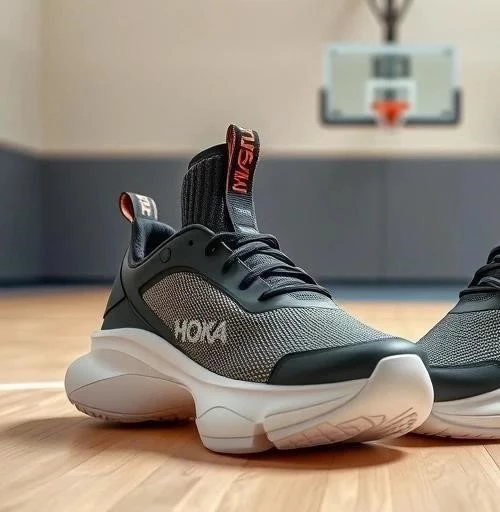
Basketball footwear usually arrives with a promise of grip, lockdown, and enough side-to-side support to survive a sudden change of direction. Hoka arrives from a different landscape: long roads, steep trails, and runners who want generous cushioning beneath every mile. So what happens when the mountain-cloud philosophy meets the hardwood? The short answer is intriguing, but important: Hoka is not a dedicated basketball-shoe brand. Its popular running and lifestyle models may appeal to basketball players, yet they are not designed to replace purpose-built court shoes.
That distinction matters more than the thickness of a midsole. Basketball asks a shoe to brake, pivot, jump, and land at angles that road running rarely demands. A sneaker can feel delightfully soft during a walk and still feel unstable when a defender cuts across your path. This review looks at what Hoka does exceptionally well, where its designs may fit a player’s life, and why the court is a stricter judge than the sidewalk.
The Hoka idea: cushioning with a silhouette
Hoka’s signature look is hard to miss: sculpted midsoles, a broad platform, and a rocker-shaped profile that encourages a smooth roll from heel to toe. In running, that combination can make long efforts feel less punishing. On a basketball court, it offers a different sensation. The landing can feel plush and protective, especially to someone accustomed to firm, low-profile shoes. The rocker, however, may also make quick, flat-footed transitions feel less natural. Basketball players do not always want their feet gently ushered forward; sometimes they need to plant and stop right now.
Think of Hoka as a comfortable touring vehicle, not a purpose-built race car. Its cushioning is a genuine strength, and the brand makes several shoes that feel inviting for daily wear, warm-ups, recovery, and travel to the gym. But a basketball shoe is a piece of movement equipment. Its job is not simply to soften impact; it must help the foot stay controlled inside the shoe while the body changes direction.
What to expect from the popular models
- Bondi: The plushest-feeling choice in Hoka’s familiar road-running family. Its generous cushioning may appeal to people who spend long hours standing or want an easy recovery-day shoe. On court, the tall, soft platform can feel disconnected during lateral cuts, and its bulk is not an advantage in a fast game. Treat it as a comfort shoe, not a basketball recommendation.
- Clifton: Lighter and more versatile than the Bondi, with a smoother ride that suits everyday walking and running. It may be the more tempting Hoka for a casual shootaround, but it still lacks the specific containment and traction design expected of a real court model. A few relaxed shots are different from full-speed play.
- Mach: A more energetic running option, often appreciated for a lively feel. That liveliness can make it enjoyable for general training, yet running responsiveness is not the same as lateral stability. Do not assume a quick road shoe is automatically ready for defensive slides.
- Kawana and other training-oriented styles: A broader base or gym-friendly intent may make some models feel more planted during ordinary workouts. Still, check the exact model and outsole rather than relying on the Hoka name. Training shoes can handle many gym routines without being built for basketball’s repeated pivots.
Grip, support, and the sideways test
Traction is the first question to ask before taking any running shoe onto a polished floor. Basketball outsoles are designed around quick starts, abrupt stops, and changes in direction; running outsoles prioritize forward motion and mileage. Tread patterns, rubber compounds, and contact with the floor all matter. A shoe that grips well on pavement may behave differently on a dusty court. If you try a Hoka for light recreation, test it gently on a clean surface first. Any slipping, twisting, or uncertain footing is a clear reason to stop.
Next comes containment. During a lateral cut, the foot can push against the shoe’s sidewall. Basketball shoes commonly use supportive uppers, secure lacing, and shapes intended to help the foot stay centered over the platform. Hoka running models are engineered around a runner’s stride, not necessarily around those sideways forces. A soft ride can feel luxurious in a straight line while offering less confidence when the game becomes unpredictable.
Then there is stack height: the amount of material between your foot and the floor. Extra cushioning may ease the sensation of landing, but a higher platform can feel less connected and may increase the feeling of wobble for some players. This is not a verdict that high-cushion shoes are inherently unsafe; fit, balance, court, and movement all matter. It is a reminder to judge the whole shoe, not just the inviting softness under the heel.
Who might enjoy Hoka around basketball?
Hoka makes the most sense for the basketball fan whose main need is not a full game shoe. If you walk to the gym, coach from the sideline, stand through a tournament, or want cushioned footwear for daily errands, the brand’s comfort-first approach can be appealing. A player returning from a tough week may also value a separate Hoka pair for recovery walks. In that role, the shoes can support a basketball routine without being asked to perform basketball’s sharpest movements.
For casual, low-intensity shooting, some people may find a Hoka model comfortable. But be honest about the activity: stationary shots and relaxed warm-ups are not equivalent to pickup, league play, or competitive practice. If you are making hard cuts, contesting rebounds, or defending a quick guard, choose footwear specifically designed for court sports. A shoe should not have to prove its worth by putting your ankles and footing to an unnecessary test.
Fit and sizing: comfort is personal
Hoka sizing varies by model, and a roomy-looking shoe does not guarantee a secure fit. Try shoes on with the socks you play in, check that your heel does not lift, and make sure your toes have space without your foot sliding from side to side. Laces should hold the midfoot comfortably, not require painful tightening to create security. If you use orthotics or have a particular foot concern, consult a qualified footwear specialist. A review cannot replace an in-person fitting.
Also consider the court surface and your own movement. A shoe that feels stable while standing may feel entirely different after a few controlled shuffles. Test any unfamiliar footwear gradually, and never ignore discomfort, slipping, or a sense that your foot is moving inside the shoe. The right fit is not merely cozy; it should feel predictable when you move.
Verdict: excellent comfort, wrong job description
Hoka’s strengths are real: cushioning, a distinctive rolling ride, and models that many people enjoy for running, walking, and everyday comfort. Those qualities may make its shoes attractive to basketball players outside the game. But there is no magic transformation from a running outsole into a basketball outsole, and the brand’s familiar road models should not be mistaken for dedicated court shoes. Grip, lateral containment, and low, controlled movement deserve priority when the ball is live.
Bottom line: Buy Hoka if you want a comfortable companion for the walk to practice, recovery days, or daily miles. For actual basketball, shop for a shoe built for the court and try it with your own footwork in mind. The best basketball shoe is not necessarily the softest one. It is the one that lets you stop, pivot, and take off with confidence. Hoka may bring a little cloud to your commute; for the game itself, make sure your feet are planted on something designed for the storm.
5 Comments. Оставить новый
This is refreshingly practical: Hoka can still have a place in a basketball player’s routine without being asked to perform a job it was not built for. Warm-ups, recovery, and the journey home are part of the game-day orbit too.
The rocker-shaped sole sounds almost like a tiny conveyor belt for your stride—helpful on a long run, perhaps less welcome when you need to freeze, pivot, and launch. A thoughtful look at how a shoe’s personality changes with the setting.
The “touring vehicle, not a race car” comparison gives this shoe question a memorable shape. It also makes the central point land: comfort on the way to the gym is not the same as confidence when the game suddenly changes direction.
I like that the article treats the court as a different kind of terrain rather than assuming more cushioning automatically means better performance. That distinction could save a hopeful player from mistaking a cloud-soft landing for reliable lateral support.
A useful reminder that a plush midsole is only one instrument in the orchestra of court movement. I’d be curious to see the discussion paired with hands-on tests of stopping, cutting, and landing—but the cautionary framework is already strong.