
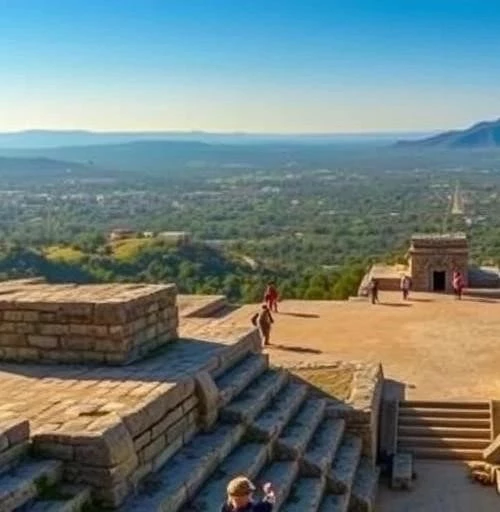
Perched above the Oaxaca Valley‚ Monte Albán is far more than a dramatic hilltop view. This archaeological complex was the heart of an ancient Zapotec city and a powerful centre of the Zapotec civilization. Its location in the state of Oaxaca made it possible to oversee routes through the valley‚ while its monumental design expressed political authority‚ spiritual beliefs and skilled engineering. For anyone curious about pre-Columbian Mexico‚ the site offers a vivid introduction to Mexican archaeology and the cultural heritage of Mexico.
Read the landscape‚ not just the ruins
Begin at the ceremonial plaza and take time to notice how the surrounding ancient pyramids frame the open space. Stone stelae preserve carved figures and signs whose meanings are still debated. The ball court‚ terraces and platforms reveal how public ritual and everyday life met in one carefully planned setting. Monte Albán is a UNESCO site‚ but its importance is not only its international status: it is a remarkable expression of Mesoamerican culture‚ shaped over centuries by people who built‚ adapted and used this mountain city.
Make the visit more meaningful
A Monte Albán tour with an archaeological-complex guide can bring context to details that might otherwise seem abstract. Ask about the changing interpretations of the carvings‚ the purpose of the structures and the evidence for daily life. The Zapotec tombs‚ some richly decorated‚ offer further clues about social status and beliefs about death. Respect barriers and fragile remains; responsible cultural tourism helps protect the place for future visitors and local communities.
For a fuller picture of the history of Oaxaca‚ continue at the Oaxaca Museum‚ where objects from the region connect the site to wider stories. If you prefer a slower pace‚ choose Oaxaca tours that include time in nearby communities rather than rushing between landmarks. The best places in Oaxaca are not limited to famous ruins: craft markets‚ Mexican villages and the city’s lively streets show how local culture continues to evolve.
Go beyond the viewpoint
Monte Albán is an excellent starting point for exploring Zapotec traditions‚ but living culture should never be treated as a museum exhibit. Buy directly from makers at craft markets‚ learn about their work respectfully‚ and try Oaxacan cuisine at family-run restaurants. These encounters offer a more thoughtful immersion in Mexican culture than simply collecting photographs. They also support local livelihoods and encourage visitors to listen as well as look.
For travellers planning what to see in Oaxaca‚ combine the archaeological complex with markets‚ neighbourhoods and lesser-known places in Mexico’s southern highlands. Leave room for conversation and unhurried discovery. Such a journey reveals authentic Mexico not as a single image‚ but as a region of many voices‚ histories and tastes. Monte Albán makes the past visible; the surrounding communities help explain why it still matters. Together‚ they make travel through Mexico a richer experience and turn historical attractions in Mexico into a genuine connection with place.

8 Comments. Оставить новый
The emphasis on respecting barriers and fragile remains is well placed. Popular sites can be damaged by careless visits, so the article’s link between responsible tourism and preservation gives its practical advice real importance.
The discussion of the Zapotec tombs adds an important dimension to the visit. Connecting burial practices with beliefs about death and social status helps readers appreciate that the site offers evidence about people and customs, not only architecture.
The article makes a convincing case for looking beyond the dramatic views at Monte Albán. Its advice to study how the plaza, platforms and ball court relate to one another helps readers understand the site as a planned civic and ceremonial centre, rather than a collection of isolated ruins.
The suggestions to ask a guide about the structures and evidence for daily life are useful. They encourage visitors to connect what they see with archaeological research, making a tour more informative than simply moving from one monument to the next.
I like the recommendation to visit the Oaxaca Museum for a broader understanding of the region. Placing objects in context can complement the experience of seeing the ruins and help explain how Monte Albán fits into the wider history of Oaxaca.
I appreciate the article’s careful wording about the carved signs and figures, whose meanings are still debated. Acknowledging uncertainty is important in archaeology and avoids presenting current interpretations as settled fact.
The article’s suggestion to leave time for nearby communities is thoughtful. It presents travel as an opportunity to learn about living culture as well as ancient history, while discouraging a rushed itinerary focused only on famous landmarks.
This is a useful introduction for first-time visitors because it combines historical context with practical guidance. The strongest point is that understanding the landscape and the site’s changing interpretations can make the visit more meaningful than relying on its UNESCO status alone.