
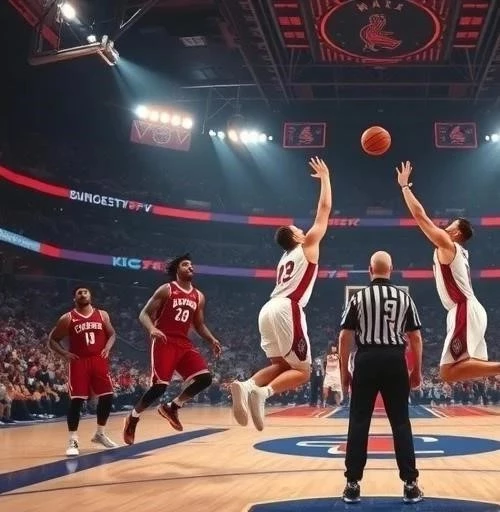
A basketball game does not begin with a shot. It begins with a small circle‚ a polished ball‚ and ten players pretending not to feel the whole arena watching them. Then a whistle cuts through the noise‚ the ball rises‚ and the court turns from a diagram into a contest.
Before the whistle: setting the stage
Long before the opening play‚ both teams warm up‚ take practice shots‚ and test their legs with quick sprints. Coaches make final adjustments; officials check the court‚ the game clock‚ and the ball. Players’ uniforms and equipment must meet the rules‚ and the scorer’s table records the starting line-ups. In professional games‚ introductions‚ music‚ and lights may turn this preparation into a show. In a school gym‚ the ceremony might be only a referee’s nod. Either way‚ the same game is waiting underneath.
The teams take their places. Each side sends one player—the center‚ most often—to the center circle. The other players arrange themselves around it‚ ready to sprint toward whichever direction the first touch sends the ball. The referee stands between the two jumpers with the ball held at chest height. For a moment‚ the court seems to hold its breath.
The opening tip
At the start of most games‚ play begins with a jump ball‚ commonly called the opening tip. The referee tosses the ball straight upward between the two opposing jumpers. They leap and try to tap it to a teammate. They are not meant to catch it or slap it repeatedly; the aim is a clean first touch that sends the ball into play.
The toss is not a ceremonial flourish: it is the first tactical problem of the night. A taller jumper may reach higher‚ but timing and direction matter just as much. A player can guide the ball backward to a guard‚ who catches it and begins the offense—or redirect it into open space‚ making the first few seconds a race. Teammates must stay outside the center circle until the ball is tapped‚ and the jumpers must follow the referee’s instructions about where to stand and when to jump. If the toss is poor‚ or the rules are broken‚ the official can call another jump ball.
The instant a jumper legally touches the ball‚ the game clock starts. Once a team controls it‚ the shot clock begins its countdown‚ urging that team to attack rather than hold the ball. A successful tip does not count as a point: scoring still requires the ball to pass through the hoop. But that first touch can decide who gets the first possession‚ the first chance to score‚ and the first chance to set the emotional tempo.
One beginning‚ different rulebooks
In FIBA competitions‚ the opening jump ball is followed by an alternating-possession system for later held-ball situations and most subsequent periods. A possession arrow at the scorer’s table shows which team receives the next such possession. The NBA uses jump balls in some held-ball situations and at the start of overtime‚ so the precise procedure depends on the league. The opening tip‚ however‚ remains a familiar sight across basketball: two rivals rise‚ one ball hangs briefly in the air‚ and the game chooses its first direction.
What to watch for
- The toss: Is it high and straight enough for a fair contest?
- The tip: Does the jumper direct the ball toward a teammate?
- The first receiver: Can that player secure possession and organize the attack?
- The transition: Does the winning team move quickly‚ or does the defense get set?
So a basketball match begins not with the scoreboard changing‚ but with a coordinated burst of timing: a whistle‚ a vertical leap‚ a fingertip’s redirection‚ and ten players reacting at once. The opening tip is a miniature version of the whole sport—height meets anticipation‚ teamwork meets improvisation‚ and a ball in the air becomes a promise that anything can happen next.
2 Comments. Оставить новый
This piece makes the opening tip feel like a tiny launch sequence: ten players, one ball, and a whole game waiting for gravity to make its decision. The contrast between a polished professional spectacle and a quiet school-gym nod gives the scene real warmth.
The strongest idea here is that the tip-off is not merely tradition but the first tactical puzzle. Height, timing, and teamwork all arrive before the scoreboard has anything to say—a neat reminder that basketball’s drama begins in the smallest details.