
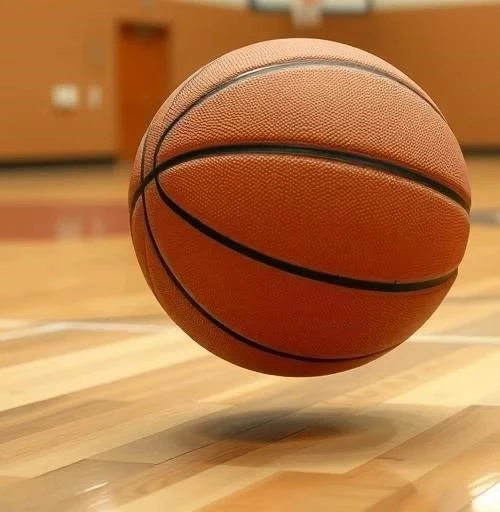
A basketball should rebound predictably, rise to a useful height, and travel in a consistent direction after it strikes the floor. It should not feel unusually hard or soft, wobble through the air, or lose most of its rebound after one bounce. The exact height depends on the ball, its inflation, the floor, and the way it is dropped, so there is no single rebound height that applies to every ball and situation.
What a normal bounce looks like
When a properly inflated ball is released vertically onto a hard, level court, it should rebound almost straight upward. Its first rebound should be strong and controlled, and later rebounds should become progressively lower as energy is lost. A ball that barely rises may be underinflated, damaged, or landing on a soft surface. A ball that feels excessively firm and rebounds very high may be overinflated.
On a pass or dribble, the rebound is affected by the angle and speed of the ball as well as the player’s force. A dribble is not expected to return to precisely the same height every time. However, a consistent ball should respond in a repeatable way when it is pushed down with similar force on the same surface.
Pressure and manufacturer guidance
Inflation pressure is a major factor in bounce. Too little air makes the ball feel soft, slows its rebound, and can make dribbling less predictable. Too much pressure makes it feel hard, can cause a sharper rebound, and may increase stress on the ball’s panels and seams. Use a pressure gauge and follow the pressure range printed on the ball or given by its manufacturer. Do not rely only on squeezing it by hand: feel is subjective and cannot measure pressure accurately.
Some competition rules specify both an inflation range and a drop test. The prescribed pressure and rebound height differ among organizations, ball sizes, and rule sets. For that reason, a test result should be compared with the requirements for the particular ball rather than treated as a universal standard. A ball intended for a child’s game may also have different specifications from an adult competition ball.
How to check the rebound
- Check the ball for visible damage, uneven seams, or a distorted shape. Make sure it is the right size and type for the intended use.
- Measure its pressure with a suitable gauge and adjust it according to the manufacturer’s instructions. Moisten the needle before inserting it, and avoid forcing it into the valve.
- Choose a flat, hard surface similar to the court where the ball will be used. Carpet, grass, and some outdoor surfaces absorb energy and produce a lower bounce.
- Hold the ball at a consistent, measured height and release it without pushing, spinning, or throwing it. Observe the first rebound and repeat the test to see whether the result is consistent.
A drop test is most useful when the height, surface, and release method are controlled. Dropping the ball from different heights or onto different floors can make comparisons misleading. If an official test is required, follow the relevant rulebook’s exact procedure and measurements.
Why the floor and ball material matter
A basketball does not bounce in isolation. A sprung wooden court, a concrete outdoor court, and a cushioned or dusty floor interact with the ball differently. A clean, dry playing surface generally gives a more dependable response than a wet or dirty one. Indoor and outdoor balls may also use different cover materials. Wear, temperature, moisture, and prolonged storage can affect how a ball feels and performs.
The ball’s construction matters as well. Its internal bladder holds air, while the outer cover and underlying layers affect grip and deformation on impact. A well-made ball should retain its shape and give a reasonably even rebound around its surface. If it consistently veers sideways after a straight drop, inspect it for damage or an uneven shape; also make sure the floor is level.
Common signs of a problem
- Low, sluggish rebound: check for low pressure, a soft surface, cold conditions, or a leak;
- Very sharp rebound: check whether the pressure exceeds the stated range.
- Uneven or sideways rebound: inspect the ball’s shape, seams, and surface, and repeat the test on level ground.
- Pressure that keeps falling: examine the valve and ball for a leak; replace the ball if it cannot hold air or has structural damage.
Adjust pressure gradually and retest rather than adding a large amount of air at once. Stop if the ball reaches the manufacturer’s maximum pressure. A damaged ball should not be used in play if its shape or rebound makes control unreliable.
In practice
For everyday play, the practical standard is a ball that feels comfortable in the hand, rebounds consistently from the court, and responds predictably during dribbling and passing. Check pressure periodically, especially after changes in temperature or storage. Before an organized game, use the required ball and verify it according to the applicable rules. A controlled bounce is not simply the highest bounce: it is a repeatable response suited to the ball, player, and playing surface.

9 Comments. Оставить новый
The caution against judging pressure only by squeezing the ball is useful. The recommendation to use a gauge makes the advice more specific.
The comparison between underinflation and overinflation is concise and helps explain how either condition can affect handling.
The article avoids presenting one rebound height as universal and notes that standards depend on the ball and the rules being used.
The article clearly explains how inflation affects a basketball’s rebound and feel. Its reminder to follow the manufacturer’s pressure guidance is practical.
The discussion distinguishes a controlled rebound from the effects of a dribble or pass. This helps clarify why bounce height can vary during play.
The explanation that later rebounds should become progressively lower gives readers a straightforward way to understand energy loss.
The article gives a practical overview of basketball bounce and appropriately emphasizes that testing conditions influence the result.
The article presents the factors affecting bounce in a neutral and accessible way, including the ball’s condition and the playing surface.
The information is organized into useful sections and covers both basic rebound behavior and pressure guidance.