
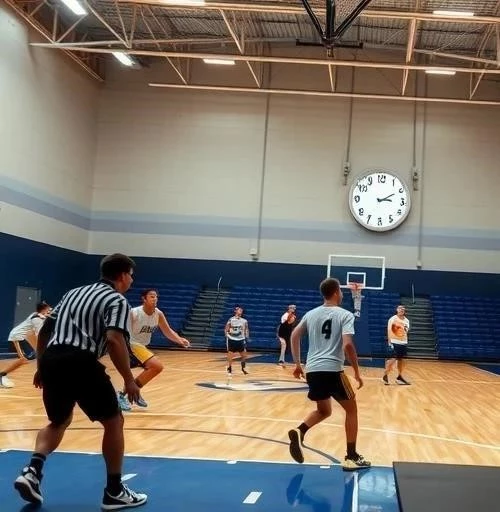
A basketball game is a small clockwork universe: four quarters, a bouncing ball, and a clock that keeps stopping just when you think the finish line is close. The short answer is that a typical professional game takes about two to two and a half hours from tip-off to the final buzzer. But the game clock tells only part of the story. A match scheduled for 40 or 48 minutes can occupy a much larger stretch of your evening.
Game time versus time on the clock
When people ask how long a basketball game lasts, they may mean either the official playing time or the time they will spend in the arena or watching at home. Those are very different measurements. The game clock counts only active playing periods. It pauses for fouls, timeouts, substitutions, reviews, and other interruptions. Halftime and quarter breaks add still more time, while the final minutes can feel as if they have been stretched on an invisible rubber band.
So a 48-minute game does not usually end 48 minutes after it begins. The clock may stop dozens of times, and teams often use timeouts strategically, especially when the score is close. A late foul can send a player to the free-throw line; a replay review can hold everyone in suspense. The ball is still part of the contest, but the clock has become a character of its own.
How long different leagues play
- NBA: Four 12-minute quarters, or 48 minutes of regulation playing time. In practice, allow roughly 2 to 2½ hours for most games.
- FIBA and many international competitions: Four 10-minute quarters, adding up to 40 minutes. A typical match often takes around 1¾ to 2¼ hours in real time.
- College basketball in the United States: The men’s game is generally played in two 20-minute halves; the women’s game uses four 10-minute quarters. Both have 40 minutes of regulation play, but their stoppages and broadcast rhythms can make the total duration vary.
- High school basketball: Usually four 8-minute quarters in many U.S. leagues, though rules differ by location. With fewer minutes on the clock, games are often shorter, commonly around 1½ to 2 hours.
These are useful estimates, not promises. Competition rules, television schedules, arena routines, and the way a particular game unfolds all affect the finish time. A fast-moving contest with few fouls may wrap up sooner. A tightly fought game with frequent timeouts can run well beyond the usual range.
Where the extra minutes go
Between quarters, players regroup and coaches draw up plans. Halftime is longer: it gives teams a proper break and, in televised games, creates room for analysis and entertainment. The exact interval depends on the competition, but it is often around 15 minutes in major leagues. Add the quarter breaks, and the clock already has several pauses built into its schedule before a referee whistles for a foul.
Then there are timeouts. Coaches use them to stop a run, settle a rattled team, or arrange one last play. Substitutions take moments, too. Fouls may lead to free throws, and a ball out of bounds can require officials to reset the action. In some competitions, video review checks a disputed call or confirms whether a shot beat the buzzer. Each delay may be brief; together, they turn a compact game clock into a long evening.
Why the ending can take so long
The final minute is the great illusionist of basketball. If one team is behind, it may foul on purpose to stop the clock and get the ball back. The leading team takes free throws; the trailing team may call a timeout, advance the ball, and try again. A single minute of game time can therefore take several minutes in real life. In a close playoff game, the last few possessions can feel like a miniature drama with repeated acts.
Overtime adds another chapter. In the NBA and FIBA rules, an overtime period lasts five minutes; other competitions also commonly use five-minute periods, though local rules can differ. If the scores are still tied, another overtime follows. There is no fixed maximum duration, so a close game can keep going until one team finally finishes ahead at the end of a period.
A practical estimate for your plans
If you are going to a game, leave room not just for the scheduled playing time but also for arriving, finding your seat, and getting out afterward. For a professional game, setting aside about three hours is a comfortable plan, especially if you are meeting friends or relying on public transport. At home, a two-hour window may be enough for a brisk game, but a close finish or overtime can push the broadcast later.
For a school or local match, ask about the competition’s quarter lengths and halftime arrangements. Youth games can use shorter periods, while tournaments may have special timing rules. The most reliable estimate is therefore not simply “four quarters”: it is the format plus the expected breaks, stoppages, and possibility of overtime.
The quick answer
On the clock: regulation basketball lasts 40 minutes in many international and college formats, 48 minutes in the NBA, and often 32 minutes in U.S. high school play. In real time: most major-league games take about two hours, with a typical professional broadcast or arena visit lasting roughly two to two and a half hours. A lopsided game may finish faster; a nail-biter can stretch longer.
Think of the official clock as the game’s heartbeat, not its full lifespan. It measures the minutes when play is live, while the audience experiences every pause, comeback, timeout, and breathless final possession. That is why the best answer to “How long does a basketball game last?” is both simple and delightfully imprecise: usually a couple of hours, unless the story needs extra time.
1 Comment. Оставить новый
The best insight here is that basketball has two clocks: one measured in minutes, the other in patience. A close finish turns every whistle into a tiny cliffhanger, which is why the evening lasts far longer than the numbers on the scoreboard suggest.