
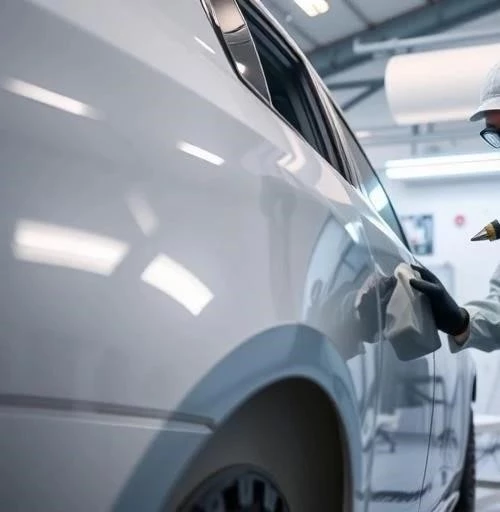
Short answer: it depends on what “acrylic paint” means. If it is a basecoat designed to be covered with clear, the usual wait is around 15–30 minutes between basecoat and clear, but the paint maker’s technical data sheet (TDS) is decisive. Apply clear only after the base has flashed off and looks evenly matte—not while it is wet or tacky. A single-stage acrylic enamel is different: it may not be intended for clear coating at all.
Basecoat and single-stage paint are not the same
Automotive “acrylic” can describe several products. A basecoat, including many metallic colors, needs a compatible clear coat for gloss and protection. Follow the specified flash time and recoat window; depending on the product, temperature and airflow, the interval may be longer than 15–30 minutes. Metallic base should be uniformly dry and matte before clear, or the finish may mottle.
Single-stage acrylic paint already contains the finish layer. Do not assume that clear can be applied over it. Check the label or TDS for compatibility and the permitted recoat window. If the paint has cured beyond that window, applying clear without the prescribed preparation can lead to poor adhesion or peeling. Sanding may be required, but only if the product instructions allow it.
What affects the waiting time?
- Temperature: cold slows evaporation and curing; excessive heat can make the surface skin over too quickly.
- Humidity and airflow: high humidity and weak ventilation can extend flash-off time. Use a clean, ventilated spray area.
- Film thickness: heavy coats and too much reducer take longer to release solvent than correctly applied thin coats.
- Product system: paint, hardener, reducer and clear must be compatible. Their instructions override general estimates.
How to check readiness
Use the TDS timing as your starting point. The surface should have an even appearance and should not feel wet. If the manufacturer specifies a touch test, perform it only as directed and in an inconspicuous area; avoid touching the panel with bare fingers. Do not rely on a fixed number of minutes if conditions differ from those listed for the product.
Apply the recommended clear coats with the specified flash interval between them. Spraying too soon can trap solvent and cause haze, bubbles, wrinkling or loss of gloss. Waiting too long can reduce chemical bonding and cause delamination. If you miss the recoat window, follow the maker’s sanding and reapplication procedure rather than spraying over the surface blindly.
After clear coating
Many automotive clear coats become handleable within hours, while polishing may be possible after roughly 6–8 hours for some fast systems. Other products need longer. A common guide is 12–24 hours for initial drying and 24–48 hours for substantial cure, with full hardness taking up to about seven days. These are estimates, not universal guarantees. During curing, protect the vehicle from water, dust, car washes and aggressive chemicals. Always use the product instructions for safe handling, drying, polishing and washing times.
4 Comments. Оставить новый
The practical guidance about waiting for an even, matte appearance makes this advice easy to apply. It’s good that the article avoids treating 15–30 minutes as a universal rule.
A useful safety-minded explanation for anyone working on a paint finish. I’d also appreciate seeing the rest of the readiness-check section, since the supplied text ends mid-sentence.
Helpful distinction between basecoat and single-stage acrylic paint. The reminder to check the product’s technical data sheet is especially important.
Clear and useful overview of how temperature, humidity, and coat thickness can affect flash time. Compatibility between the products is an important point, too.