
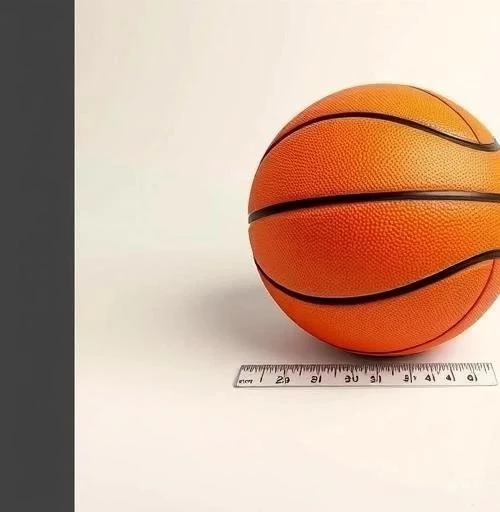
A basketball is not one fixed number of centimeters. Like shoes, it comes in different sizes for different players and competitions. The measurement people usually mean is the ball’s circumference—the distance around its widest part. If you mean straight across the middle, that is the diameter, a smaller number. Confusing the two is an easy way to order a ball that feels like it belongs to somebody else’s game.
For a standard adult men’s ball, the circumference is about 75–76 cm, and its diameter is roughly 24 cm. An adult women’s ball is usually about 72–74 cm around, with a diameter close to 23 cm. These are useful everyday figures, not a promise that every ball from every brand will measure identically. League rules, manufacturing tolerances, and inflation can all make small differences.
Basketball sizes at a glance
- Size 7 — adult men: approximately 75–76 cm in circumference; about 24 cm in diameter. This is the familiar full-size ball used in men’s professional and many adult competitions.
- Size 6 — adult women and many youth leagues: approximately 72–74 cm around; about 23 cm across. It is slightly smaller, making it easier to control and shoot for many players.
- Size 5 — junior players: approximately 69–71 cm around; about 22 cm in diameter. It gives younger hands a more manageable ball to dribble, pass, and launch.
- Size 4, younger children: roughly 63.5–66 cm around; close to 20–21 cm across, depending on the standard and maker.
- Size 3 — mini basketball: about 56–57 cm around; approximately 18 cm across. It is made for small hands, practice, or a quick game where the hoop is more ambition than architecture.
Those ranges are deliberately approximate: size charts can differ slightly between organizations and manufacturers. If you are buying for a league, check its current rules rather than relying on a label alone. A ball marked “size 6,” for instance, is a helpful clue, but the competition’s specification is the final referee.
Why the circumference is bigger than the diameter
Imagine wrapping a soft measuring tape around the ball’s middle. The tape follows the curved surface, so it records the circumference. To get the diameter, measure straight from one side to the other through the center. For a round ball, the relationship is simple:
Diameter = circumference ÷ π
So a ball with a circumference of about 75 cm has a diameter of around 23.9 cm, because 75 divided by 3.14 is close to 23.9. The difference matters: saying “a 75-centimeter basketball” normally describes the distance around it, not its width. A basketball 75 cm across would be a comically enormous piece of equipment—and a very difficult opponent at the free-throw line.
Official figures and real-world balls
International and professional rules often state measurements in inches or millimeters, while shops and size guides may convert them into centimeters. For orientation, the commonly used adult men’s ball is about 29.5 inches in circumference, which is almost 75 cm. A typical women’s size 6 is about 28.5 inches, or roughly 72.4 cm. A conversion may look exact on paper, but a published range is more honest than pretending every ball has precisely the same measurement.
Inflation changes the feel, too. A ball that is underinflated may seem softer and less lively; one pumped beyond its recommended pressure can feel hard and spring away from the floor. Pressure does not turn a size 6 into a size 7, but it can affect the ball’s shape and make measuring less reliable. Use the pressure printed near the valve or on the manufacturer’s instructions, and measure a properly inflated ball.
How to measure one at home
- Inflate the ball to the maker’s recommended pressure and let it settle into a round shape.
- Wrap a flexible tape around its widest point, keeping the tape snug but not squeezing the cover.
- Read the circumference where the tape meets itself. If you only have string, mark the overlap, then lay the string against a ruler.
- For a rough diameter, divide the circumference by 3.14. Or measure straight across the center, though it can be tricky to find that line on a curved ball.
A cloth tape is better than a rigid ruler for circumference: the ruler measures a straight line, while the ball’s outside edge curves away. If your result differs by a centimeter or two from a chart, check the tape placement, inflation, and size label before declaring the ball a mysterious new species.
Which size should you choose?
Start with the player and the competition, not just the number of centimeters. Older boys and men commonly use size 7; women’s adult competitions commonly use size 6; younger players often use size 5 or smaller. But age cutoffs vary by country and league. A coach’s recommendation or the official rulebook is the safest guide. For casual play, choose a ball the player can grip, pass, and shoot with control. The right size should invite practice, not make every dribble feel like wrestling a planet.
Indoor and outdoor balls can share the same size while having different covers. Leather or composite models are often designed for indoor courts; tougher rubber or outdoor composites are made to handle rougher surfaces. The cover changes grip and durability, not the basic meaning of size. Always look for both the size marking and the intended playing surface.
The short answer
A standard adult men’s basketball measures about 75 cm around and 24 cm across. A women’s size 6 is about 72–74 cm around and 23 cm across. Junior balls are smaller, with size 5 near 70 cm in circumference. When somebody asks how many centimeters a basketball is, the best answer is therefore: “Which size—and do you mean around it or straight across?” That tiny clarification can save a surprisingly large amount of confusion, and perhaps a few errant shots.

6 Comments. Оставить новый
The article makes measurement feel less like homework and more like choosing the right instrument for a game. Its practical ranges are helpful without losing sight of the fact that the ball still has to feel right in someone’s hands.
A nicely grounded guide with just enough personality to keep the numbers from bouncing off the page. I especially appreciate the distinction between a useful estimate and an official competition specification.
I like how the size chart turns a jumble of league labels into something you can picture in your hands. The playful “ambition is more than architecture” line gives the guide a little bounce of its own.
The circumference-versus-diameter distinction is a small detail with outsized power: it may save a buyer from ordering a ball sized for a different planet. Clear, practical, and easy to remember.
A useful read for anyone shopping across age groups. The chart makes the progression feel intuitive, and the note to check league rules is the quiet hero that could prevent a very annoying return.
This is the rare gear guide that respects both measurements and real life. The reminder that brands and inflation can shift the numbers keeps the advice honest rather than pretending every ball rolls off an identical production line.