
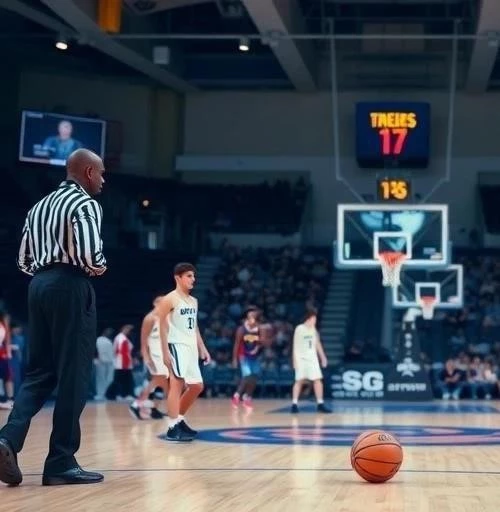
A basketball period is most commonly called a quarter. The terms mean the same thing in competitions that divide a game into four sections: the first period is the first quarter, the second is the second quarter, and so on. So if someone asks how many periods are in a standard basketball game, the usual answer is four quarters, followed by an overtime period if the score is tied at the end of regulation.
Period, quarter, and half: what is the difference?
Period is the broad, neutral word for a timed section of a game. It is often used in official rules, scoreboards, and general explanations. Quarter is the everyday name for one of the four regulation sections. Since each section is one quarter of the game’s scheduled playing time, the name is literal.
A half is not usually another name for a single quarter. It means one of the two larger portions of a game. In a four-quarter format, the first and second quarters make up the first half, while the third and fourth make up the second half. The break between the second and third quarters is therefore called halftime.
People sometimes use “half” loosely when talking about a basketball game, or confuse basketball with sports that divide play into two halves. For clarity, say “quarter” for one of the four sections and “half” for the first or second pair of sections. In competitions that really do use two halves, however, “half” is the correct term for each scheduled section.
How long is a basketball quarter?
The length depends on the competition’s rules. Under the standard FIBA format used in many international and domestic leagues, a game has four 10-minute quarters. In the NBA, regulation is also divided into four quarters, but each lasts 12 minutes. Other leagues and age groups may set different playing times, so the competition’s rulebook is the best guide.
These are playing-clock minutes, not the total time a spectator spends in the arena or watching a broadcast. The clock stops for certain interruptions, including fouls, time-outs, and other dead-ball situations. As a result, a quarter lasting 10 or 12 minutes on the game clock normally takes longer in real time.
What is an overtime period?
If the score is tied after the fourth quarter, many competitions add an overtime period, also known as overtime or, informally, an extra period. It is not a fifth regulation quarter: it is an additional section played to decide the result. If the score remains tied when overtime ends, another overtime period is played, according to the competition’s rules.
Overtime is often shorter than a regulation quarter. For example, FIBA and NBA rules use five-minute overtime periods. The exact duration and procedures can vary by league, tournament, or level of play, so avoid assuming every competition follows the same format.
Why do official sources say “period”?
Rules and regulations often prefer period because it is a general term that works for both regulation sections and overtime. The word also fits administrative phrases such as “time-out in a period” or “start of the next period.” In ordinary conversation, commentators and fans are more likely to say “quarter” when referring to one of the four standard sections.
In short, “period” is the general label, while “quarter” is the familiar name for each regulation section in a four-quarter game. “Half” describes two quarters together in that format, and “overtime period” describes an extra section played when the score is tied.
Quick guide
- One of four regulation sections: a quarter, or a period.
- Two quarters together: a half.
- An added section after a tie: an overtime period or extra period.
- Typical FIBA game: four 10-minute quarters.
- NBA game: four 12-minute quarters.
Bottom line: If you mean one ordinary section of a modern four-part basketball game, it is called a quarter. “Period” is also correct, especially in formal language, but it is broader and can include overtime.

5 Comments. Оставить новый
The explanation of quarters, periods, and halves is clear and easy to follow. The examples make the terminology especially useful for new fans.
I appreciate the distinction between playing-clock time and the total time a game takes to watch. That detail helps set realistic expectations.
The comparison between FIBA and NBA quarter lengths is helpful. It makes clear why the answer can vary depending on the competition.
This is a useful overview for anyone unfamiliar with basketball terminology. Mentioning that different leagues and age groups may use different timings is a good touch.
A straightforward guide to basketball game structure. The explanation of halftime and how the quarters fit into each half is particularly clear.