
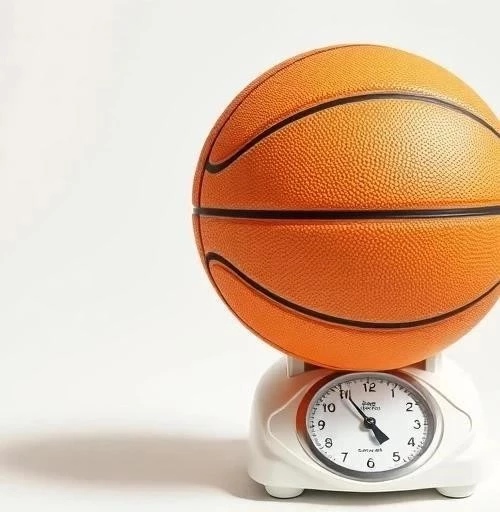
A basketball’s weight depends mainly on its size, which is selected for the competition, age group, and players’ category. The most familiar adult men’s ball is size 7. An adult women’s game generally uses size 6. Smaller sizes are commonly used by children and younger players. The size number describes the ball; it is not a rating of quality or a universal guide to age.
Official weights by size
- Size 7: The standard ball for adult men’s competitions. Under FIBA specifications, it weighs 580–620 grams and has a circumference of 75–77 centimetres. Some other rule sets and product specifications give a wider permitted weight range, often about 567–650 grams.
- Size 6: Commonly used in women’s competitions. Its circumference is 72.4–73.7 centimetres. Depending on the applicable rules, the permitted weight is approximately 510–567 grams; check the competition’s current regulations when precision matters.
- Size 5: A smaller ball often used for children’s play and training. Its exact weight varies by governing body and manufacturer, so there is no single figure that applies to every size 5 ball.
These figures are specifications, not a promise that every ball on sale will weigh exactly the same. A model may sit anywhere within its stated tolerance. Manufacturers may also list a product’s approximate weight, while the rules for a particular league define the ball that can be used in a match.
Why can published figures differ?
Different sources may quote different numbers because they refer to different rule books, product ranges, or measurement methods. For example, a broad range such as 567–650 grams for size 7 is not identical to FIBA’s narrower 580–620-gram specification. Both may appear in descriptions, but they should not be treated as interchangeable standards. Always use the rules of the competition in question as the deciding reference.
It is also easy to confuse weight with dimensions. A ball’s size is often described by its circumference, while diameter is a separate measurement. A size 7 ball has a diameter of roughly 24 centimetres, but the circumference is about 75–77 centimetres. Listings that provide only one dimension may therefore seem inconsistent even when they describe the same general ball.
What affects the weight of an individual ball?
The ball’s construction, materials, and intended use can cause small differences between models. Leather, composite, or rubber covers do not necessarily produce identical weights. Inflation also matters: a ball inflated to the correct pressure can feel firmer and may weigh slightly more than the same ball when underinflated. Moisture, dirt, wear, and an inaccurate scale can affect a measurement too. These factors do not change the official size category, but they can explain why two balls marked with the same size feel different.
Which weight should you choose?
For organized play, choose the size and specification required by the league, school, or coach. For casual use, consider the player’s age and ability, but confirm the recommendation with the training group: youth programs do not all switch ball sizes at the same age. A ball that is too large or heavy may make shooting and ball handling more difficult, while an appropriately sized ball can support comfortable practice.
If you want to check a ball at home, use a reliable scale and weigh it dry and clean. Compare the result with the manufacturer’s stated range, not with a single number found in a general article. In short, a size 7 basketball is typically around 580–620 grams under FIBA rules, while a size 6 is lighter. The exact permitted weight depends on the standard being followed.



2 Comments. Оставить новый
The article clearly explains that basketball weight varies by size and competition rules. Its distinction between general product ranges and FIBA specifications is useful for readers comparing published figures.
The discussion of why weight ranges differ adds helpful context, and the advice to consult the relevant competition rules is practical. The article could be easier to scan if the size specifications were presented in a table.