
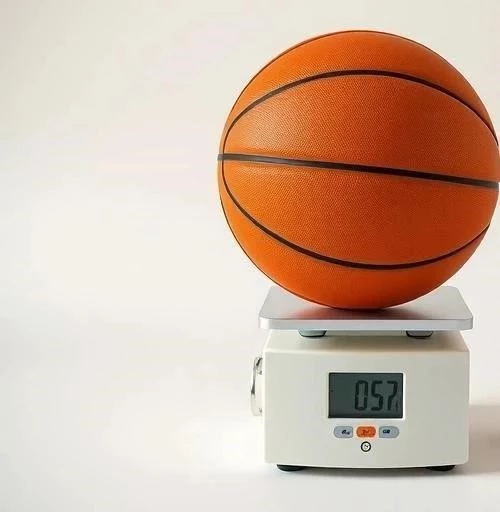
A basketball should feel like a small, lively planet in your hands: substantial enough to travel true, light enough to rise from a clean jump shot. But there is no single weight for every basketball. The right mass depends on the ball’s size, the rules of the competition, and sometimes the age group it is designed for.
The quick answer
A standard men’s Size 7 ball weighs about 600–650 grams (21–23 ounces). In NBA specifications, the ball weighs approximately 22 ounces, or 624 grams. A standard women’s Size 6 ball is lighter, usually around 510–550 grams (18–19.4 ounces). Youth balls are lighter still. For a specific game or league, check that organization’s current equipment rules: approved ranges can differ slightly.
Basketball weights by size
- Size 7, men’s full-size: roughly 580–620 grams under FIBA specifications; the NBA’s stated weight is about 624 grams. Typical circumference is around 75–76 centimeters.
- Size 6 — women’s full-size: about 510–550 grams, with a circumference of roughly 72–73 centimeters.
- Size 5, commonly used by younger players: around 470–500 grams, depending on the standard and manufacturer.
- Smaller junior balls: weights vary by size and intended age. Follow the coach’s or league’s guidance rather than choosing by appearance alone.
These figures are useful guides, not a promise that every ball on a shop shelf will weigh exactly the same. A competition ball must meet its governing body’s requirements; a recreational ball may be sold with a broader size or weight description.
Why does the weight matter?
Weight changes the conversation between player and ball. A ball that is too heavy can make passing, shooting, and controlling the bounce harder—especially for a young player still building strength and coordination. One that is too light may feel unusually jumpy, drift more easily, or fail to behave like the ball used in competition.
The correct size and weight help a player learn repeatable mechanics. Fingers spread across the surface, the wrist snaps through a shot, and the ball leaves the hand on a familiar line. When the ball suits the player, practice is less about wrestling with equipment and more about developing skill.
Weight is not the only thing to check
A ball’s circumference and inflation affect how it feels just as much as its mass. A correctly weighted ball can still play badly if it is underinflated, overinflated, worn out, or the wrong size. Follow the pressure printed near the valve or the manufacturer’s instructions. As a rough NBA-style check, drop the ball from shoulder height: it should rebound to approximately waist height. This is only a practical check, not a substitute for the official pressure specification.
For a more reliable weight check, use a kitchen or parcel scale. Weigh the dry ball without adding anything to it, and compare the result with the range required by your league. If it seems far outside that range, check that the scale is set to grams and that the ball is the size you think it is.
Choosing the right ball
- Look for the size recommended by the player’s league or coach.
- Check the ball’s printed size and weight information.
- Choose a surface suited to where it will be used: indoor, outdoor, or both.
- Inflate it according to the manufacturer’s guidance and test its bounce.
In short, a full-size men’s ball is usually near 600–625 grams, while a women’s Size 6 ball is commonly around 510–550 grams. Youth balls weigh less. Match the ball to the rules and the player, and it will feel less like a heavy object and more like an extension of the hand.

2 Comments. Оставить новый
A basketball’s weight is more than a number on a scale—it’s part of the player’s conversation with the court. This guide makes that idea easy to grasp while neatly separating league standards from the balls young players need.
I like how this article treats choosing a basketball as a matter of fit, not guesswork. The size-by-size comparisons are a handy compass for shoppers, and the reminder to check league rules keeps the advice grounded.