
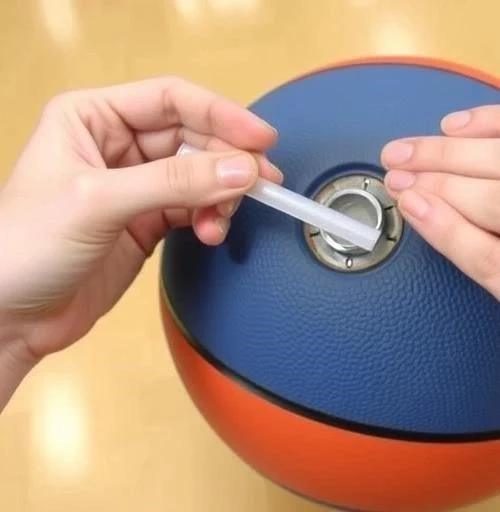
A basketball’s valve is designed to let air in while preventing it from escaping. The proper tool is a ball-pump needle‚ but if you do not have one‚ a thin‚ hollow plastic drinking straw may work in an emergency. This is a workaround‚ not a risk-free replacement: forcing an object into the valve can damage it and leave the ball leaking permanently.
What you will need
- A clean‚ narrow plastic straw‚ preferably with a smooth‚ rounded end.
- A little water to moisten the straw.
- A pressure gauge‚ if you plan to check the ball afterwards.
Method
- Remove the ball from direct sunlight and let it cool. Warm air expands‚ so deflating a hot ball can lead you to remove more air than intended.
- Find the small inflation valve‚ usually a dark opening on one of the panels. Check that the straw is clean and has no sharp edges. Do not use a metal tube‚ paper clip‚ pin‚ or other rigid improvised tool.
- Wet the straw’s tip with water. This reduces friction; avoid oil‚ which may harm the valve material.
- Hold the ball steady and gently guide the straw a short distance into the valve. Stop if you meet strong resistance. Never force or twist it: the valve’s inner flap can tear or become displaced.
- Listen and feel for air escaping. Press the ball lightly‚ pausing often to check its firmness. Remove the straw when the ball reaches the desired pressure‚ then allow the valve to close.
Important limits
A straw may be too wide‚ too soft‚ or too short to open the valve‚ and some valves are recessed or shaped in a way that makes this method unsuitable. If air does not flow with gentle pressure‚ stop. Repeated attempts are more likely to damage the valve than to help. Never suck on the straw or blow into it; the valve may be dirty‚ and blowing adds air rather than releasing it.
Do not squeeze the ball hard to speed up deflation. Uneven pressure can strain its seams‚ while removing too much air can deform it and affect its bounce. If the ball is being packed for travel‚ reduce pressure only enough to meet the space or transport need‚ and reinflate it with a proper pump as soon as possible.
The best solution
For a valuable or frequently used basketball‚ borrow or buy the correct inflation needle. It is inexpensive‚ fits the valve‚ and is designed to avoid damage. The straw method is reasonable only as a cautious‚ temporary measure when no proper tool is available. If the valve resists‚ leaks afterwards‚ or the ball will not hold pressure‚ stop experimenting and have it checked or replaced.
8 Comments. Оставить новый
This is a careful explanation of an emergency workaround rather than a claim that a straw is a proper tool. I would still choose a ball-pump needle whenever one is available.
It is helpful that the article advises against using metal objects or sharp tools. Those might seem convenient, but the risk of puncturing or deforming the valve is not worth it.
The advice to use water rather than oil is useful, especially since valve materials can be damaged by unsuitable substances. The instructions also appropriately emphasize stopping if there is resistance.
The explanation of how forcing or twisting an object can damage the valve makes the risks clear. Checking the ball gradually is a sensible way to avoid letting out too much air.
A pressure gauge is a good suggestion because judging firmness by hand can be imprecise. Overall, the article balances practical guidance with sensible cautions about possible damage.
The warnings about not forcing the straw into the valve are important. A pump needle is clearly the safer option, and this makes the workaround’s limits easy to understand.
I appreciate the reminder to let a sun-warmed ball cool before adjusting its air. Temperature can affect pressure, so that detail helps prevent an unnecessary mistake.
The practical limits are well explained: if the straw does not work with gentle pressure, repeated attempts could make the problem worse. That is a useful point for readers to keep in mind.