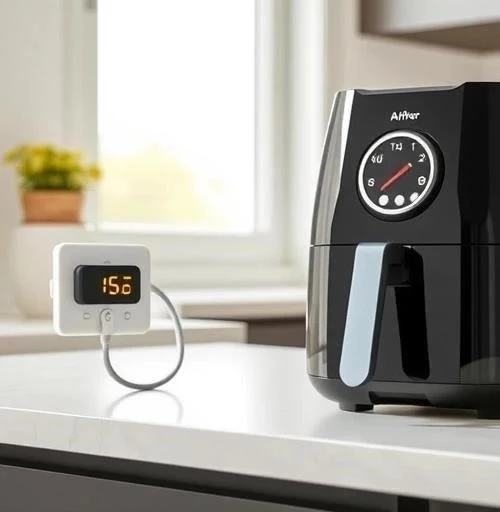
An air fryer uses electricity to heat a compact cooking chamber and circulate hot air. Its power rating is often between 1,200 and 2,000 watts, although some small models use less and large ones may use more. That rating describes the appliance’s maximum power while its heating element is on; it does not mean the fryer draws that amount continuously throughout every cooking cycle.
Estimate energy use
Electricity use is measured in kilowatt-hours (kWh), the units shown on a household bill. To estimate consumption, multiply the appliance’s power in kilowatts by the time it operates in hours:
Energy (kWh) = power (kW) × operating time (hours)
For example, a 1,500-watt air fryer is rated at 1.5 kW. If it runs for 20 minutes, or one-third of an hour, its maximum estimated use is 1.5 × ⅓ = 0.5 kWh. A 1,800-watt model running for 30 minutes would use up to 0.9 kWh by the same calculation.
These are useful estimates, not guaranteed readings. Many fryers switch the heating element on and off to maintain the selected temperature. Once hot, the element may not run constantly, so actual energy use can be lower than the simple maximum-power calculation. Preheating, opening the basket, the food load, room temperature, and the appliance’s design also affect the result.
Typical use and cost
For an ordinary meal, a small or medium fryer may run for roughly 15–30 minutes. Depending on its wattage and heating cycle, that might amount to around 0.3–0.8 kWh per cooking session. A large batch, longer recipe, or extended preheat can use more. The appliance’s rating plate or manual gives its rated power, but only a plug-in energy meter can show the electricity used in a particular cooking cycle.
To turn energy use into a cost, multiply kWh by your electricity price. If a session uses 0.5 kWh and your rate is 25 cents per kWh, the energy charge is about 12.5 cents. At a rate of 30 pence per kWh, the same session costs about 15 pence. Use the rate on your own bill; prices and billing units vary by location and plan.
Here is a simple monthly illustration: cooking once a day at 0.5 kWh per session uses about 15 kWh in a 30-day month. At 25 cents per kWh, that is approximately $3.75. If you cook twice a day, the estimate doubles to 30 kWh and $7.50. Actual totals depend on the appliance, recipes, and local tariff.
Does a higher-wattage fryer always use more?
Not necessarily. A higher-rated appliance can draw more power at a given moment, but it may cook a portion faster. A lower-wattage model might need to run longer to finish the same food. For a fair comparison, consider the energy used for a specific task—not just the wattage printed on the label. Capacity matters too: cooking a full basket in one cycle may be more efficient than preparing the same amount in several small batches.
An air fryer can use less energy than a full-size electric oven for a small portion because it heats a smaller space and often needs less preheating time. That is not a universal guarantee: results vary with the oven, recipe, portion size, and cooking time. For large quantities, an oven may be the more practical choice.
Ways to reduce electricity use
- Choose the right capacity. A compact model may suit one or two people; a family-sized basket can avoid repeated batches.
- Cook an appropriate amount at once. Leave room for air to circulate, but avoid running several unnecessarily small loads.
- Follow the recipe’s preheating advice. Some foods need preheating; others can go straight into the basket.
- Limit unnecessary checks. Opening the drawer releases heat and may extend cooking time. Use the viewing window, if available, or check near the end.
- Keep the appliance clean and unobstructed. Follow the manual’s cleaning and ventilation instructions so it can operate as intended.
- Switch it off after cooking. Standby draw, if present, is usually much smaller than the energy used while heating, but unplugging or switching off can prevent idle use.
Bottom line
Most air fryers are rated around 1.2–2.0 kW, but a typical short cooking session generally uses a fraction of a kilowatt-hour; A useful starting estimate is power in kW multiplied by cooking time in hours; multiply the result by your electricity rate to estimate cost. For an accurate figure, measure a complete cooking cycle with a suitable energy meter and compare meals cooked in similar quantities.