
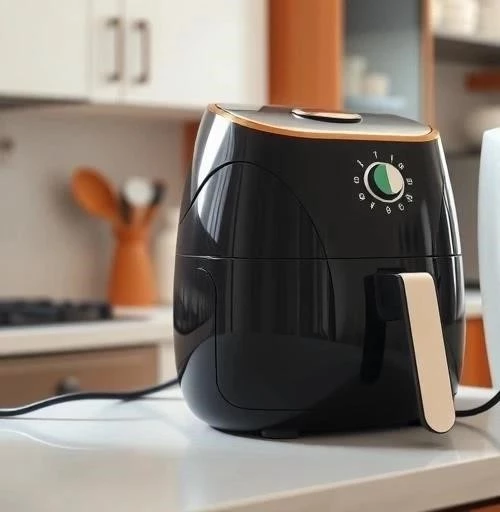
An air fryer is a tiny kitchen whirlwind: it blasts hot air around dinner, browning the outside while its heating element works in bursts. Its power rating may look intimidating, but watts describe the rate of energy use—not a bill for running it all day. The real question is how long it cooks.
The quick answer
Most household air fryers are rated at roughly 1,200–2,000 watts (1.2–2.0 kW). A larger model may draw more. If a 1,500-watt fryer ran continuously for one hour, it would use 1.5 kilowatt-hours (kWh). In practice, the thermostat switches the heater on and off, so actual use can be lower than that simple maximum.
Calculate a cooking session
Use this formula:
Power in kW × cooking time in hours = energy in kWh
For example, a 1.5 kW model running for 20 minutes uses up to 1.5 × ⅓ = 0.5 kWh. Multiply that by your electricity price to estimate the cost. At 20 cents per kWh, the session costs about 10 cents. Your tariff and the appliance’s cycling change the real figure.
A little kitchen energy map
- 15 minutes: a 1,500 W model uses up to 0.375 kWh.
- 30 minutes: up to 0.75 kWh.
- One hour: up to 1.5 kWh, though the heater may not run constantly.
These are estimates based on rated power. Preheating, opening the basket, food quantity, and temperature all affect the result. A packed basket can take longer; a small portion may cook quickly;
Why it can be economical
An air fryer doesn’t magically make heat free; Its advantage is often the short cooking time and compact chamber. For a small meal, it may need less total energy than heating a full-size oven for longer. But compare like with like: a large air fryer cooking several batches might lose that advantage. Appliance size, recipe, and oven efficiency matter more than the name on the door.
Spend fewer watts on dinner
- Cook suitable portions together without blocking airflow.
- Check food near the end; avoid adding minutes “just in case.”
- Skip preheating when the recipe or manual says it isn’t needed.
- Keep the basket and vents clean, and use the maker’s guidance.
Bottom line: expect about 1.2–2.0 kW while the heater is on, but judge consumption in kWh per meal. A quick calculation turns a mysterious countertop machine into a readable recipe: watts × hours, then multiply by your local price. The crisp result may be loud; the electricity estimate needn’t be.

7 Comments. Оставить новый
My favorite takeaway: don’t leave the basket crowded or the oven comparison vague. Good energy advice begins with the meal you’re actually making.
A useful reminder that the appliance’s rating describes its potential, while the thermostat conducts the real performance. The difference is where the practical savings hide.
The air fryer emerges as a little theater of heat—efficient for a solo act, perhaps less so when asked to stage dinner in several batches.
The best insight here is that watts are a speedometer, not a receipt. That small distinction makes kitchen-energy math feel far less mysterious.
A clear, grounded guide—and a gentle nudge to stop adding extra minutes “just in case.” Sometimes the cheapest watt is the one you never use.
This makes energy costs feel tangible without pretending every kitchen runs the same experiment. Portion size and cooking habits get their proper starring roles.
I like the article’s pocket-calculator approach: one quick multiplication turns dinner from an energy puzzle into something you can actually estimate.