
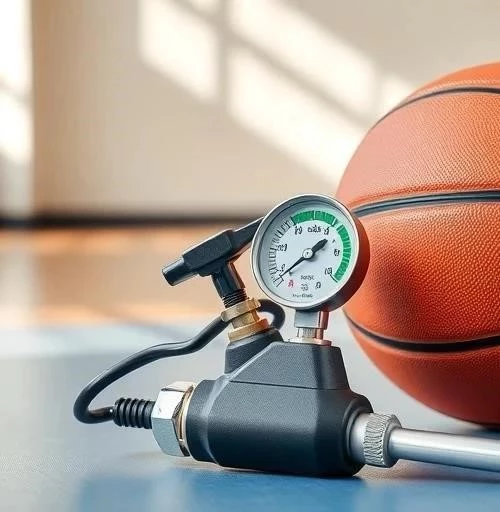
For most basketballs, a good starting point is about 0.55 bar. The commonly recommended range is approximately 0.52–0.59 bar, equivalent to 7.5–8.5 psi. However, there is no single pressure that suits every ball: the manufacturer’s instructions, printed on the ball or its packaging, should take priority over a general rule.
Why the right pressure matters
Pressure affects how a basketball bounces, feels in the hands and responds to dribbling and shooting. An underinflated ball tends to bounce weakly, feel heavy and make passes less predictable. An overinflated one can rebound too sharply, feel unusually hard and be less comfortable to catch. It may also place unnecessary strain on the seams and bladder. Therefore, inflating “as much as possible” is not a sensible way to improve performance; consistent, recommended pressure is more useful.
How to read the numbers
Many pumps display pressure in psi rather than bar. Use this conversion: 1 bar is about 14.5 psi. Thus, 0.55 bar is roughly 8 psi. If the ball gives a range, aim near its middle for ordinary play, then make small adjustments only if the maker allows them. Do not confuse bar with kilopascals: 0.55 bar equals 55 kPa, not 0.55 kPa.
Inflating it accurately
- Find the pressure recommendation on the ball or in its manual. If it is missing, 0.52–0.59 bar is a reasonable general guide for many standard basketballs, but check the brand’s advice where possible.
- Use a pump with a pressure gauge. Moisten the needle before inserting it, and push it gently into the valve; a dry or forced needle can damage the valve.
- Add air gradually and check the gauge as you go. Stop at the recommended value rather than relying on how hard the ball feels when squeezed.
- Remove the needle carefully and test the bounce on the surface where you will play. If the bounce seems wrong, check the gauge and the ball’s instructions before making a small correction.
Can the bounce test replace a gauge?
No. A bounce test is a useful final check, not a precise measurement. A familiar rule is to drop the ball from around 1.8 metres (6 feet) and see whether it rebounds to roughly waist height, but the result varies with the floor, the ball and how it is released. Indoor wood, outdoor concrete and softer surfaces do not produce identical rebounds. A gauge is the better way to set pressure; the bounce test helps confirm that the ball behaves normally in actual conditions.
Temperature, storage and common mistakes
Cold air can lower a ball’s pressure, while warmth can raise it. If the ball has been stored in a cold car or garage, let it reach playing temperature before checking and adjusting it. Recheck pressure from time to time, especially before a game, because small leaks can occur. Avoid inflating by feel alone, exceeding the printed maximum, or repeatedly inserting a needle without lubrication. These habits can give unreliable results or shorten the ball’s life.
Bottom line
For a typical basketball, start at approximately 0.55 bar (about 8 psi), while staying within the range printed by its manufacturer. The most reliable approach is to use a gauge, inflate gradually and finish with a bounce check. That combination is better than guessing: it gives the ball a predictable response without risking the discomfort or damage that can come from overinflation.

5 Comments. Оставить новый
The explanation of how pressure affects bounce and handling makes the advice more convincing. It shows why both underinflation and overinflation can interfere with play, rather than focusing only on a target number.
The article gives a clear, practical pressure range while correctly emphasizing that the manufacturer’s recommendation should come first. That distinction helps readers avoid treating a general guideline as a universal rule.
The inflation steps are sensible and safety-conscious, especially the advice to moisten the needle and add air gradually. Using a gauge is a more reliable approach than judging pressure by feel alone.
This is a well-organized guide for players who want a dependable starting point. The reminder to check the ball’s own instructions keeps the general recommendation appropriately qualified.
The bar-to-psi conversion is useful because pumps often display different units. Including the warning not to confuse bar with kilopascals also prevents a potentially significant measurement mistake.